

Categories
Camden County, Burlington County, Gloucester County, Home Buying Guides, Home Buying Tips, Housing Guide, NJ Housing, Real Estate Guides, South Jersey Real EstatePublished September 21, 2026
What Buyers Should Know About Property Easements Before Buying a Home in South Jersey

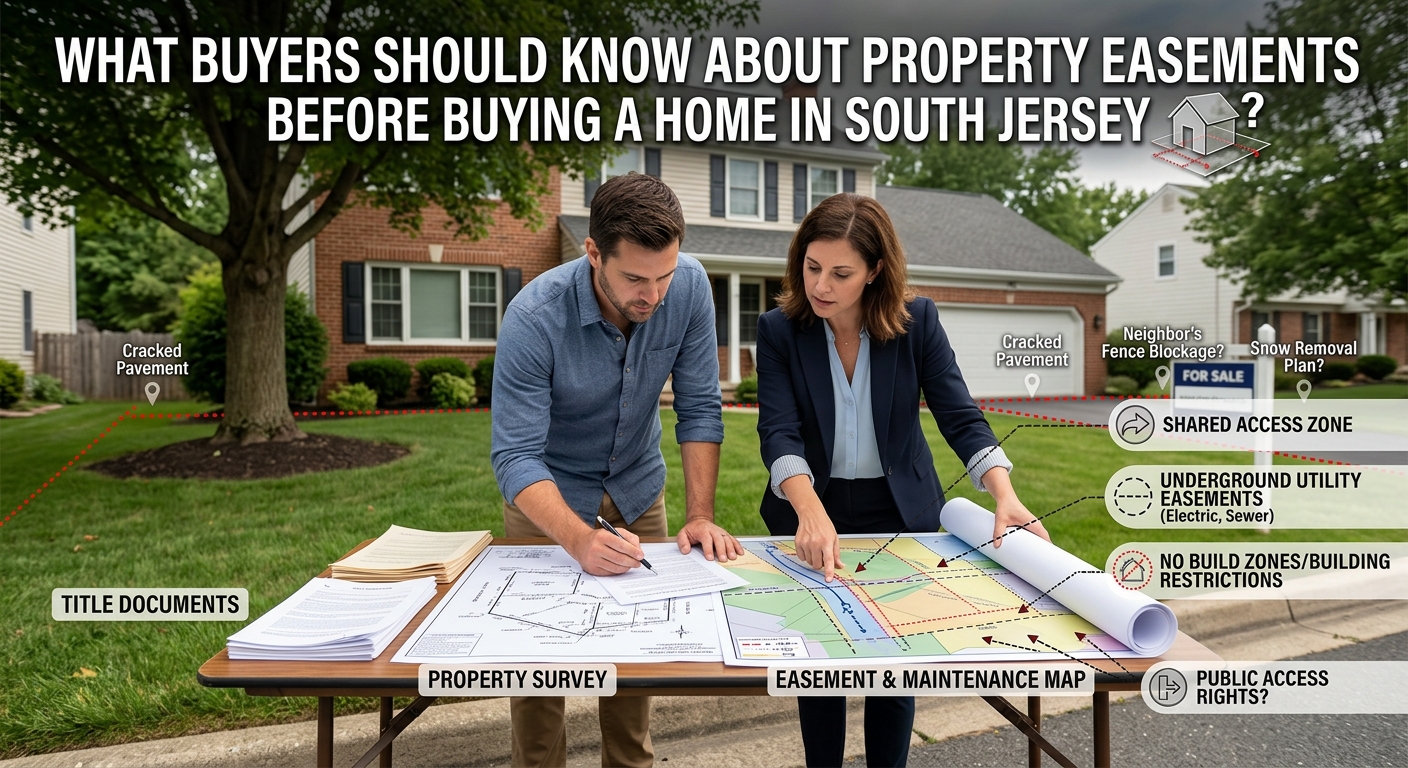
You find the South Jersey home you've been looking for.
The neighborhood works.
The layout works.
The yard is exactly what you wanted.
Then you review the title documents and see a word that can make any buyer pause:
Easement.
Suddenly, you have questions.
What exactly does that mean?
Does someone else have rights to your property?
Can you still build that fence?
Can a neighbor use part of your driveway?
Can the utility company access your yard?
Could an easement affect your future plans—or your home's resale value?
The answer depends on the type of easement, where it is located, who benefits from it, and what the recorded document actually allows.
Easements are not unusual in real estate. They can address access, utilities, conservation, drainage, historic preservation, and other property interests. New Jersey land-survey guidance specifically recognizes the importance of identifying easements and rights-of-way affecting property.
So an easement isn't automatically a problem.
But it is something a buyer should understand before closing.
As Mary Murphy of The Murphy Group explains:
“An easement doesn't necessarily take away the value of a property. The important question is how that easement affects the way you can use the property today—and what it could mean for you in the future.”
🏠 What Is a Property Easement?
An easement is a legal right involving the use of land owned by someone else.
In a residential transaction, an easement might allow someone to:
- Cross part of a property
- Access a road
- Maintain utility lines
- Use a shared driveway
- Access drainage infrastructure
- Perform certain maintenance
- Preserve a portion of land
- Restrict specific uses or alterations
The person or entity benefiting from an easement generally has specific rights, while the property owner may still own the underlying land.
That's the key distinction:
An easement does not necessarily mean someone else owns your property.
It means another party may have a legally defined right affecting part of it.
📜 1. Easements Can Benefit Your Property
Not every easement is something imposed against a buyer.
Some easements actually help a property.
For example, imagine a home that doesn't directly connect to a public road.
The property may depend on an access easement across another parcel.
Without that legal access, reaching the property could be a major issue.
The American Bar Association notes that access easements can be particularly important when a property needs a right-of-way to reach a public road, and recommends checking the survey and title documents to confirm that easements benefiting the property are properly reflected.
So when reviewing an easement, don't ask only:
“What am I giving up?”
Also ask:
“What right does this easement give my property?”
🚗 2. Access Easements Can Affect How You Reach Your Home
One of the most important easements for a buyer is an access easement.
It may allow a property owner to cross another parcel to reach:
- A public road
- A driveway
- A parking area
- Another portion of the property
This can be especially important for homes with:
- Shared driveways
- Long private lanes
- Rear lots
- Flag lots
- Properties without traditional street frontage
A buyer should understand the exact location and scope of the access right.
A vague understanding such as “everyone uses this driveway” isn't the same as knowing what the recorded documents provide.
🛣️ 3. A Right-of-Way Is Not Always the Same as Owning the Land
This is another distinction buyers should understand.
You may have the legal right to travel across a particular strip of land without owning that strip of land.
Conversely, someone else may have a right-of-way across your property.
New Jersey survey standards recognize private rights-of-way and easements as interests that can affect a surveyed parcel and call for identifying relevant recorded information when applicable.
The practical question is:
Who owns the land, and who has the right to use it?
Those are two different questions.
⚡ 4. Utility Easements Are Common—but Still Worth Understanding
Utility easements may allow utility providers to access portions of a property for infrastructure and related purposes.
You might find easements associated with:
- Electric lines
- Gas
- Water
- Sewer
- Telecommunications
- Other utility infrastructure
A buyer may barely notice an existing utility easement until they decide to make a change.
For example:
“I'd like to put a shed here.”
Or:
“Let's install a pool in this part of the yard.”
That's when the location of the easement can suddenly become important.
🏊 5. Your Backyard May Not Be Completely Available for Any Improvement You Want
A large backyard can feel like a blank canvas.
But an easement may cross a portion of it.
That can affect plans involving:
- Pools
- Fences
- Sheds
- Garages
- Additions
- Landscaping
- Retaining walls
- Driveway expansion
- Other permanent improvements
This does not mean an easement automatically prohibits improvements.
It means the buyer should determine what the easement permits and what restrictions apply before spending money on a project.
🏡 6. The Location of the Easement Matters as Much as the Easement Itself
Two homes could both have easements and experience completely different practical effects.
Home A
The easement runs along the edge of the rear yard.
Home B
The easement runs directly through the center of the backyard.
Both technically have an easement.
But the impact on how the property can be used could be very different.
That's why buyers shouldn't stop at:
“There is an easement.”
Ask:
“Where is it?”
A survey can help show the physical relationship between the easement, property boundaries, buildings, driveways, fences, and other improvements. The New Jersey Society of Professional Land Surveyors specifically notes that a survey can identify property boundaries, easements, rights-of-way, and potential conflicts or encroachments.
🔍 7. The Survey and Title Documents Tell Different Parts of the Story
Buyers sometimes assume that one document tells them everything.
Not necessarily.
A survey helps show physical conditions and property boundaries.
A title search and title commitment help identify recorded interests affecting ownership.
The recorded easement document explains the actual rights and restrictions involved.
You may need all three perspectives to understand the situation properly.
That's why an easement should never be evaluated from a map alone.
🧑⚖️ 8. Read the Actual Easement Language
This may be the most important step.
Don't rely only on:
- A listing description
- A seller's explanation
- A neighbor's interpretation
- A real estate agent's summary
- What previous owners supposedly did
The recorded document may specify:
- Who has the right
- Where the right applies
- What the right can be used for
- Maintenance obligations
- Access rights
- Restrictions
- Duration
- Conditions
- Other responsibilities
The meaning of an easement depends heavily on the language creating it.
That's why buyers should have their New Jersey real estate attorney review documents that materially affect the property.
🛠️ 9. Maintenance Responsibilities Can Become a Major Issue
Some easements involve ongoing maintenance.
Consider an access road shared by multiple properties.
Eventually someone needs to:
- Repair potholes
- Resurface pavement
- Clear fallen trees
- Repair drainage
- Remove snow
- Address erosion
Who pays?
The answer may be addressed in the easement or another recorded agreement.
If it isn't clear, the buyer should understand that uncertainty before purchasing.
A property right can also come with responsibilities.
🌧️ 10. Drainage and Stormwater Easements Deserve Attention
Water-related easements can be especially easy to overlook.
A property may have an easement involving:
- Drainage
- Stormwater infrastructure
- Swales
- Pipes
- Detention areas
- Access for maintenance
These arrangements can affect what a homeowner can do with portions of the property.
For example, a buyer may envision installing landscaping or changing the grade of a particular area.
But if that area is subject to a drainage-related right, additional questions may need to be answered first.
🌳 11. Conservation Easements Can Limit Development
Not all easements are about driveways or utilities.
Some are designed to preserve land.
A conservation-related easement can restrict certain types of development or changes to a property.
The New Jersey Pinelands Commission, for example, recognizes deed restrictions and easements that can permanently control certain uses or development rights associated with property.
For a buyer, that means a beautiful wooded section of land shouldn't automatically be viewed as future building space.
The fact that you own land doesn't necessarily mean every part of it can be developed however you want.
🏛️ 12. Historic Preservation Easements Can Affect Future Changes
Some South Jersey properties may have historic significance or preservation restrictions.
New Jersey's Historic Trust explains that preservation easements can become part of the chain of title and may restrict demolition or changes to protected portions of a property.
This could matter to a buyer planning:
- Exterior renovations
- Additions
- Demolition
- Landscaping changes
- Other alterations
If a property has historic or preservation restrictions, those limitations should be understood before purchase.
🚧 13. Easements Can Affect Privacy
Imagine buying a home because you love its private backyard.
Then you discover that another party has a legal right to cross a portion of the property.
That doesn't necessarily destroy the property's privacy.
But it may change your expectations.
Depending on the easement, there could be authorized access involving:
- Neighbors
- Utility companies
- Municipal entities
- Maintenance contractors
- Other parties
The important thing is knowing who has the right and for what purpose.
🏗️ 14. Future Construction Can Become More Complicated
One of the most important questions for buyers is:
“What do I want to do with this property in the future?”
Maybe you're planning:
- A pool
- A detached garage
- An addition
- A fence
- A larger driveway
- A backyard studio
- Extensive landscaping
An easement could affect where or how those projects can be completed.
This doesn't necessarily mean the project is impossible.
It means the buyer should investigate the easement before making the purchase based on a future plan.
💰 15. Easements Can Influence How Buyers Perceive Value
An easement doesn't automatically reduce a property's value.
The impact depends on the nature of the easement and how it affects the property's use, utility, privacy, and marketability.
For example:
Property A
A narrow utility easement runs along the rear property line.
Property B
A major access easement runs through the center of the backyard.
Both have easements.
But the practical effect could be very different.
That distinction matters when comparing properties.
🏦 16. Title Insurance and Easements Need to Be Reviewed Together
Title insurance is another reason buyers should pay attention to easements.
The American Bar Association notes that an owner's title policy can address legal access to property and that buyers should make sure easements benefiting the property are properly reflected in the title documentation.
New Jersey's Green Acres program also maintains current title, deed, and easement-related documentation standards, illustrating how easements can form part of the recorded property-interest framework.
The takeaway for a buyer is simple:
Don't assume an easement is automatically covered—or automatically harmless.
Ask your title professional and attorney what the documents mean for your specific transaction.
🚨 17. Be Careful With “It's Been That Way Forever”
This phrase comes up frequently in real estate.
A seller may say:
“The neighbor has always used that driveway.”
Or:
“We've always parked there.”
Or:
“The utility company has never had a problem.”
Those statements may provide useful history.
But they don't replace the legal documents.
If an important property right isn't clear from the recorded documents, that's something to discuss with the appropriate title and legal professionals.
📝 18. Ask About Easements Before You Make an Offer
You don't necessarily need to understand every legal detail before submitting an offer.
But if an easement is already disclosed, buyers should know what questions to ask.
Consider asking:
About Access
- Who can use the property?
- Does another property have a right-of-way?
- Does my property depend on an easement for access?
About Utilities
- Are utility lines located within an easement?
- Can utility providers enter the property?
- Where is the easement located?
About Improvements
- Can I build a fence?
- Can I install a pool?
- Can I build an addition?
- Can I put a shed in that area?
About Maintenance
- Who maintains the affected area?
- Who pays for repairs?
- Who is responsible for access?
About Restrictions
- Are there development restrictions?
- Are there conservation provisions?
- Are there historic restrictions?
The more specific the question, the more useful the answer.
🔎 19. What Buyers Should Review During Due Diligence
Before closing, buyers should consider reviewing the available:
- Deed
- Title commitment
- Title exceptions
- Recorded easements
- Rights-of-way
- Survey
- Property disclosure
- Shared-driveway agreements
- Utility-related documents
- Conservation restrictions
- Other recorded agreements affecting the property
A current professional survey can also help reveal physical conditions that may not be obvious from the listing or public records. The New Jersey Society of Professional Land Surveyors recommends buyers consider a current land survey and appropriate owner's title protection as part of protecting their property interests.
⚠️ 20. Easements Aren't Automatically a Red Flag
This distinction is important.
Many properties have easements that create little or no meaningful day-to-day inconvenience.
A utility easement along the edge of a lot may have very little practical effect on a buyer.
An access easement through the middle of a backyard could matter much more.
The question isn't:
“Does this property have an easement?”
It's:
“What does this easement actually mean for this property and how I plan to use it?”
That is the question that matters.
🧠 21. Think About the Property Five Years From Now
Don't evaluate an easement only based on today's lifestyle.
Think ahead.
Will you want:
- A pool?
- A larger garage?
- A fence?
- An addition?
- More privacy?
- A new driveway?
- A different landscaping plan?
A property that works perfectly today may have limitations that become important later.
Understanding those limitations before purchasing can help you make a more informed decision.
📋 The South Jersey Property Easement Checklist
Before closing, buyers should be able to answer:
📜 What Is the Easement?
- What type of easement is it?
- Who benefits from it?
- Who owns the underlying land?
- Where exactly is it located?
🚗 Access
- Does anyone have access rights across the property?
- Does my property rely on an access easement?
- Is the access legally documented?
🛠️ Maintenance
- Who maintains the affected area?
- Who pays for repairs?
- Are there shared responsibilities?
🏡 Future Improvements
- Can I build a fence?
- Can I install a pool?
- Can I add a structure?
- Can I expand the driveway?
⚖️ Legal and Title
- Has the title company reviewed the easement?
- Has my attorney reviewed the document?
- Is the easement properly recorded?
- Is it reflected in the title commitment?
📐 Survey
- Where is the easement physically located?
- Does it cross the yard or driveway?
- Are there any visible encroachments?
- Does the physical property match the documents?
If you can't answer these questions, it's worth investigating before closing.
💼 How The Murphy Group Helps Buyers Navigate Property Easements
At The Murphy Group, the goal isn't to make a legal determination about an easement.
It's to make sure buyers recognize when a property detail deserves a closer look.
That can include helping buyers:
- Notice unusual access arrangements
- Ask questions about property boundaries
- Understand why title and survey review matters
- Identify potential restrictions before committing to a property
- Coordinate questions with attorneys, title professionals, inspectors, and surveyors
- Think beyond today's purchase and consider future property plans
“Easements are one of those details buyers may not notice during the first showing,” Mary says. “But understanding them before closing can make a big difference in how confident you feel about the property you're purchasing.”
📊 The Bottom Line
An easement doesn't automatically make a South Jersey home a bad investment or an inconvenient property.
But it can affect:
- Access
- Privacy
- Parking
- Utilities
- Maintenance
- Landscaping
- Construction
- Future improvements
- Development potential
- Resale considerations
The most important thing is understanding the specific easement attached to the specific property.
Before closing, buyers should know:
Who has the right.
Where that right applies.
What they can do.
What they cannot do.
And whether the easement affects the way they intend to use the property.
A few minutes of careful document review can prevent a major surprise after closing.
📲 Buying a South Jersey Home With an Easement?
The Murphy Group helps South Jersey buyers look beyond the obvious features of a property and identify the questions worth asking before moving forward.
👉 Start here: www.mgsells.com

Mary Murphy
Team Leader | The Murphy Group | eXp Realty, LLC | PLACE
or another way