

Categories
Home Buying Tips, homebuyer checklist, South Jersey Real Estate, South Jersey Buyer Insights, home inspection, Camden County, Burlington County, Gloucester CountyPublished November 9, 2026
How to Evaluate a South Jersey Home’s Storage Space Before Making an Offer

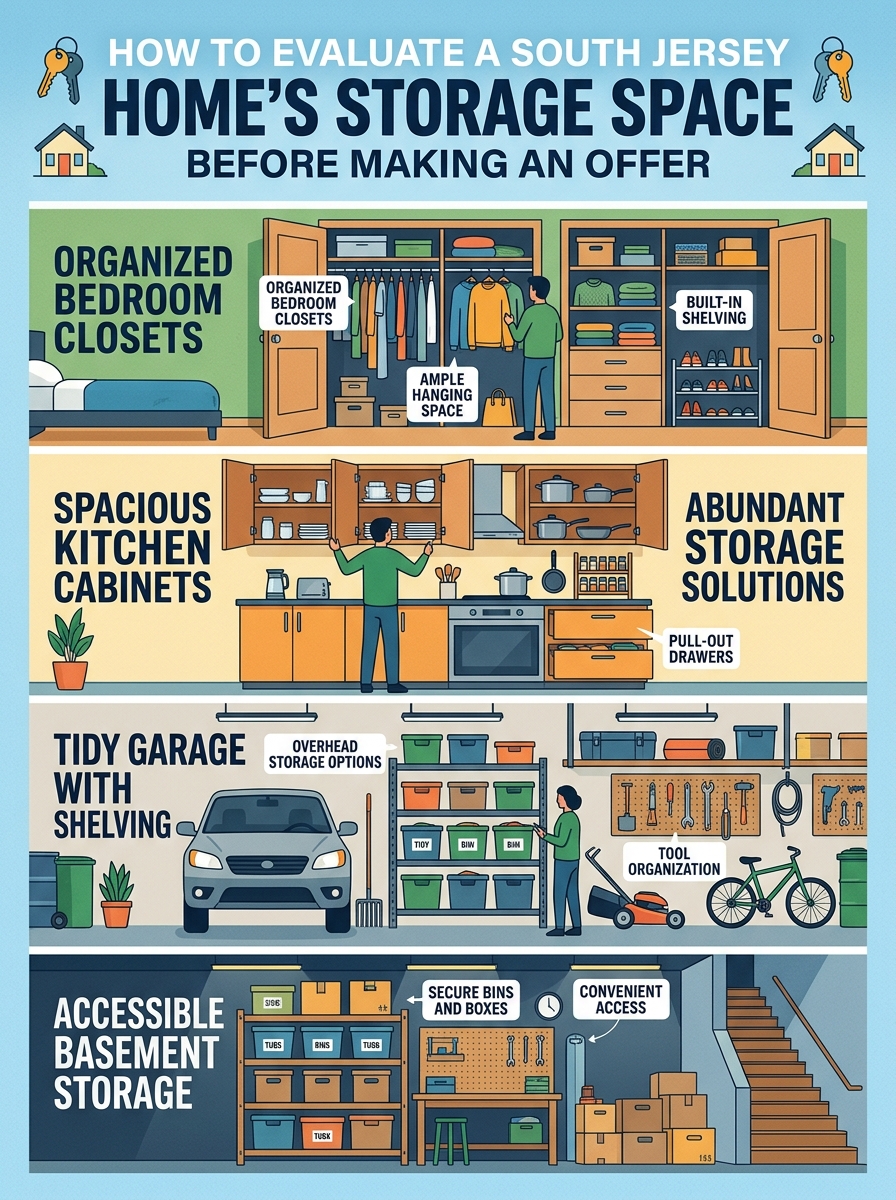
When touring a home in South Jersey, it's easy to focus on the kitchen, bathrooms, bedrooms, and backyard. Storage space often receives only a quick glance—until moving day arrives and you realize there isn't enough room for everything you own.
A home may have plenty of square footage but surprisingly few closets. A spacious garage may leave little room for tools and seasonal decorations once vehicles are parked inside. Even a large basement or attic may offer less practical storage than expected because of moisture, limited access, or structural restrictions.
Before making an offer, buyers should look beyond the number of closets and evaluate how well the home's storage areas will support their everyday lives.
As Mary Murphy of The Murphy Group explains:
“Storage is one of those features buyers may overlook during a showing, but it can affect everyday comfort long after closing. Understanding how a home will accommodate your belongings is an important part of choosing the right property.”
Here's how to assess a South Jersey home's storage capacity before committing to a purchase.
🧠 1. Start With Your Household's Actual Storage Needs
Before evaluating a property's storage, take inventory of what you already own.
Think about the items that need dedicated space, including:
- Clothing, shoes, coats, and accessories
- Kitchen appliances, cookware, and pantry supplies
- Cleaning products and household equipment
- Sports equipment, bicycles, and outdoor gear
- Holiday decorations and seasonal clothing
- Luggage, hobby supplies, and tools
- Children's toys, school supplies, and pet accessories
Consider whether your household may grow or your needs may change. A couple moving into a home may eventually need additional storage for children, hobbies, or work-from-home equipment.
If you're currently renting a storage unit, determine whether you expect to continue paying for it after moving.
The goal: Understand what the new home must accommodate instead of assuming that a certain number of closets will automatically be enough.
🏡 2. Look Beyond the Number of Bedrooms and Closets
A home advertised with three or four bedrooms doesn't necessarily offer generous storage.
During your walkthrough, open accessible closets and assess their actual capacity.
Look for:
- Hanging rods and usable vertical space
- Shelving for folded clothing and accessories
- Depth for coats, clothing, and storage bins
- Space for shoes and other everyday items
- Convenient access without obstructing doors
A walk-in closet isn't always more practical than a well-designed reach-in closet. Its shape, shelving, and usable floor area matter just as much as its overall size.
Also consider linen closets, hallway closets, and other storage areas outside the bedrooms. These often become essential for towels, bedding, cleaning supplies, and household essentials.
Don't forget to picture the closets without the current owner's belongings. A neatly arranged closet may look spacious because the owner has already decluttered or organized it for the showing.
🍽️ 3. Evaluate Kitchen Cabinets and Pantry Space
Kitchen storage affects how comfortably you can cook, prepare meals, and organize groceries.
Look beyond the number of cabinets. Consider their size, depth, configuration, and accessibility.
During the showing, assess:
- Upper and lower cabinet capacity
- Drawer space for utensils and cookware
- Pantry shelves or dedicated pantry closets
- Space for small appliances
- Storage for bulk groceries and household supplies
- Room for dishes, food containers, and serving pieces
Pay attention to awkward corners, narrow cabinets, and shelves that may not accommodate the items you regularly use.
A kitchen with fewer but larger cabinets and a practical pantry may serve your household better than one with numerous small cabinets and limited usable space.
If the kitchen appears short on storage, consider whether additional shelving or cabinetry could realistically help. Before budgeting for built-ins, check the available wall space, appliance clearances, and potential renovation costs.
🧺 4. Check Bathroom, Laundry, and Entryway Storage
Smaller storage areas can have an outsized effect on daily organization.
Bathrooms
Look for vanity drawers, cabinets, linen storage, and space for toiletries, towels, and cleaning products. If several people will share a bathroom, limited storage may quickly become inconvenient.
Laundry areas
Check whether there is room for laundry detergent, cleaning supplies, hampers, ironing equipment, and other essentials. Shelving above appliances may help, provided it can be installed safely and doesn't interfere with equipment access.
Entryways and mudrooms
Consider where coats, shoes, umbrellas, backpacks, and bags will go when everyone arrives home.
A hallway closet, mudroom, or designated drop zone can prevent everyday clutter from spreading into living areas.
These spaces may not be major selling points in listing photos, but they can make a home feel much more functional once you move in.
🚗 5. Assess the Garage as a Working Storage Area
A garage can be valuable storage space in South Jersey, especially for homeowners with lawn equipment, bicycles, tools, outdoor furniture, and seasonal decorations.
However, don't assume that a two-car garage will comfortably hold two vehicles and everything else you own.
Imagine the garage with your actual belongings inside. Consider:
- Vehicle dimensions and door-opening clearance
- Shelving along the walls
- Space for bicycles and sports equipment
- Lawn mowers, snow equipment, and gardening tools
- Workbenches and hobby supplies
- Holiday decorations and larger storage bins
Check whether existing shelving and cabinets will remain with the property. Ask your agent to clarify which items and fixtures are included in the sale.
Also consider the garage's condition. Water intrusion, damaged flooring, poor ventilation, or other concerns may affect what can safely be stored there.
If you plan to add overhead racks or substantial built-in storage, confirm that the structure and installation method are suitable. Keep electrical panels, mechanical equipment, exits, and other required access areas clear.
🏚️ 6. Examine Attic Storage Carefully
An attic can provide useful space for lightweight seasonal belongings, luggage, and items you don't need every day. However, not every attic is designed to function as a storage area.
Before counting it as usable space, evaluate:
- How you access it
- Whether the opening can accommodate your storage containers
- Available headroom and floor area
- Lighting and safe movement
- Visible insulation and ventilation conditions
- Signs of leaks, staining, pests, or moisture
A pull-down ladder or small attic opening may make frequent access difficult. Sloped ceilings can also reduce the usable area.
Most importantly, never assume that an attic floor can support heavy stored items simply because it is accessible. Ask a qualified professional to evaluate load capacity if you intend to store heavy belongings.
If the attic has visible damage or areas that cannot be safely accessed, discuss them with your home inspector rather than treating the space as guaranteed storage.
🧱 7. Determine Whether the Basement Is Practical for Storage
Basements are common in many South Jersey homes, but their usefulness depends on their condition and configuration.
An unfinished basement may offer substantial room for tools, durable household items, and seasonal decorations. A finished basement may provide less open storage because the area is divided into living spaces, bedrooms, or recreation rooms.
During your visit, look for:
- Musty odors or visible water staining
- Signs of previous water intrusion
- Cracks or other visible foundation concerns
- Sump pumps and drainage equipment
- Utility systems occupying potential storage areas
- Adequate access, lighting, and headroom
A basement that looks spacious may not be appropriate for storing documents, electronics, upholstered furniture, or clothing if humidity and water intrusion are concerns.
Ask the seller, through your agent, about known moisture problems, previous repairs, and the history of any sump pump or drainage system.
The New Jersey homebuyer guide recommends having a qualified inspector assess accessible building components, including the foundation and basement. A professional inspection can help identify concerns that deserve further evaluation.
🌿 8. Don't Overlook Sheds and Other Outdoor Storage
Some South Jersey properties include detached sheds, garden structures, exterior cabinets, or other spaces for equipment and outdoor belongings.
These features can be useful, but assess them separately from the home's interior storage.
Check for:
- Sufficient room for the items you plan to keep there
- Doors wide enough for lawn equipment or bicycles
- Roof and floor condition
- Signs of water intrusion or pest activity
- Convenient access from the driveway or yard
- Adequate ventilation for the intended use
Ask whether the structure is included in the sale and whether any known restrictions or maintenance concerns apply.
If you are considering adding a new shed or enlarging an existing structure, verify applicable municipal zoning, permit requirements, and any homeowners' association restrictions before assuming the project will be allowed.
⚠️ 9. Watch for Storage Spaces That Hide Potential Problems
Storage areas can be easy to overlook because they are often tucked away from the main living spaces.
Pay attention to visible warning signs such as:
- Musty odors
- Water stains or peeling finishes
- Swollen or deteriorated wood
- Pest droppings or nesting material
- Loose or damaged shelving
- Unusual cracks or uneven surfaces
- Stored items obscuring walls, floors, or mechanical equipment
These observations do not automatically mean the property has a serious defect. They are reasons to ask questions and investigate further.
A standard home inspection is generally visual and non-invasive, and the inspector may not move stored belongings to examine concealed areas.
If a storage area is blocked or inaccessible during the inspection, ask what could not be evaluated and whether additional access or specialist review is appropriate.
📏 10. Measure the Space Instead of Guessing
Measurements can turn a vague impression into a practical decision.
If permitted during the showing, record approximate dimensions of important closets, pantry shelves, garage areas, or storage rooms.
Compare them with items you already own, such as:
- Large plastic storage bins
- Shelving units
- Bicycles
- Luggage
- Holiday decoration containers
- Tools and outdoor equipment
Take photos of accessible storage spaces if the seller's showing rules allow it. Keep notes on which items would fit and which might need a different location.
Also consider how easily you can reach stored belongings. Deep shelves and tall cabinets may technically offer plenty of capacity but become frustrating if frequently used items are difficult to retrieve.
Usable storage is more valuable than storage that exists only on paper.
💰 11. Estimate the Cost of Improving Storage
A home with limited storage isn't necessarily the wrong choice. Some shortcomings can be addressed with simple, affordable solutions.
Potential improvements include:
- Freestanding shelving
- Closet organizers
- Wall-mounted hooks
- Pantry dividers
- Storage benches
- Garage cabinets
- Built-in shelving
Before making an offer, separate straightforward organizational improvements from projects that could require substantial work.
Adding a closet system is very different from converting an attic, finishing a basement, or changing a garage into living space. Larger projects may involve structural considerations, moisture control, electrical work, permits, and other requirements.
Get realistic estimates before relying on a proposed improvement to make up for a major storage shortage.
If the property needs significant work, factor the expected cost into your overall affordability assessment rather than focusing only on the purchase price.
🏘️ 12. Consider Storage in Relation to Your Lifestyle
The right amount of storage depends on how you live.
A household that enjoys gardening may need room for tools, soil, pots, and outdoor equipment. A family with children may prioritize toys, sports gear, and school supplies. Someone who works remotely may need organized space for office equipment and records.
Consider how your belongings move through the house during an ordinary day.
Ask yourself:
- Where will everyday items go when I walk through the door?
- Can I store seasonal items without crowding living spaces?
- Is there enough room for hobbies and equipment?
- Will the home still work if my household's needs change?
- Will I need to rent an external storage unit?
A property doesn't need an enormous amount of storage to be practical. It needs the right storage in the right places for your household.
📋 13. Use a Storage Checklist Before Making an Offer
Before deciding whether a home meets your needs, review each major storage area.
Bedroom and hallway storage
- Are the closets large enough for clothing and linens?
- Is there room for additional shelving?
- Are everyday items easy to access?
Kitchen and bathroom storage
- Is there enough cabinet and pantry space?
- Can appliances and supplies be stored conveniently?
- Is the available space practical for your household size?
Garage and outdoor storage
- Can vehicles fit while leaving room for equipment?
- Are sheds or other structures included in the sale?
- Are the spaces dry, accessible, and in suitable condition?
Attic and basement
- Can the areas be accessed safely?
- Are there visible signs of moisture or damage?
- Are there restrictions on how the space can be used?
- Is professional evaluation needed?
Future needs
- Will the storage work as your household changes?
- Are proposed improvements realistic and affordable?
- Will you need additional off-site storage?
Use the same checklist for every property you tour. Consistent comparisons can help you distinguish a home that merely looks spacious from one that will function well after moving day.
💼 How The Murphy Group Helps Buyers Evaluate a Home's Practical Value
At The Murphy Group, choosing a home means looking beyond the listing photos and headline features to understand how the property may fit a buyer's everyday needs.
The buying process can include evaluating practical features, discussing potential trade-offs, and identifying questions that deserve further investigation before an offer moves forward.
That may involve helping buyers:
- Compare storage options across properties
- Identify practical limitations in closets, garages, and utility areas
- Consider how storage affects everyday convenience
- Recognize visible concerns that may require professional review
- Evaluate potential improvements alongside the overall home budget
“The right home should work for your everyday life, not just look impressive during a showing,” Mary says. “Paying attention to practical details can help buyers make decisions with greater confidence.”
📊 The Bottom Line
Evaluating a South Jersey home's storage space before making an offer means looking beyond the number of closets or the home's total square footage.
Buyers should consider:
- Their actual household storage needs
- Closet, pantry, and cabinet capacity
- Garage and outdoor storage potential
- Attic and basement accessibility
- Moisture, pest, and maintenance concerns
- The cost and feasibility of future improvements
A home with less storage may still be a great fit if the available space is organized and functional. A larger property may disappoint if its storage areas are inconvenient, inaccessible, or unsuitable for the items you need to keep.
The goal is to understand what the home can realistically accommodate before committing to the purchase.
📲 Looking for a Home That Fits Your Lifestyle in South Jersey?
The Murphy Group helps South Jersey buyers evaluate properties, compare practical features, and navigate the homebuying process with local insight.
👉 Start here: www.mgsells.com

Mary Murphy
Team Leader | The Murphy Group | eXp Realty, LLC | PLACE
or another way