

Categories
Burlington County, Camden County, Gloucester County, Home Buying Tips, Home Buying Guides, Housing Guide, NJ Housing, Real Estate Guides, South Jersey Real Estate, South Jersey Market Trends, home improvementsPublished August 31, 2026
The Hidden Value of a South Jersey Home With a Finished Basement

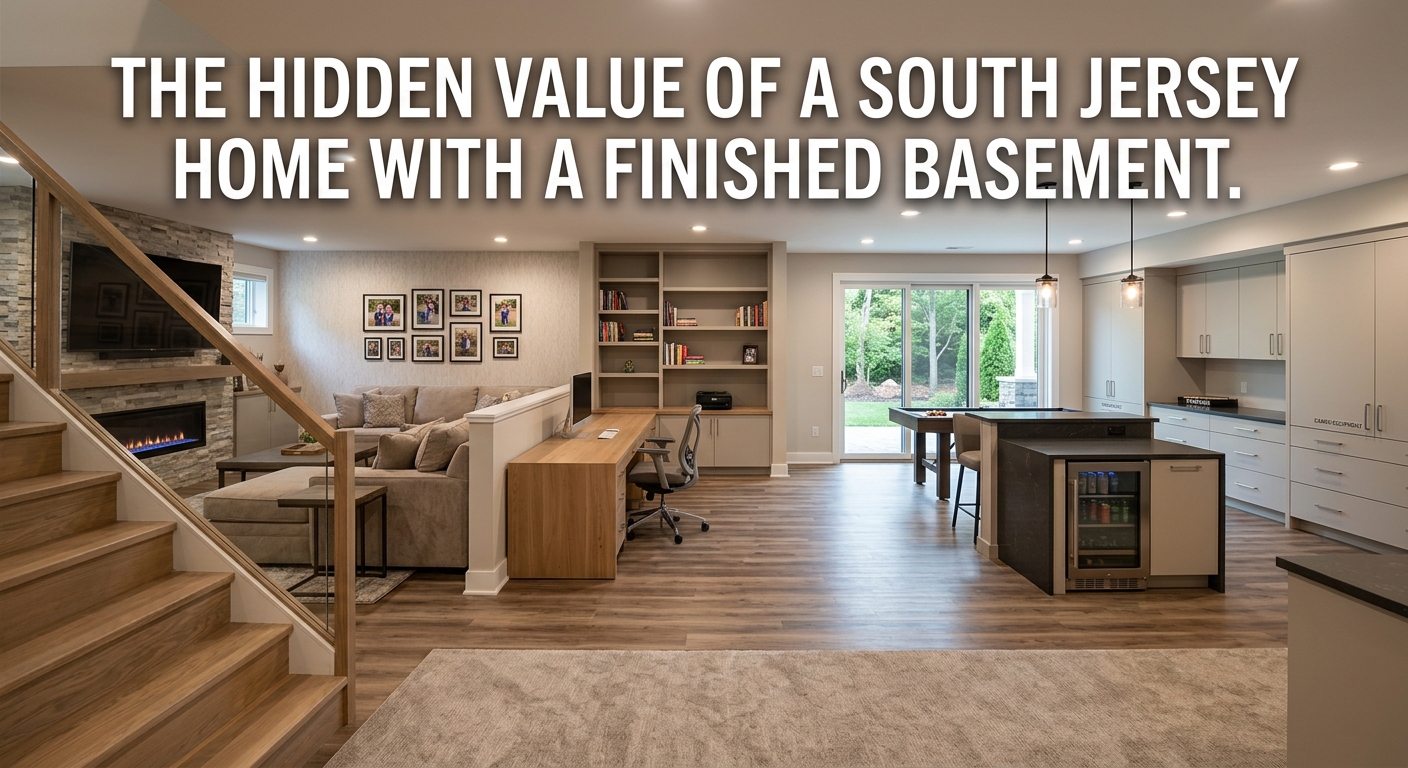
When buyers compare South Jersey homes, they naturally focus on the main living areas.
The kitchen.
The bedrooms.
The bathrooms.
The backyard.
But sometimes one of the home's most useful spaces is located below them:
The finished basement.
A well-designed basement can provide additional room for entertaining, working, exercising, relaxing, storing belongings, or accommodating guests—without changing the home's existing footprint.
That flexibility can make a finished basement an important feature when buyers compare otherwise similar properties.
However, there is an important distinction:
Finished basement space can add value, but it generally isn't valued the same way as above-grade living space. New Jersey appraisal guidance distinguishes finished basement areas from the home's primary above-grade living area, and NAR notes that below-grade space is generally accounted for separately in appraisal.
As Mary Murphy of The Murphy Group explains:
"A finished basement can give buyers something they don't always realize they need until they see it—a flexible area that can adapt as their lifestyle changes."
🏡 1. A Finished Basement Can Give Buyers More Usable Space
One of the biggest advantages is simple:
More room to live.
A finished basement can become:
- A family room
- Home office
- Playroom
- Home gym
- Media room
- Hobby area
- Guest space
- Entertainment area
Instead of leaving the basement unfinished or using it primarily for storage, homeowners can turn it into an extension of their lifestyle.
🛋️ 2. Flexible Space Can Appeal to Different Buyers
Not every buyer wants the same thing from a basement.
One household may want a movie room.
Another may need a home office.
Another may want space for children.
Someone else may want a private exercise area.
That's what makes a flexible basement particularly appealing.
The space doesn't have to serve one specific purpose.
It can evolve with the homeowner.
💻 3. A Basement Can Provide a Dedicated Work Area
Remote and hybrid work have changed how homeowners think about extra rooms.
A basement can provide separation between:
Work life upstairs
and
Home life upstairs.
A finished basement office can offer:
- Privacy
- Reduced household distractions
- Space for multiple monitors
- Storage
- A dedicated work environment
For buyers who work from home, that separation can be valuable.
🎬 4. Entertainment Space Can Set a Home Apart
A finished basement can become a natural gathering area.
Potential uses include:
- Home theater
- Game room
- Bar area
- Lounge
- Pool table area
- Sports-viewing space
These features may not appeal equally to every buyer, but they can help a property stand out when the space is thoughtfully designed.
🧸 5. Families May Appreciate the Extra Room
For households with children, additional living space can solve practical problems.
A basement can provide room for:
- Toys
- Games
- Homework
- Sleepovers
- Family activities
- Indoor play
That allows the main living areas to remain quieter and more organized.
🏋️ 6. A Basement Can Become a Private Fitness Area
Home gyms continue to be a practical use for finished lower-level space.
A basement may accommodate:
- Exercise equipment
- Yoga areas
- Weight training
- Cardio equipment
- Stretching areas
The advantage is convenience.
Instead of driving to a gym, homeowners can have a dedicated workout area just steps away.
📦 7. Finished Doesn't Mean Storage Has to Disappear
One mistake homeowners make when finishing a basement is eliminating every practical storage area.
A strong basement design can provide both:
Finished living space + organized storage.
Useful additions can include:
- Built-in cabinets
- Utility closets
- Shelving
- Seasonal storage
- Under-stair storage
That combination can make the basement more functional for everyday life.
🚪 8. A Separate Entrance Can Increase Flexibility
Some finished basements have direct exterior access.
Depending on the home's design and applicable local requirements, this can make the space particularly versatile.
Buyers may see potential for:
- Guest access
- Recreation
- Home office use
- Mudroom functions
- Separate activity areas
However, homeowners should never assume that a separate entrance automatically makes a basement a legal separate living unit.
Any conversion involving bedrooms, kitchens, bathrooms, or independent occupancy should be evaluated for applicable zoning, building, and permit requirements.
🚿 9. A Basement Bathroom Can Add Convenience
A bathroom can make a finished basement significantly more functional.
Imagine hosting guests during a game night.
Or having children playing downstairs.
Or spending several hours in a home gym.
Having a nearby bathroom means fewer trips upstairs.
A basement bathroom can therefore improve the overall usability of the space.
🏠 10. A Finished Basement Can Make a Home Feel More Adaptable
One of the biggest advantages isn't necessarily what the basement is today.
It's what it could become tomorrow.
A finished basement might start as:
Family room → Home office → Guest area → Hobby room
That adaptability can be particularly attractive to buyers who don't know exactly how their needs will change over the next several years.
💰 11. Finished Basements Can Contribute to Resale Value
A finished basement can contribute to a property's market appeal and value.
But homeowners should avoid assuming that every dollar spent finishing a basement will automatically return dollar-for-dollar at resale.
The National Association of REALTORS®' 2025 Remodeling Impact Report estimated a 71% cost recovery for basement conversions to living areas.
The actual contribution of a specific basement depends on factors such as:
- Quality of construction
- Local buyer demand
- Size
- Ceiling height
- Natural light
- Accessibility
- Condition
- Bathroom availability
- Comparable properties
📐 12. Basement Square Footage Isn't Automatically Equivalent to Above-Grade Space
This is one of the most important points for sellers.
A finished basement can be valuable without being treated as equivalent to above-grade living space.
NAR explains that basement space is generally reported separately for appraisal purposes because buyers typically place different value on below-grade versus above-grade living areas.
New Jersey appraisal guidance likewise distinguishes finished basement areas from the home's primary living area when documenting property characteristics.
So a seller should avoid simply adding basement square footage to the home's above-grade square footage and presenting the combined figure as if it were equivalent.
Accurate presentation builds buyer confidence.
🌤️ 13. Natural Light Can Make a Huge Difference
Not all basements feel the same.
A basement with:
- Large windows
- Walk-out access
- Good lighting
- Higher ceilings
- Light finishes
can feel dramatically more inviting than a dark, cramped lower level.
When evaluating a finished basement, buyers should consider how the space actually feels—not simply whether it has been finished.
🧱 14. Ceiling Height Can Affect Perceived Quality
Ceiling height can influence whether a basement feels like a true living area or simply a finished storage room.
Higher ceilings can make a space feel:
- Larger
- Brighter
- More comfortable
- More finished
- Easier to furnish
Low ceilings can limit how buyers envision using the space.
This is one reason the quality of the finished area matters as much as the existence of finished walls and flooring.
💧 15. Moisture Protection Matters
A beautiful basement isn't much of an advantage if it has moisture problems.
Buyers should pay attention to:
- Musty odors
- Water stains
- Efflorescence
- Damp walls
- Drainage issues
- Sump pump systems
- Previous flooding
- Foundation concerns
A finished basement can hide problems if the underlying space wasn't properly addressed before finishing.
That's why a professional inspection remains important.
⚡ 16. Buyers Should Ask About Permits and Improvements
If a basement has been converted into finished living space, buyers may want to understand:
- What work was completed
- When it was completed
- Whether permits were obtained when required
- Whether electrical work was professionally completed
- Whether plumbing was added
- Whether the space meets applicable requirements
A finished appearance doesn't necessarily tell the full story.
Documentation can help buyers understand what they're purchasing.
🏘️ 17. Finished Basements Can Be Particularly Useful in Established Homes
Many South Jersey homes have basements that offer additional opportunities for customization.
For homeowners who like the location, lot, and neighborhood but need more usable space, finishing the basement can provide an alternative to moving or building a major addition.
That can be particularly attractive when the existing property already has strong fundamentals.
🔨 18. Not Every Basement Needs to Be Overdesigned
Sellers sometimes assume a basement needs an expensive entertainment center, custom bar, or luxury finishes to impress buyers.
Not necessarily.
A clean, bright, well-maintained basement with flexible functionality can be more broadly appealing.
Consider:
- Neutral finishes
- Good lighting
- Quality flooring
- Organized storage
- Clean walls
- Functional outlets
- Comfortable furniture
The goal is to help buyers imagine how they would use the space.
📸 19. Sellers Should Market the Basement Properly
If a finished basement is one of the home's strengths, don't hide it near the end of the listing.
Show it.
Professional photography can highlight:
- Size
- Natural light
- Recreation areas
- Offices
- Storage
- Bathrooms
- Walk-out access
A floor plan can also help buyers understand how the basement connects to the rest of the home.
🔍 20. Buyers Should Compare Basements—Not Just Count Them
Two homes can both advertise:
"Finished basement."
But the spaces may be completely different.
When comparing properties, buyers should consider:
Home A
- Dark basement
- Low ceilings
- Limited storage
- Minimal finish quality
Home B
- Bright basement
- Comfortable ceiling height
- Dedicated rooms
- Bathroom
- Organized storage
- Quality finishes
Both are technically finished.
But the buyer experience can be very different.
📈 21. The Best Basement Is One That Solves a Problem
The strongest finished basements aren't necessarily the most expensive.
They're the ones that answer a buyer's question:
"What can I do with this space?"
If the answer is immediately obvious, the basement becomes a selling feature.
If buyers can't determine how the space fits into their lives, its value may be harder to communicate.
💼 How The Murphy Group Helps Sellers Position Finished Basement Space
At The Murphy Group, basement space is considered as part of the property's overall functionality and buyer appeal.
Their approach can include evaluating:
- Basement condition
- Quality of finishes
- Functionality
- Comparable properties
- Buyer expectations
- Marketing presentation
- Potential resale appeal
"The goal isn't simply to say a basement is finished," Mary says. "It's to show buyers how that space can make the entire home work better for their lifestyle."
📊 The Bottom Line
A finished basement can be one of the most versatile features in a South Jersey home.
It can provide:
- Additional living space
- Entertainment options
- Home office potential
- Fitness space
- Family areas
- Storage
- Flexibility for changing needs
But buyers and sellers should remember that finished basement space is not automatically equivalent to above-grade living space for appraisal purposes.
👉 The real value of a finished basement comes from how well the space is designed, maintained, documented, and positioned for the buyer who will eventually use it.
For homeowners considering finishing their basement, the smartest approach isn't simply asking:
"How much will this renovation cost?"
It's also asking:
"How will this space improve the home's functionality and appeal when I eventually sell?"
📲 Wondering How Much Your Finished Basement Could Matter at Resale?
The Murphy Group can help South Jersey homeowners evaluate how basement space, property condition, layout, location, and comparable homes may influence buyer interest and resale positioning.
👉 Start here: www.mgsells.com

Mary Murphy
Team Leader | The Murphy Group | eXp Realty, LLC | PLACE
or another way