

Categories
South Jersey Real Estate, New Jersey Real Estate, Home Buying Guides, Burlington County, Camden County, Gloucester County, Jersey Shore Real Estate, Real Estate Guides, South Jersey Market TrendsPublished September 21, 2026
Why Some South Jersey Home Closings Get Delayed at the Last Minute

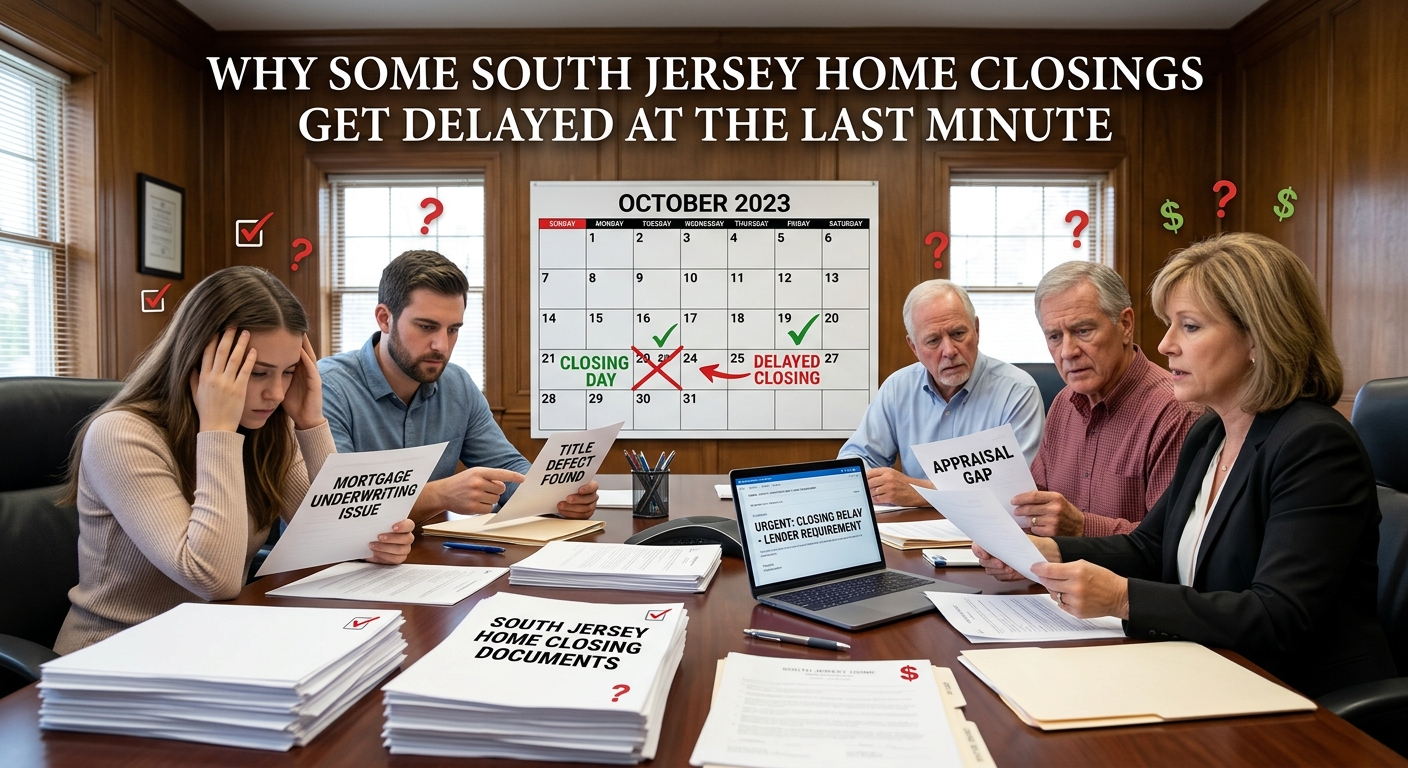
Everything seems finished.
The inspections are done.
The appraisal came back.
The mortgage is moving forward.
The closing date is on the calendar.
Then, just days—or sometimes hours—before closing, someone says:
“We have a problem.”
Suddenly, the closing date may need to move.
For buyers, this can mean changing movers, extending a lease, rescheduling utilities, or delaying a long-awaited move.
For sellers, it can mean carrying another mortgage payment, delaying their next purchase, or rearranging an entire moving schedule.
And the frustrating part?
The problem may not have appeared overnight.
Many last-minute closing delays happen because an issue wasn't fully resolved earlier in the transaction.
As Mary Murphy of The Murphy Group explains:
“A closing date is a goal, not the finish line. The best way to protect it is to identify potential problems early and keep every part of the transaction moving together.”
🏡 Why Closing Delays Happen
A real estate closing involves multiple moving parts.
The buyer, seller, lender, attorneys, title company, municipality, inspectors, insurance provider, and real estate professionals may all have different responsibilities.
One unresolved item can affect the entire timeline.
New Jersey's homebuying guidance specifically recommends reviewing closing documents and confirming the buyer has the necessary funds and documentation before settlement. The state's consumer guidance also emphasizes the importance of the final walkthrough and confirming agreed-upon repairs and property condition before closing.
Here are some of the most common reasons a South Jersey closing can get delayed.
💰 1. The Mortgage Isn't Fully Ready
One of the biggest sources of closing delays is financing.
A buyer may have received a loan approval but still have outstanding conditions.
The lender could request:
- Additional bank statements
- Updated income documentation
- Explanations for deposits
- Employment verification
- Updated insurance information
- Documentation related to debts or assets
Even a buyer who feels completely approved may still have lender requirements to satisfy.
That's why “approved” doesn't always mean “ready to close.”
📄 2. Last-Minute Loan Changes
Mortgage details can change as the lender completes final underwriting.
For example, a buyer's financial situation may require additional documentation or clarification.
Large deposits, new credit accounts, employment changes, or other financial activity can trigger additional review.
This is one reason buyers should avoid making major financial changes during the mortgage process without first discussing them with their lender.
🏠 3. Title Issues Appear
Title work can uncover issues that need to be addressed before ownership can transfer cleanly.
Examples can include:
- Outstanding liens
- Unresolved judgments
- Ownership discrepancies
- Missing documents
- Estate-related issues
- Old mortgages that were not properly released
- Easements or other recorded matters requiring clarification
Some problems are simple to resolve.
Others can take significantly longer.
A title issue discovered shortly before closing can therefore become a major scheduling problem.
🧾 4. Missing or Incorrect Documents
Real estate transactions involve a surprising amount of paperwork.
A missing signature or incorrect document may seem minor—but if the document is required before closing, it can stop the process.
Potential issues include:
- Incorrect names
- Missing signatures
- Incomplete disclosures
- Incorrect property information
- Missing lender documents
- Delayed attorney documents
- Outstanding municipal paperwork
The closer everyone gets to the scheduled closing date, the more important document accuracy becomes.
🏛️ 5. Municipal Certificates or Requirements Aren't Complete
Municipal requirements can also affect the closing timeline.
Depending on the property and municipality, there may be certificates, inspections, or other local requirements that need to be completed before the transaction can move forward.
NJ REALTORS® specifically notes that, as closing approaches, agents may check whether an appropriate Certificate of Occupancy has been obtained where applicable.
This is particularly important when a property has:
- Recent renovations
- Additions
- Converted spaces
- Changes in occupancy
- Recently completed repairs
A municipal requirement discovered late can create an unexpected delay.
🔨 6. Agreed-Upon Repairs Aren't Finished
A seller may agree to complete repairs as part of the transaction.
But what happens if the work isn't finished by the expected deadline?
The buyer may want documentation, receipts, or an opportunity to verify that the agreed work was actually completed.
New Jersey consumer guidance recommends using the final walkthrough to confirm that agreed repairs have been completed and that the home's systems and included items are in the expected condition.
That makes the walkthrough more than a formality.
It can uncover a problem immediately before closing.
🚪 7. The Final Walkthrough Reveals a Problem
Imagine the buyer walks through the house before closing and discovers:
- A refrigerator that was supposed to remain is gone
- A repair wasn't completed
- The property isn't vacant
- New damage has occurred
- A plumbing issue has appeared
- The heating or cooling system isn't functioning
- The condition is substantially different from what was expected
The parties may need to resolve the issue before the transaction can proceed.
Sometimes the solution is simple.
Sometimes it requires negotiation between the buyer and seller.
🏦 8. Homeowners Insurance Isn't Ready
For financed purchases, homeowners insurance is an important part of the closing process.
NJ REALTORS® advises buyers to begin shopping for homeowners insurance after signing a contract because the mortgage lender will require appropriate insurance to be in place at closing.
If insurance cannot be finalized in time, the lender may not be able to complete its closing requirements.
That can put the closing date at risk.
💵 9. The Buyer Doesn't Have the Final Closing Funds Ready
A buyer may know approximately how much cash they need but still be waiting for the final numbers.
Closing costs can include:
- Down payment
- Loan costs
- Title-related expenses
- Prepaid taxes
- Insurance
- Adjustments
- Other transaction-specific charges
New Jersey consumer guidance recommends reviewing the settlement statement before closing so buyers understand the amount required and how funds will be distributed.
A discrepancy in the final amount can create unnecessary stress—or delay.
🏦 10. Wire Transfer Problems
Money transfers need to be handled carefully.
A buyer may have the money available but still encounter a problem if:
- Funds are sent too late
- The bank places a hold
- Transfer instructions are misunderstood
- A wire is not received when expected
- The closing attorney or title company cannot verify the funds
This is one reason buyers should communicate with their attorney, lender, and title/settlement professionals before moving funds.
Never rely on an unexpected change in wire instructions without independently verifying it.
🧮 11. The Closing Disclosure or Settlement Figures Change
Closing numbers can change as the transaction approaches settlement.
Taxes, insurance, credits, repairs, lender charges, commissions, and other adjustments may affect the final figures.
If something doesn't match expectations, the parties may need additional time to review and correct the numbers.
New Jersey consumer guidance encourages buyers to review settlement documents before closing rather than discovering discrepancies at the closing table.
⚖️ 12. Attorney Review or Contract Issues Take Longer Than Expected
New Jersey has a distinct attorney-review process for many residential transactions.
NJ REALTORS® explains that attorney review generally occurs within a three-day period, excluding Saturdays, Sundays, and legal holidays, unless the parties agree in writing to extend the period.
While this happens much earlier than the actual closing, unresolved contract questions can affect everything that follows.
Changes to:
- Closing dates
- Repair obligations
- Credits
- Contingencies
- Contract terms
may require additional communication among the attorneys and parties.
🧾 13. A Seller's Tax or Recording Issue Appears
Certain transactions can involve additional documentation related to the seller and the transfer of the property.
New Jersey's Division of Taxation notes that more complicated transactions may require additional attention to GIT/REP documentation and advises contacting the state unit ahead of closing in certain circumstances.
The lesson for sellers is simple:
Don't wait until closing week to discover that required paperwork needs clarification.
🏚️ 14. An Older Home Creates a Last-Minute Question
Older South Jersey properties can come with layers of history.
That may include:
- Older additions
- Finished basements
- Converted garages
- Previous renovations
- Outdated systems
- Older permits or municipal records
A question about whether past work was properly documented may arise during inspection, title review, appraisal, insurance underwriting, or municipal review.
Not every older improvement creates a problem.
But unresolved questions can create delays.
📋 15. The Appraisal Creates a Complication
For financed purchases, the lender typically needs an appraisal or other valuation process appropriate to the loan.
If the appraised value comes in below the contract price, the parties may need to renegotiate, the buyer may need additional funds, or another solution may be required.
That can push the transaction beyond the original closing date.
The important point is that an appraisal issue is not automatically the end of a transaction—but it can change the timeline.
📅 16. Everyone Has a Different Timeline
A real estate transaction isn't controlled by one person.
The buyer may be ready.
The seller may be ready.
But the lender, title company, municipality, attorney, contractor, or another party may still have an outstanding item.
This is why communication matters so much during the final days.
A transaction can be technically on schedule while still having several unresolved dependencies.
⚠️ Why “Last Minute” Doesn't Always Mean Someone Made a Mistake
This is an important distinction.
A closing delay doesn't necessarily mean that someone failed.
Some issues simply cannot be known until a later stage of the transaction.
For example:
- A title search can uncover something unexpected.
- A lender can request additional documentation.
- A final walkthrough can reveal new damage.
- A municipal requirement can take longer than anticipated.
- Final numbers can change as the transaction is reconciled.
The goal isn't to eliminate every possible surprise.
The goal is to identify potential problems early enough that there is time to solve them.
🧠 The Hidden Problem: Assuming “No News” Means “Everything Is Fine”
One of the biggest mistakes buyers and sellers can make is assuming that silence means the transaction is progressing perfectly.
Instead, both sides should understand:
What is completed?
What is still outstanding?
Who is responsible for it?
What is the deadline?
Could it affect closing?
That simple checklist can expose problems before they become emergencies.
🏡 What Buyers Can Do to Reduce Closing Delays
Buyers can help protect their closing timeline by:
- Responding quickly to lender requests
- Avoiding major financial changes
- Securing homeowners insurance early
- Reviewing closing documents before settlement
- Confirming the required funds
- Completing the final walkthrough
- Staying in communication with their attorney and real estate professional
- Asking about unresolved contingencies well before closing day
The earlier a question is identified, the more options usually exist for resolving it.
🏠 What Sellers Can Do to Protect the Closing Date
Sellers have responsibilities too.
Before closing, sellers should make sure:
- Agreed repairs are completed
- Receipts or documentation are available where appropriate
- The property is in the expected condition
- Included appliances and fixtures remain
- Required municipal items are addressed
- Personal belongings are removed as agreed
- Keys, remotes, codes, and other agreed items are ready
- Attorneys and the buyer's side have what they need
A seller shouldn't assume that getting an accepted offer means the work is finished.
💼 How The Murphy Group Helps Keep Transactions Moving
At The Murphy Group, the goal isn't simply to get a property under contract.
It's to help keep the transaction moving from contract to closing.
That means paying attention to:
- Important deadlines
- Inspection outcomes
- Financing progress
- Appraisal timing
- Repair commitments
- Municipal requirements
- Final walkthrough preparation
- Communication between the professionals involved
Mary Murphy puts it this way:
“The closer you get to the closing table, the more important communication becomes. Small unanswered questions can become much bigger problems when there isn't enough time left to solve them.”
📊 The Bottom Line
A South Jersey home closing can be delayed at the last minute because of:
- Financing issues
- Title problems
- Missing documents
- Insurance delays
- Municipal requirements
- Unfinished repairs
- Final walkthrough discoveries
- Appraisal complications
- Closing-fund issues
- Last-minute contract questions
The important takeaway is that the closing date should never be treated as the only milestone that matters.
A successful closing depends on dozens of smaller milestones being completed along the way.
When buyers, sellers, attorneys, lenders, title professionals, municipalities, and real estate professionals communicate early and clearly, there is more opportunity to resolve problems before they become closing-day emergencies.
📲 Want a Smoother South Jersey Home Sale?
The Murphy Group helps buyers and sellers navigate the transaction from the initial offer through the final walkthrough—with a focus on communication, preparation, and keeping the process moving.
👉 Start here: www.mgsells.com

Mary Murphy
Team Leader | The Murphy Group | eXp Realty, LLC | PLACE
or another way