

Categories
Burlington County, Camden County, Gloucester County, home buying costs, Home Buying Guides, Home Buying Tips, Housing Guide, NJ Housing, Real Estate Guides, South Jersey Real Estate, South Jersey Market TrendsPublished September 22, 2026
Why a Low Asking Price Isn’t Always a Real Bargain in South Jersey Real Estate

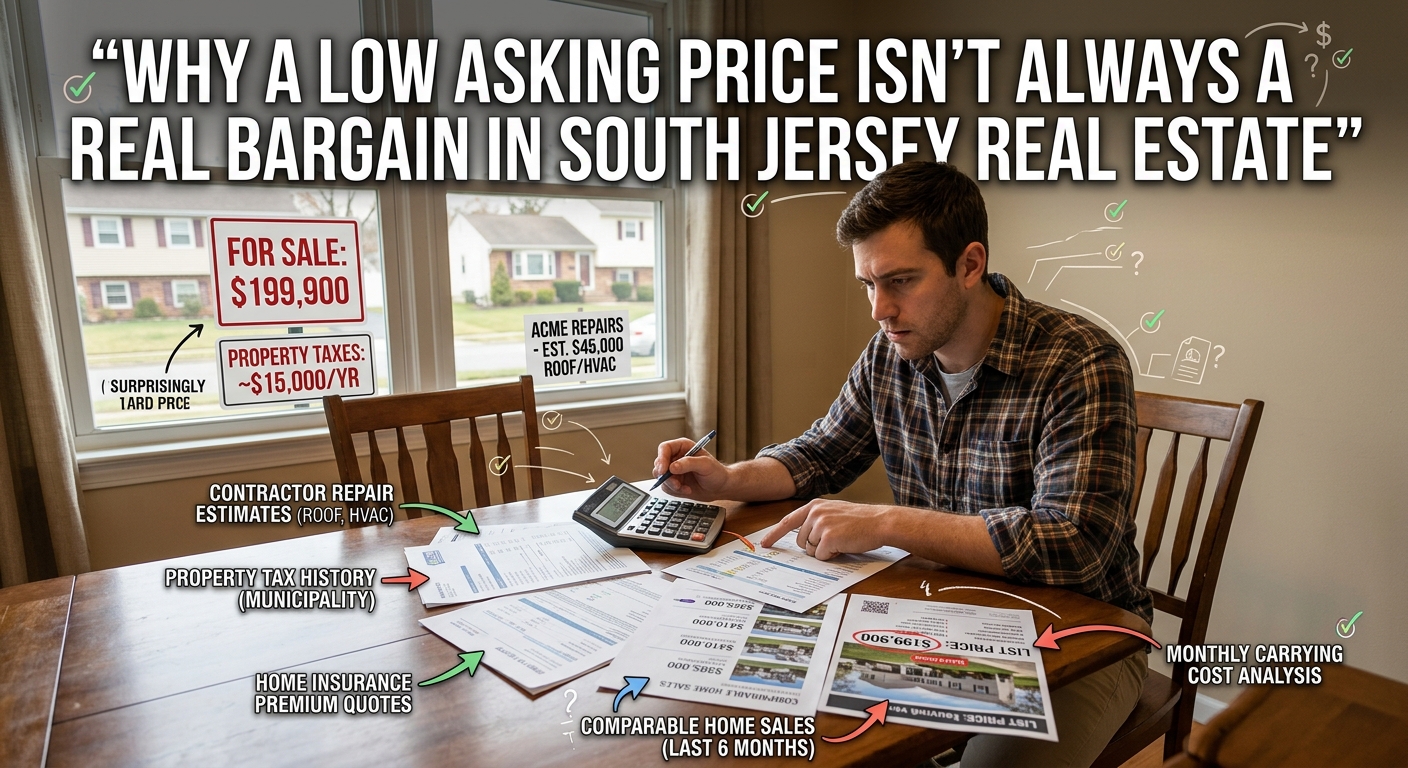
A South Jersey home listed for significantly less than comparable properties can immediately grab a buyer’s attention.
The reaction is almost automatic:
“This could be a great deal.”
But a low asking price doesn't necessarily mean a home is undervalued.
Sometimes, the lower price is the market's way of signaling that buyers should look more closely.
The property may need substantial repairs. The taxes may be higher than expected. Insurance could be more complicated. The location may come with tradeoffs. Or the seller may simply be pricing aggressively to attract attention and generate activity.
That is why smart buyers don't stop at the listing price.
They ask a more important question:
👉 “What will this home actually cost me after I buy it?”
New Jersey Housing and Mortgage Finance Agency guidance encourages buyers to consider the expenses involved in owning a home—not just the purchase price—and specifically points buyers toward factors such as flooding and other environmental concerns.
As Mary Murphy of The Murphy Group explains:
“A low asking price can create excitement, but buyers still need to understand the full picture. The right question isn't simply whether the home is inexpensive—it’s whether the value makes sense once everything is considered.”
🧠 Why a Low Price Can Be So Attractive
Price is one of the first things buyers notice online.
A home listed at $375,000 can look dramatically more appealing when nearby properties are listed at $425,000 or $450,000.
That difference can create the perception of an opportunity before the buyer has even seen the property.
A lower price can also:
- Increase clicks and online views
- Attract more showing requests
- Encourage buyers who previously thought the area was unaffordable
- Generate competition
- Create a sense of urgency
But attention isn't the same as value.
The lower price may reflect something buyers need to investigate.
🔎 1. The Home May Need More Repairs Than Expected
One of the most obvious reasons a home may be priced below comparable properties is condition.
A house can look affordable until the buyer starts adding up what it will take to make it comfortable and functional.
Potential expenses can include:
- Roof replacement
- HVAC repairs or replacement
- Electrical updates
- Plumbing work
- Window replacement
- Basement waterproofing
- Structural repairs
- Exterior maintenance
- Kitchen or bathroom renovations
A $25,000 difference in asking price can disappear quickly if the property requires $40,000 or $50,000 in improvements.
That's why the purchase price should always be considered alongside the condition of the property.
🏚️ 2. “Cosmetic” Problems Can Hide Bigger Questions
Some inexpensive homes simply need cosmetic updates.
That isn't necessarily a problem.
Paint, flooring, fixtures, landscaping, and outdated finishes can often be addressed over time.
The important distinction is between:
“This home looks dated.”
and
“This home may have underlying maintenance or system issues.”
A dated kitchen may simply be unattractive.
An aging roof, outdated electrical system, drainage problem, or deteriorating foundation can have a very different financial impact.
Buyers should separate appearance from condition before deciding that a property is a bargain.
💰 3. Property Taxes Can Change the Affordability Equation
Two homes with similar purchase prices can have very different ongoing costs.
Property taxes are one reason.
New Jersey buyers should look beyond the asking price and understand the property's tax situation as part of the overall affordability picture.
A lower-priced home with significantly higher annual property taxes may not provide the monthly savings a buyer initially expects.
The better comparison is:
Purchase price + taxes + insurance + financing + maintenance + expected improvements
rather than simply:
Purchase price vs. purchase price.
🛡️ 4. Insurance Can Be a Bigger Factor Than Buyers Expect
Insurance is another cost that shouldn't be treated as an afterthought.
New Jersey's Department of Banking and Insurance recommends that buyers compare homeowners insurance policies and consider factors such as the home's age, construction, location, coverage, and deductibles.
Certain properties may also require buyers to investigate additional flood coverage.
New Jersey's insurance guidance notes that standard homeowners policies exclude flood-related water damage.
That means a home with a low asking price could still have a very different monthly ownership cost depending on its insurance requirements and risk profile.
Before assuming a property is inexpensive, buyers should get an insurance quote.
🌧️ 5. Location Can Explain the Price
Sometimes the house isn't the reason the price is low.
The location is.
A property may be close to:
- A busy roadway
- Commercial activity
- Railroad tracks
- Industrial areas
- High-traffic intersections
- Limited parking
- Dense neighboring properties
- Areas with drainage or flooding concerns
None of these automatically makes a home undesirable.
But they can affect buyer demand and resale considerations.
This is particularly important because location is one of the factors buyers cannot renovate away.
You can remodel a kitchen.
You can't move the street.
🏡 6. The Layout May Be Limiting Buyer Demand
A low-priced home may have the right number of bedrooms but still lack the functionality buyers want.
For example:
- A bedroom may be unusually small
- The only bathroom may be inconveniently located
- The kitchen may be isolated from the main living area
- There may be little storage
- The basement may have limited practical use
- There may be no dedicated workspace
These aren't necessarily defects.
But they can explain why a property doesn't command the same price as another home with a more functional floor plan.
Buyers should ask:
👉 “Is this layout actually going to work for my life?”
🔧 7. The Cheapest Home May Become the Most Expensive Project
This is one of the biggest traps buyers can fall into.
Imagine two South Jersey homes:
Home A: $400,000 and move-in ready
Home B: $360,000 but needs $60,000 in improvements
At first glance, Home B looks cheaper.
But after estimated improvements:
$360,000 + $60,000 = $420,000
And that doesn't include the time, disruption, financing costs, or unexpected problems that can accompany renovation work.
The lower asking price isn't necessarily a bargain if the total investment becomes higher.
📊 8. The Asking Price May Be a Marketing Strategy
Sometimes a seller intentionally lists below what they believe the property could ultimately sell for.
The goal may be to:
- Generate more attention
- Increase showing activity
- Encourage multiple offers
- Create urgency
- Bring more buyers into the conversation
In that situation, a buyer shouldn't automatically assume:
“They're asking $50,000 below market, so I can buy it for $50,000 below market.”
The actual market response determines what happens next.
A low list price can sometimes produce strong competition rather than a discounted purchase.
🧠 9. A Low Price Can Trigger the Wrong Buyer Psychology
Price doesn't just influence finances.
It influences expectations.
When buyers see a home priced significantly below comparable properties, they may immediately assume they've discovered something other buyers missed.
That excitement can cause them to move too quickly.
They may:
- Skip deeper research
- Underestimate repair costs
- Focus only on the discount
- Overlook location concerns
- Assume the seller is simply motivated
The better approach is to treat a low price as a reason to investigate—not a reason to stop investigating.
🏦 10. Financing and Appraisal Still Matter
A buyer's budget isn't determined solely by the listing price.
Mortgage qualification, down payment, closing costs, insurance, taxes, and other ownership expenses all matter.
NJHMFA's homebuying guidance emphasizes budgeting for the broader costs of homeownership and notes that lenders use appraisals to assess a home's fair market value during loan processing.
That means buyers should understand how the property's condition and overall market value fit into their financing strategy.
A low asking price doesn't eliminate the need for careful financial planning.
💵 11. Closing Costs Add to the Real Purchase Price
Another common mistake is focusing on the listing price while forgetting the expenses associated with purchasing the property.
Depending on the transaction, buyers may encounter costs related to:
- Mortgage financing
- Inspections
- Appraisal
- Title insurance
- Survey
- Attorney
- Recording
- Prepaid taxes or insurance
- Escrow
New Jersey consumer guidance specifically identifies closing costs and other settlement expenses as costs above and beyond the property's purchase price.
The exact amount varies by transaction, lender, property, and other circumstances.
But the principle is simple:
The asking price is not the same thing as the cash required to buy the home.
🔍 12. Buyers Should Investigate What the Listing Doesn't Explain
A low price should lead to better questions.
Ask:
About the condition:
- How old are the roof and HVAC?
- Have there been recent repairs?
- Are there known water or drainage concerns?
- Are there visible signs of deferred maintenance?
About the property:
- What are the annual property taxes?
- Is there an HOA or association fee?
- What does the insurance quote look like?
- Are there flood-related considerations?
About the history:
- How long has the property been on the market?
- Has the price changed?
- Was it previously listed?
- Has it gone under contract before?
About improvements:
- Which renovations were completed?
- Were permits required?
- Are receipts or documentation available?
The goal isn't to assume something is wrong.
It's to understand why the price is where it is.
📍 13. Compare the Home to the Right Properties
One of the biggest mistakes buyers make is comparing a low-priced property to homes that aren't truly comparable.
A $375,000 home isn't necessarily a bargain because another nearby home sold for $450,000.
The homes may differ in:
- Lot size
- Condition
- Renovations
- Square footage
- Garage or parking
- Basement
- Location
- Age
- Layout
- Outdoor space
A meaningful comparison requires more than looking at two prices.
It requires understanding what buyers are actually getting for those prices.
🧮 14. Think in Terms of Total Cost of Ownership
Instead of asking:
“How much is this house?”
Try asking:
“What will this house cost me to own?”
That calculation can include:
- Mortgage payment
- Property taxes
- Homeowners insurance
- Flood insurance if applicable
- Utilities
- Maintenance
- Immediate repairs
- Planned renovations
- HOA or association costs
- Commuting expenses
A home with a higher asking price can sometimes have fewer immediate expenses.
A lower-priced home can sometimes require substantial investment after closing.
Neither is automatically the better financial choice.
The key is understanding the complete picture.
🏠 15. The Cheapest Home Isn't Always the Best Resale Opportunity
Buyers should also think beyond the first few months of ownership.
If the home has characteristics that consistently limit buyer demand, those factors may matter when it is time to sell.
Potential considerations include:
- Challenging location
- Unusual layout
- Limited parking
- Major deferred maintenance
- Small or awkward lot
- Limited outdoor space
- High ongoing costs
A low purchase price may provide an opportunity—but buyers should understand whether they're purchasing an undervalued property or simply purchasing a property with fewer competing buyers.
💡 The Right Question Isn't “Why Is It So Cheap?”
A better question is:
👉 “What does the price tell me about this property?”
Sometimes the answer is positive.
Maybe the seller wants a fast sale.
Maybe the home is priced strategically.
Maybe the property has been overlooked.
But sometimes the price reflects genuine differences in condition, location, ongoing expenses, or buyer demand.
The job of the buyer is not to assume which explanation is correct.
It's to investigate.
💼 How The Murphy Group Helps Buyers Look Beyond the Price
At The Murphy Group, the goal isn't simply to help buyers find the lowest asking price.
It's to help them understand value.
That means looking at:
- Comparable properties
- Property condition
- Neighborhood characteristics
- Pricing history
- Potential improvement costs
- Taxes and recurring expenses
- Insurance considerations
- Resale factors
- Overall market positioning
As Mary Murphy explains:
“A great purchase isn't always the home with the lowest price. It's the home where the price makes sense for what you're actually getting.”
That distinction can make a major difference when evaluating South Jersey properties.
📋 The South Jersey Low-Price Homebuyer Checklist
Before assuming a low-priced home is a bargain, ask:
☐ What are comparable homes selling for?
☐ Why is this property priced below them?
☐ What repairs are likely needed immediately?
☐ How old are the major systems?
☐ What are the annual property taxes?
☐ What will homeowners insurance cost?
☐ Is flood insurance a consideration?
☐ Are there HOA or association fees?
☐ Does the location have meaningful tradeoffs?
☐ Does the layout work for my needs?
☐ Has the property been listed previously?
☐ Has the asking price changed?
☐ Are renovations documented?
☐ What will the total monthly ownership cost look like?
☐ How might the home's characteristics affect future resale?
If those questions have reasonable answers, the low asking price becomes much more meaningful.
📈 The Bottom Line
A low asking price can absolutely create an opportunity.
But cheap and valuable are not automatically the same thing.
A South Jersey home may be priced below nearby properties because of condition, location, taxes, insurance considerations, layout, maintenance needs, market strategy, or other factors.
The smartest buyers don't chase the lowest number.
They investigate the number.
Because the real bargain isn't necessarily the home that costs less to purchase.
👉 It's the home where the price, condition, location, ongoing costs, and long-term value make sense together.
📲 Thinking About Buying a Home in South Jersey?
The Murphy Group helps buyers look beyond the listing price and understand the bigger picture—from property value and condition to neighborhood considerations and long-term ownership costs.
👉 Start here: www.mgsells.com

Mary Murphy
Team Leader | The Murphy Group | eXp Realty, LLC | PLACE
or another way