

Categories
Burlington County, Camden County, Gloucester County, Home Buying Guides, Home Buying Tips, Housing Guide, Real Estate Guides, South Jersey Real Estate, South Jersey Market Trends, New Jersey Real EstatePublished September 30, 2026
What Buyers Should Know About Drainage Problems Before Buying a South Jersey Home

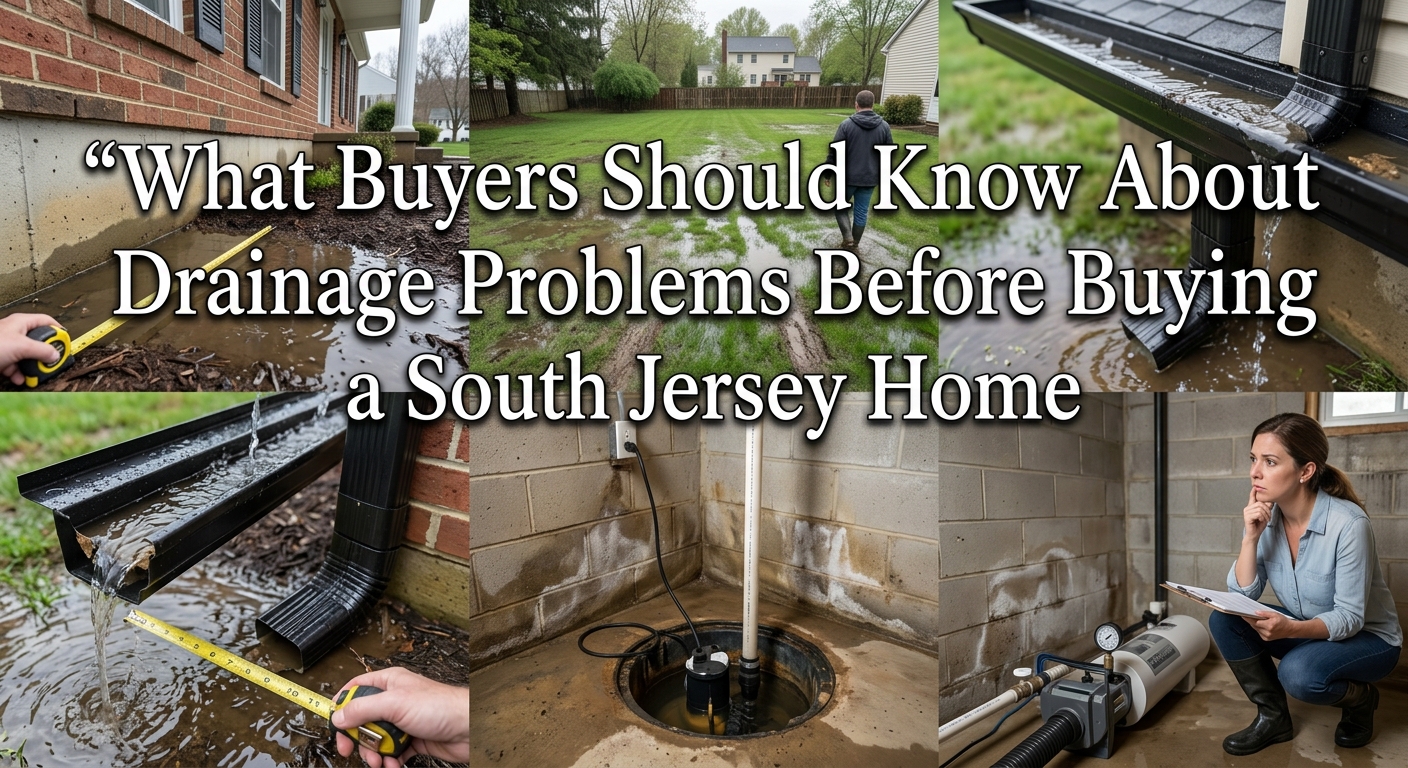
A South Jersey home can look perfect during a sunny afternoon showing.
The landscaping looks great.
The basement is finished.
The backyard appears spacious.
Everything seems dry and well maintained.
Then a major rainstorm arrives.
Suddenly, water is collecting near the foundation. The backyard stays saturated. A basement wall shows moisture. A sump pump runs constantly.
And the buyer discovers something that wasn't obvious during the original showing:
The property has a drainage problem.
Not every puddle means a home has a serious defect.
But recurring water problems can become expensive, frustrating, and difficult to solve if the underlying cause isn't understood.
New Jersey's Department of Environmental Protection notes that flooding can occur outside mapped flood zones and identifies local factors such as increased impervious surfaces, changes to stream flow, natural impediments, and aging or failing infrastructure as factors that can influence flooding.
That makes drainage an important part of South Jersey home-buying due diligence.
As Mary Murphy of The Murphy Group explains:
“Buyers often notice the kitchen, bathrooms, and finishes first. But water management can have just as much impact on the long-term ownership experience. It's important to understand what happens to water on the property—not just what the home looks like on a sunny day.”
💧 What Exactly Is a Drainage Problem?
Drainage problems occur when water isn't moving away from a property in a way that protects the home and surrounding structures.
The issue can involve:
- Poor grading
- Standing water
- Downspout discharge
- Saturated soil
- Blocked or inadequate drainage systems
- Yard runoff
- Basement moisture
- Foundation drainage
- Neighboring-property runoff
- Street or stormwater flow
Some drainage issues are relatively simple to correct.
Others can indicate larger site, grading, stormwater, or flood-related concerns.
The important distinction is whether you're looking at:
A temporary puddle after an unusually heavy storm
or
A recurring water-management problem that affects the property.
🏡 1. Start With the Yard
One of the easiest places for buyers to look is the yard.
Walk around the property and look for areas where water appears to collect.
Potential signs include:
- Persistent muddy areas
- Dead or unusually stressed grass
- Erosion
- Depressions in the lawn
- Water stains on hardscaping
- Moss or excessive moisture
- Saturated soil
- Standing water around landscaping
None of these signs automatically means the property has a serious drainage defect.
But they can justify asking additional questions.
📐 2. Pay Attention to the Grading Around the Home
Ideally, the area immediately around a home's foundation should not encourage water to flow toward the structure.
Poor grading can direct runoff toward:
- Foundation walls
- Basement windows
- Crawl spaces
- Patios
- Garages
- Other low points
A buyer doesn't need to become a drainage engineer during a showing.
Instead, look at the basic pattern:
Where does the water go when it rains?
If the obvious answer appears to be toward the house, that's worth investigating.
🌧️ 3. Visit the Property After Rain If Possible
A sunny-day showing only tells you so much.
If you're seriously considering a property, observing it after meaningful rainfall can provide valuable information.
You may notice:
- Water collecting in the driveway
- Saturated lawn areas
- Overflowing gutters
- Water near the foundation
- Slow-draining areas
- Street runoff
- Basement moisture
You don't necessarily need a major storm.
Even ordinary rainfall can reveal patterns that aren't visible during dry weather.
🏠 4. Look Carefully at the Basement
Basements can provide some of the clearest clues about past water problems.
Look for:
- Water stains
- Discoloration
- Musty odors
- Peeling paint
- Efflorescence
- Cracks
- Damp walls
- Damaged flooring
- Mold-like growth
- Evidence of previous repairs
Also look at the mechanical systems.
Is there a sump pump?
Is there a backup pump?
Where does the discharge line go?
A sump pump isn't automatically a red flag.
In many homes, it is an important part of managing groundwater.
The question is whether the system appears appropriately maintained and whether the buyer understands what role it plays.
🔧 5. Don't Ignore Gutters and Downspouts
A surprising amount of water management begins at the roof.
Rainwater collected by gutters needs to be directed somewhere appropriate.
During a showing, look at:
- Downspout locations
- Extensions
- Splashing or erosion below downspouts
- Water stains
- Discharge direction
- Whether water appears to be directed toward the foundation
A downspout that releases a large volume of water immediately next to the foundation deserves attention.
The solution may be simple.
But it should be understood before assuming everything is fine.
🌊 6. The Backyard Can Tell a Different Story
Buyers often focus on the home's interior.
But the backyard can reveal important drainage clues.
Look for:
- Low areas
- Standing water
- Erosion
- Uneven grading
- Retaining walls
- Drainage channels
- French drains
- Dry wells
- Swales
- Recently installed landscaping
A beautifully landscaped yard can still have drainage problems underneath the surface.
If you see extensive drainage infrastructure, don't automatically assume something is wrong.
Instead, ask:
“Why was this system installed?”
The answer can tell you much more.
🧱 7. Foundation Moisture Shouldn't Be Ignored
Water-related foundation concerns can range from relatively minor moisture issues to problems requiring significant professional evaluation.
Potential warning signs include:
- Horizontal cracks
- Persistent dampness
- Water staining
- Repeated patching
- Crumbling masonry
- Rusted components
- Damp insulation
- Evidence of previous waterproofing
A buyer shouldn't try to diagnose structural or water-intrusion issues independently.
A qualified home inspector or appropriate specialist can help determine what further evaluation may be warranted.
🚗 8. Driveways and Low Points Can Collect Water
Drainage problems aren't limited to yards.
Driveways can become collection points because of:
- Sloping terrain
- Improper grading
- Curb configuration
- Nearby pavement
- Garage elevation
- Stormwater runoff
Pay attention to where water appears to move across the driveway.
If the garage sits lower than surrounding pavement, buyers should understand how water is prevented from entering the structure.
🏘️ 9. The Neighboring Properties Matter Too
A home's drainage isn't always determined by the property itself.
Water can move across property boundaries.
A neighboring property that sits higher may direct runoff toward a lower property.
Likewise, changes to nearby landscaping, paving, retaining walls, or construction can alter how water moves.
New Jersey DEP notes that changes in impervious surfaces and local landscape conditions can influence flooding and drainage patterns.
That's why buyers should look beyond the property lines.
Ask:
“What happens to water coming from the surrounding properties?”
🛣️ 10. Street Drainage Can Affect the Property
Sometimes the source of the water isn't the house or yard.
It may be the surrounding roadway or stormwater system.
During heavy rainfall, water can accumulate because of:
- Street elevation
- Storm drains
- Blocked drainage structures
- Runoff from surrounding areas
- Aging infrastructure
- Changes to nearby development
This is particularly important for homes positioned near low points, intersections, or streets where water visibly collects.
If the street floods but the house remains protected, the issue may be more manageable.
But buyers should understand the pattern rather than assume it won't matter.
🌧️ 11. Drainage Problems Are Not the Same as Flood-Zone Problems
This distinction is extremely important.
A property can experience drainage or stormwater problems without being located in a FEMA Special Flood Hazard Area.
New Jersey DEP specifically warns that FEMA flood maps do not tell the entire story and that flooding can occur outside official flood zones.
So buyers shouldn't rely solely on:
“It's not in a flood zone.”
That answers one question.
It doesn't necessarily answer:
“Has water ever entered this property?”
or:
“Does this yard drain properly after heavy rainfall?”
Those are separate questions.
📋 12. New Jersey's Flood Disclosure Rules Matter
New Jersey has specific flood-risk disclosure requirements for residential property sales.
Since March 20, 2024, sellers must provide certain flood-risk information through the property condition disclosure process before the purchaser becomes obligated under a purchase contract. The disclosure includes whether the property is located in certain FEMA flood hazard areas and the seller's actual knowledge concerning flood risks.
The state's updated disclosure questions also address issues such as previous flooding, flood damage, and pooled water associated with heavy rainfall or other natural flood events.
For buyers, this means the disclosure deserves careful attention.
Don't simply sign it and move on.
Read it.
Ask questions.
Compare it with what you observe at the property.
🔎 13. Ask Whether the Property Has Experienced Pooled Water
A home doesn't have to experience a catastrophic flood to have a meaningful drainage problem.
Repeated pooled water can create its own concerns.
Ask whether the property has experienced:
- Standing water after storms
- Water entering the basement
- Yard flooding
- Driveway flooding
- Crawl-space moisture
- Drainage backups
- Water coming through basement windows
The New Jersey property condition disclosure process specifically addresses pooled water associated with heavy rainfall and other natural flood events.
That makes the question particularly relevant during buyer due diligence.
🧭 14. Use Flood Maps—But Don't Stop There
New Jersey DEP provides a Flood Indicator Tool that can show indicators of potential flood risk on or near a property.
However, the agency emphasizes that the tool is a screening resource and does not calculate actual site-specific flood risk.
That's an important distinction.
Maps are useful for identifying questions.
They aren't always enough to answer them.
Depending on the situation, buyers may need additional information from:
- The municipality
- A qualified home inspector
- A licensed professional engineer
- An insurance professional
- Other appropriate specialists
NJDEP specifically recommends contacting a licensed professional engineer or municipality when a more detailed property-specific assessment is needed.
🛠️ 15. Ask What Drainage Improvements Have Already Been Made
A property with drainage infrastructure isn't necessarily a bad property.
In fact, previous owners may have already invested significantly in solving a known problem.
Ask whether the property has:
- French drains
- Catch basins
- Dry wells
- Sump pumps
- Exterior waterproofing
- Interior drainage systems
- Grading improvements
- Drainage swales
- Retaining walls
Then ask:
When was the work completed?
Why was it needed?
Who completed it?
Are there invoices, permits, warranties, or maintenance records?
Understanding the history can be more useful than simply seeing the equipment.
💰 16. Drainage Problems Can Become an Ownership Expense
Water management can involve more than one-time repairs.
Potential ongoing costs may include:
- Sump pump replacement
- Backup power
- Gutter maintenance
- Drain cleaning
- Landscaping adjustments
- Waterproofing maintenance
- Pump maintenance
- Drainage system repairs
- Basement remediation
That doesn't mean every home with a sump pump or French drain will be expensive to own.
It means buyers should understand what systems exist and what they require.
🛡️ 17. Insurance Is Another Part of the Conversation
Drainage and flood risk can affect the insurance discussion.
New Jersey's Department of Banking and Insurance explains that standard homeowners insurance policies exclude flood damage and that flood insurance is separate coverage.
That distinction matters.
A buyer shouldn't assume that because a property has homeowners insurance, all water-related losses are covered.
Ask the insurance professional:
- What water damage is covered?
- What is excluded?
- Is flood coverage appropriate?
- What deductibles apply?
- Are there property-specific underwriting concerns?
Insurance should be investigated before closing—not after the first major storm.
🏚️ 18. Finished Basements Deserve Extra Attention
A finished basement can add substantial appeal to a South Jersey home.
It can also make drainage problems more expensive if water enters the space.
Buyers should inspect:
- Baseboards
- Flooring
- Walls
- Storage areas
- Utility rooms
- Sump pump areas
- Basement windows
- Floor drains
Look for signs that materials have been replaced or repaired.
A freshly renovated basement isn't necessarily a problem.
But if new flooring appears alongside evidence of previous moisture, buyers should ask questions.
🌳 19. Landscaping Can Change Water Flow
Landscaping isn't purely decorative.
Changes to:
- Soil
- Mulch
- Pavers
- Patios
- Retaining walls
- Trees
- Shrubs
- Garden beds
can influence how water moves around the property.
Likewise, removing vegetation or adding large paved areas can change runoff.
This becomes especially relevant when a property has undergone substantial outdoor renovations.
Ask whether recent landscaping changed the property's drainage pattern.
🏗️ 20. Nearby Development Can Change Drainage Patterns
A neighborhood doesn't remain static.
New construction, additions, paving, road work, or changes to nearby properties can alter how stormwater moves.
New Jersey's stormwater rules address runoff management in development and redevelopment contexts, and DEP notes that changes in impervious surfaces can affect local flooding conditions.
For buyers, the practical takeaway is simple:
Look at the property and its surroundings—not just the house.
🔍 21. Drainage Problems Can Be Hard to See During a Showing
This is one of the biggest challenges.
A drainage problem may be:
- Seasonal
- Weather-dependent
- Hidden underground
- Covered by landscaping
- Noticeable only during heavy rain
- More severe at certain times of year
That's why a single walkthrough isn't always enough.
The buyer's inspection and due-diligence period can provide an opportunity to investigate issues that aren't obvious during a normal showing.
🧠 22. Don't Automatically Assume Every Water Issue Is a Dealbreaker
This is an important distinction.
A property may have:
- A sump pump
- A French drain
- A drainage swale
- A basement dehumidifier
- Gutter extensions
without being an inherently problematic property.
Many homes use systems specifically designed to manage ordinary groundwater and stormwater.
The better question is:
👉 Is the system appropriate, maintained, and effective for the property's conditions?
That is something qualified professionals can help determine.
📋 South Jersey Drainage Due-Diligence Checklist
Before purchasing a South Jersey home, buyers should consider asking:
☐ Does water drain away from the foundation?
☐ Are there areas of standing water?
☐ Does the yard show signs of erosion or persistent saturation?
☐ Are gutters and downspouts functioning properly?
☐ Where do downspouts discharge?
☐ Is there a sump pump?
☐ Is there a backup pump or power source?
☐ Are there signs of previous basement moisture?
☐ Has the property ever experienced pooled water?
☐ Has water ever entered the basement or crawl space?
☐ Are there French drains, dry wells, or other drainage systems?
☐ Why were those systems installed?
☐ Are records of previous drainage work available?
☐ What does the seller's property condition disclosure say?
☐ Is the property located in a FEMA flood hazard area?
☐ What does New Jersey's flood-risk information show?
☐ What does the insurance quote look like?
☐ Should a drainage or engineering professional evaluate the property?
💼 How The Murphy Group Helps Buyers Look Beyond the House
At The Murphy Group, evaluating a South Jersey property means looking beyond the finishes and asking questions about how the home functions as a whole.
That includes helping buyers recognize potential concerns involving:
- Drainage
- Property condition
- Location
- Flood-risk information
- Maintenance
- Insurance
- Long-term ownership costs
The goal isn't to assume that every water-management feature represents a problem.
It's to help buyers identify the questions that deserve professional investigation.
As Mary Murphy explains:
“A beautiful home should also make sense as a property. Understanding how water moves around the house is one of those details that can save buyers from unexpected surprises later.”
📊 The Bottom Line
Drainage problems aren't always obvious during a South Jersey home showing.
A property can look completely dry on a sunny day while still experiencing recurring water problems after heavy rainfall.
Before buying, pay attention to:
- Yard grading
- Standing water
- Gutters and downspouts
- Basement moisture
- Foundation conditions
- Drainage systems
- Neighboring properties
- Street runoff
- Flood history
- Flood-risk disclosures
- Insurance requirements
New Jersey's flood-risk resources emphasize that properties outside mapped flood zones can still experience flooding, and the state requires specific flood-risk disclosures in residential real estate transactions.
The most important takeaway is simple:
👉 Don't just ask whether a South Jersey home has ever flooded. Ask how water moves around the property—and what happens after a major rainstorm.
Understanding that before you buy can help you evaluate the property's condition, potential costs, and long-term suitability with much greater confidence.
📲 Thinking About Buying a South Jersey Home?
The Murphy Group helps buyers look beyond the listing photos and understand the property factors that can affect ownership—from drainage and condition to location, insurance, and long-term value.
👉 Start here: www.mgsells.com

Mary Murphy
Team Leader | The Murphy Group | eXp Realty, LLC | PLACE
or another way