

Categories
Burlington County, Camden County, Gloucester County, Home Buying Guides, Home Buying Tips, New Jersey Real Estate, NJ Housing, Real Estate GuidesPublished August 31, 2026
Why South Jersey Buyers Are Looking More Closely at Neighborhood Turnover

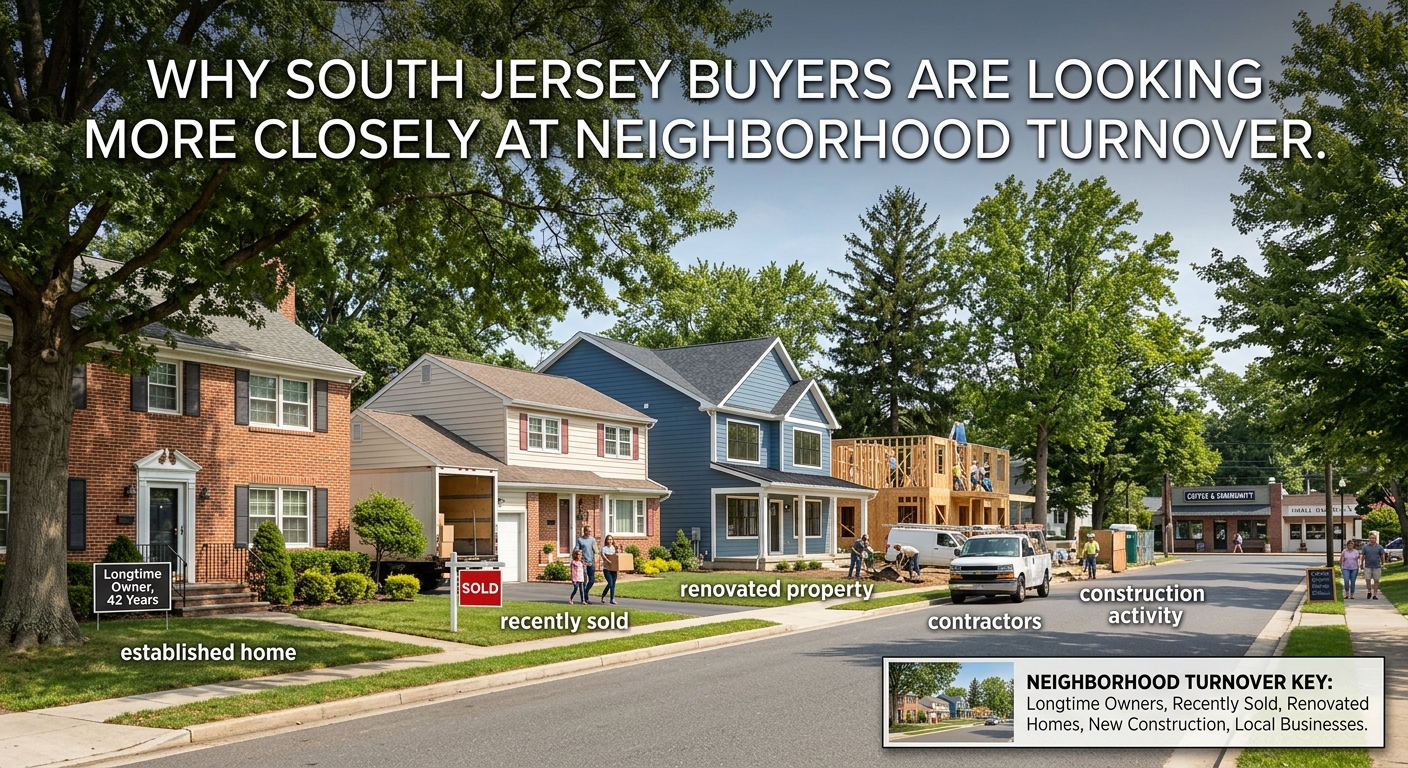
When buyers evaluate a South Jersey home, they naturally focus on the property.
The kitchen.
The bedrooms.
The backyard.
The price.
But increasingly, buyers are asking another question:
"What's happening around this house?"
That question is leading more buyers to pay attention to neighborhood turnover—how frequently homes are changing owners, who is moving into the area, which properties are being renovated, and how the surrounding community is evolving.
Neighborhood turnover doesn't automatically mean a neighborhood is improving or declining.
Instead, it can provide clues about where a community is in its broader life cycle.
As Mary Murphy of The Murphy Group explains:
"Buyers aren't just purchasing a house. They're buying into a neighborhood. Understanding who's moving in, who's moving out, and how properties are changing can provide valuable context before making a long-term decision."
🏘️ What Does Neighborhood Turnover Actually Mean?
Neighborhood turnover refers to the rate at which homes change ownership or occupancy over time.
It can happen when:
- Longtime homeowners retire or downsize
- Younger families move into the area
- Buyers relocate from nearby cities
- Families move for work
- Investors purchase properties
- Homeowners renovate and resell
- New construction introduces additional residents
A neighborhood with frequent transactions may be experiencing a period of transition.
A neighborhood with very few sales may have a large population of longtime homeowners.
Neither situation is automatically better.
The important question is what the turnover is revealing about the community.
🔍 1. Buyers Want to Know Where the Neighborhood Is Heading
A home purchase is usually a long-term decision.
That means buyers aren't only asking:
"What is this neighborhood like today?"
They're also thinking:
"What might it look like five or ten years from now?"
Recent ownership changes can provide clues.
For example, buyers may notice:
- Older homes being renovated
- More properties coming to market
- New families moving in
- Businesses opening nearby
- Public improvements
- Increasing investment in properties
These patterns can help buyers understand whether a neighborhood is stable, changing, or entering a new phase.
🏠 2. Renovations Can Be an Important Signal
One of the easiest forms of neighborhood turnover to notice is renovation activity.
If several homes are being:
- Updated
- Expanded
- Landscaped
- Repainted
- Restored
- Completely remodeled
buyers may interpret that activity as a sign that homeowners see long-term value in the area.
It doesn't guarantee future appreciation.
But it can indicate that residents are willing to invest in their properties.
👨👩👧👦 3. New Residents Can Change What Buyers Look For
Different generations and household types can bring different preferences to a neighborhood.
New residents may increase demand for:
- Home offices
- Larger kitchens
- Finished basements
- Outdoor living
- Walkable amenities
- Restaurants
- Child-friendly spaces
- Low-maintenance properties
As the resident mix changes, local businesses and services can sometimes respond as well.
That can gradually reshape the neighborhood experience.
📊 4. Buyers Can Look at Recent Sales—Not Just Current Listings
Current listings show what is available.
Recent sales can reveal something different:
What buyers actually purchased.
Looking at recent transactions can help buyers understand:
- Which homes are selling
- What price ranges are attracting demand
- How quickly properties are moving
- Whether renovated homes command stronger interest
- Which property characteristics buyers appear to value
This is especially important because South Jersey is not one uniform market. Conditions can differ significantly between counties, towns, neighborhoods, and property types.
🏡 5. A Neighborhood With Turnover Isn't Necessarily Unstable
Some buyers hear "high turnover" and immediately think something is wrong.
That isn't necessarily the case.
Turnover can simply reflect a healthy transition between generations.
For example:
A neighborhood may have been primarily occupied by homeowners who purchased decades ago.
As those homeowners retire or move, younger families may purchase the properties.
The neighborhood's physical character may remain recognizable while its residents gradually change.
🌳 6. Low Turnover Can Have Advantages Too
The opposite can also be true.
A neighborhood with very little turnover may indicate:
- Longtime residents
- Strong community relationships
- High homeowner satisfaction
- Stable property ownership
- Limited inventory
For some buyers, that type of stability is extremely attractive.
A neighborhood where homeowners stay for decades may signal that residents are comfortable remaining there long term.
💰 7. Turnover Can Affect Available Inventory
Neighborhood turnover can also influence how many homes buyers have to choose from.
If very few homeowners are selling, inventory can remain tight.
If more longtime owners decide to move, additional properties may enter the market.
South Jersey's 2026 market continues to show differences in inventory and market conditions from one area to another, making local supply especially important when evaluating a neighborhood.
🏗️ 8. New Construction Can Accelerate Neighborhood Change
New development can introduce an entirely new group of residents.
That can influence:
- Population
- Local businesses
- Traffic patterns
- Amenities
- Housing demand
- Property comparisons
New construction can also change how buyers evaluate older homes nearby.
An established property may become more attractive because of its larger lot or mature landscaping.
Or buyers may prefer the newer home's modern systems and lower expected maintenance.
The impact depends heavily on the specific location.
🛍️ 9. Local Businesses Can Reveal Neighborhood Momentum
Buyers shouldn't look only at houses.
They can also watch what is happening commercially.
New:
- Restaurants
- Coffee shops
- Grocery stores
- Fitness businesses
- Retail
- Professional services
can sometimes indicate changing demand in an area.
Commercial investment doesn't guarantee higher property values, but it can provide another piece of the neighborhood puzzle.
🚧 10. Infrastructure Changes Matter Too
Neighborhood turnover should also be evaluated alongside infrastructure.
Buyers may want to investigate:
- Road improvements
- Transportation projects
- New sidewalks
- Parks
- School improvements
- Utility upgrades
- Development proposals
These changes can affect how a neighborhood functions and how attractive it becomes to future residents.
🧠 11. Buyers Are Trying to Reduce Long-Term Risk
At its core, paying attention to neighborhood turnover is about reducing uncertainty.
A buyer isn't simply asking:
"Do I like this house?"
They're also asking:
"Will I still like this location years from now?"
Understanding neighborhood trends can help buyers make decisions based on more than emotion.
📍 12. South Jersey's Micro-Markets Make Neighborhood Research More Important
One of the biggest mistakes buyers can make is treating all of South Jersey as one market.
A home in:
- Camden County
- Burlington County
- Gloucester County
- Salem County
- Cumberland County
can experience very different buyer demand and market conditions.
Even two neighborhoods within the same county can behave differently.
Recent South Jersey market reporting continues to show significant differences in inventory, days on market, pricing, and buyer competition across local markets.
That's why neighborhood-level research matters.
🔎 13. What Buyers Should Look for During a Neighborhood Drive-Through
Before making an offer, buyers can spend some time observing the surrounding area.
Look for:
- Homes being renovated
- Homes sitting vacant
- New landscaping
- New construction
- "For Sale" signs
- Well-maintained properties
- Commercial development
- Traffic patterns
- Parks and recreational areas
- Overall property upkeep
One drive-through won't tell the entire story.
But it can generate useful questions.
📅 14. Look at the Direction of Change—Not One Snapshot
A single new development doesn't define a neighborhood.
Neither does one home sale.
Buyers should look for patterns over time.
Ask:
Are improvements becoming more common?
Are more homes changing hands?
Are longtime properties being renovated?
Are new amenities appearing?
Is inventory increasing or decreasing?
Patterns are generally more informative than isolated events.
⚠️ 15. Turnover Can Have Both Positive and Negative Effects
Neighborhood change isn't automatically positive.
Rapid turnover can sometimes bring:
- Increased investment
- New amenities
- Higher buyer demand
But it can also create concerns such as:
- Construction activity
- Traffic
- Rising housing costs
- Changes in neighborhood identity
- Increased rental activity
The important thing is understanding what is causing the turnover.
🏡 16. Sellers Can Benefit From Understanding Turnover Too
Neighborhood turnover isn't only relevant to buyers.
Sellers should understand it because changing buyer demographics can influence how a property should be marketed.
For example, a neighborhood attracting younger families may respond well to marketing that emphasizes:
- Family spaces
- Schools
- Outdoor areas
- Home offices
- Storage
A neighborhood attracting downsizers may have stronger demand for:
- First-floor living
- Low maintenance
- Accessibility
- Walkability
Understanding who is buying can help sellers position their properties more effectively.
📈 17. Turnover Can Reveal a Neighborhood's Next Buyer Pool
Perhaps the most useful question is:
"Who is replacing the homeowners who are leaving?"
If older homeowners are selling and younger families are purchasing, the neighborhood may gradually develop a different housing demand profile.
If families are leaving and investors are purchasing, the trajectory may look very different.
The pattern matters more than the turnover number itself.
💼 How The Murphy Group Helps Buyers Understand Neighborhood Trends
At The Murphy Group, neighborhood analysis goes beyond looking at a property's four walls.
Their approach can include evaluating:
- Recent sales
- Inventory
- Property condition
- Buyer demographics
- Neighborhood characteristics
- Development activity
- Local amenities
- Long-term marketability
"We want buyers to understand not just the house they're purchasing, but the environment they're becoming part of," Mary says. "The neighborhood can be just as important to long-term satisfaction as the property itself."
📊 The Bottom Line
Neighborhood turnover isn't something buyers should automatically fear—or automatically celebrate.
It is information.
When buyers look at ownership changes, renovations, new residents, businesses, infrastructure, and local development together, they can build a clearer picture of where a South Jersey community may be heading.
👉 The smartest buyers aren't just asking whether a neighborhood is desirable today. They're looking at the signals that could shape its appeal tomorrow.
Because when you're buying a home, you're not just buying an address.
You're buying into a community's future.
📲 Thinking About Buying in South Jersey?
The Murphy Group can help you evaluate not only the property, but also the neighborhood, comparable sales, market conditions, and factors that could influence long-term value.
👉 Start here: www.mgsells.com

Mary Murphy
Team Leader | The Murphy Group | eXp Realty, LLC | PLACE
or another way