

Categories
Burlington County, Camden County, Gloucester County, South Jersey Real Estate, South Jersey home prices, Real Estate Guides, New Jersey Real Estate, Home Buying TipsPublished September 21, 2026
The Underground Oil Tank Question Every South Jersey Homebuyer Should Ask Before Closing

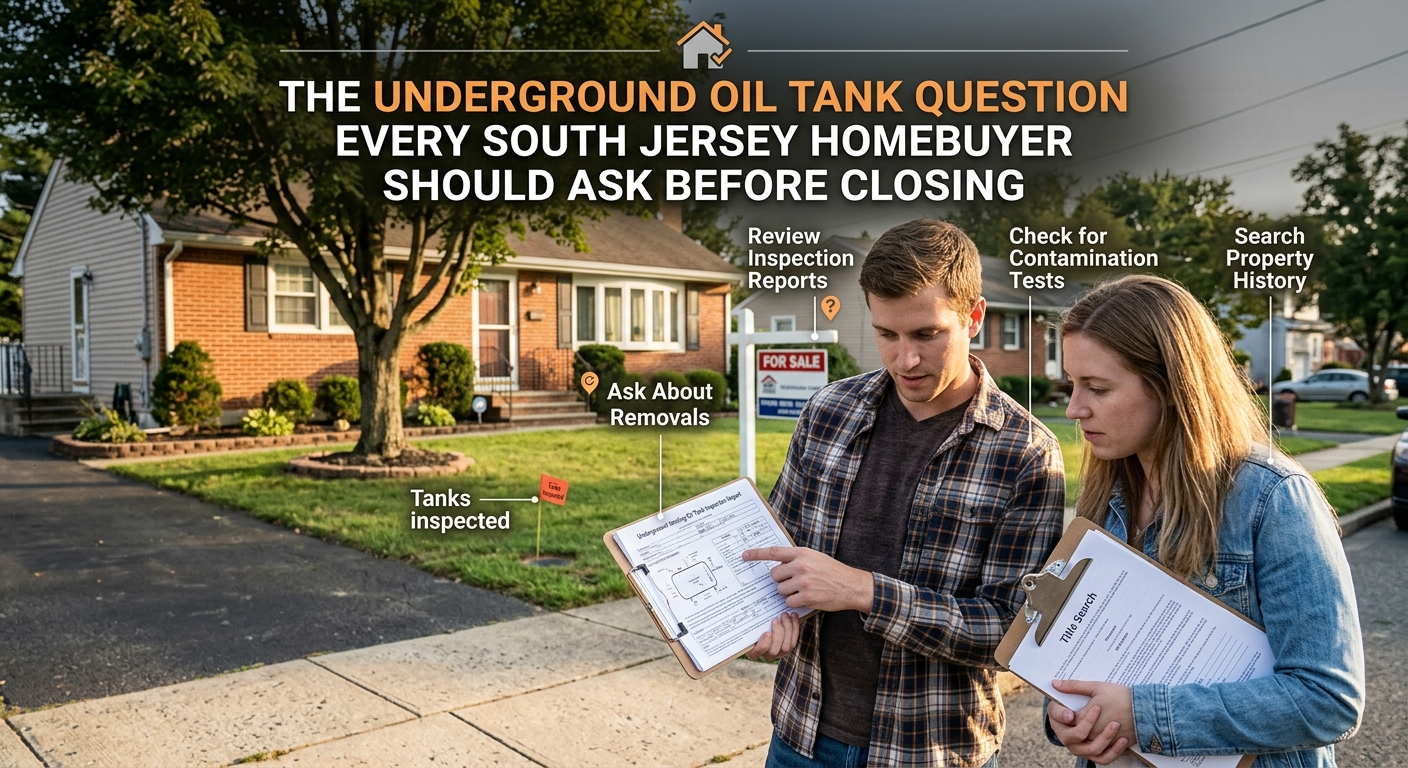
You're touring a South Jersey home.
The kitchen looks great.
The neighborhood feels right.
The price fits your budget.
Then someone asks:
“Does this property have—or ever have had—an underground oil tank?”
For buyers of older homes, that question can be extremely important.
A property may no longer use heating oil, yet an underground tank could still be present or there could be a history of a former tank on the property.
And the issue isn't simply whether a tank exists.
Buyers may also want to know:
- Was the tank tested?
- Was it removed?
- Was it abandoned in place?
- Was there evidence of a leak?
- Was soil evaluated?
- Was contamination discovered?
- Was remediation completed?
- Are there closure or environmental records?
New Jersey's Department of Environmental Protection (NJDEP) specifically addresses residential heating-oil tanks through its Unregulated Heating Oil Tank program.
As Mary Murphy of The Murphy Group explains:
“When you're buying an older home, asking about the property's heating history can be just as important as asking about the condition of the roof, HVAC, or plumbing. Buyers want to understand what happened before they take ownership.”
🛢️ What Exactly Is an Underground Oil Tank?
An underground oil tank is a storage tank located below ground that was historically used to store heating oil for a home.
Many older properties were heated with oil before switching to systems such as:
- Natural gas
- Electric
- Propane
- Heat pumps
The presence of a newer heating system does not necessarily mean an old underground tank is gone.
A former tank could potentially remain underground unless it was properly closed or removed.
That is why buyers shouldn't simply ask:
“Does the house use oil?”
A better question is:
“Has this property ever had an underground heating-oil tank?”
🔍 1. Why Buyers Should Ask Before Closing
An underground tank can become an important part of a property's environmental and financial history.
If a tank has leaked, petroleum can affect surrounding soil and, in some circumstances, groundwater.
NJDEP notes that leaking underground heating-oil tanks can result in soil or groundwater contamination.
That doesn't mean every underground tank has leaked.
It means buyers should understand the property's history rather than make assumptions.
📋 2. Ask Whether the Property Ever Had a Tank
This should be one of the first questions.
Ask the seller or appropriate professionals:
“Has there ever been an underground heating-oil tank on this property?”
Don't limit the question to whether there is one today.
A previous owner may have:
- Removed the tank
- Abandoned it in place
- Converted the heating system
- Replaced the tank
- Completed testing or remediation
Documentation from previous work can be extremely useful.
📄 3. Ask for Testing and Closure Records
If a tank was previously removed or closed, buyers should ask whether documentation exists.
Potential records may include:
- Tank removal documentation
- Closure certificates
- Tank testing reports
- Soil sampling results
- Municipal permits
- Environmental reports
- Remediation documentation
- NJDEP correspondence
- No Further Action documentation, when applicable
NJDEP's current guidance explains that closure of an underground residential heating-oil tank must be performed by a properly certified contractor.
Having documentation can make it much easier to understand what happened.
⚠️ 4. “Abandoned in Place” Doesn't Automatically Mean “No Problem”
This is an important distinction.
A tank may have been abandoned in place rather than physically removed.
That doesn't automatically mean the property has contamination.
But it also doesn't automatically prove that the tank never leaked.
NJDEP specifically notes that an abandoned-in-place tank does not guarantee that no leak occurred.
That's why buyers should review the available records and discuss the appropriate due diligence with qualified professionals.
🧪 5. Ask Whether the Tank Was Tested Before Removal
If the tank was removed, ask:
What was found when it came out?
Depending on the circumstances, professionals may inspect the tank and surrounding area for signs of a discharge.
NJDEP guidance says that when an underground tank is removed, the process includes checking for holes or signs of a discharge.
If evidence of a leak is discovered, additional investigation and remediation may be necessary.
🌱 6. Ask Whether Soil Was Tested
The condition of the tank itself isn't necessarily the entire story.
A buyer may also want to know whether surrounding soil was evaluated.
Why?
Because a tank can deteriorate underground without the problem being obvious from inside the house.
Depending on the circumstances, environmental professionals may conduct subsurface evaluation or other investigation.
The appropriate testing depends on the property's history and the specific situation.
🚨 7. What Happens If a Leak Is Discovered?
If a residential heating-oil tank has discharged oil, the issue may move beyond a simple tank-removal project.
NJDEP explains that when a discharge is discovered, investigation and remediation may be required.
The process can involve:
- Reporting the discharge
- Environmental investigation
- Soil evaluation
- Remediation
- Documentation
- Final reporting
NJDEP's UHOT program provides a framework for investigating and remediating qualifying residential heating-oil tank discharges.
This is one reason buyers should understand the property's history before closing, rather than discovering an issue afterward.
📑 8. What Is a No Further Action Letter?
Buyers may encounter the term:
NFA — No Further Action.
According to NJDEP, an NFA letter is a final remediation document indicating that contaminants are not present or that discharged contaminants have been remediated to applicable standards.
However, buyers shouldn't assume that every property with a former oil tank should automatically have an NFA.
NJDEP explains that when an unregulated heating-oil tank is closed without evidence of a discharge and the tank passes the applicable municipal inspection, an NFA may not be required.
The important point is to understand what documentation actually exists and what it means for that specific property.
🏠 9. Look at the Property's Heating History
Buyers should consider the home's historical heating systems.
Ask:
- Was the home previously heated by oil?
- When was the heating system converted?
- Where was the oil tank located?
- Was there ever an above-ground tank?
- Was there an underground tank?
- When was the tank removed?
- Who performed the work?
- Are permits or reports available?
This information can help create a clearer picture of the property's history.
🔎 10. Look for Physical Clues—But Don't Rely on Them Alone
There may be visible clues suggesting an older oil-heating system.
These could include:
- Old fuel lines
- Former fill pipes
- Vent pipes
- Unusual areas of disturbed soil
- Old basement equipment
- Abandoned heating components
But visual clues aren't a substitute for professional evaluation.
A tank can be difficult to locate or may have been modified or removed years earlier.
When the history is unclear, buyers should consider appropriate professional due diligence.
💵 11. Why the Issue Can Affect the Financial Side of a Purchase
An underground tank isn't automatically a financial problem.
But an unresolved tank or environmental concern can create uncertainty.
Potential considerations may include:
- Testing costs
- Tank removal costs
- Environmental investigation
- Soil remediation
- Professional fees
- Delays
- Negotiation over responsibility
The financial impact depends heavily on the property's specific circumstances.
That's why buyers should avoid assuming that a tank will either be inexpensive or extremely expensive without first getting the facts.
🏦 12. Don't Forget About the Transaction Timeline
Environmental questions can become particularly important when a buyer is working toward a closing date.
If additional testing or documentation is needed, the parties may need time to:
- Schedule professionals
- Review reports
- Determine next steps
- Negotiate responsibility
- Complete required work
- Obtain documentation
The earlier the issue is identified, the more options everyone may have.
📝 13. Check the Seller's Property Disclosure
New Jersey's Seller's Property Condition Disclosure Statement specifically asks sellers whether they are aware of underground storage tanks and whether a tank has been tested.
Buyers should review the disclosure carefully.
Questions about:
- Current or former tanks
- Testing
- Closure
- Environmental concerns
- Corrective actions
should not be treated as minor details.
If an answer is unclear, buyers can ask for clarification through the appropriate professionals.
🧠 14. Don't Assume “No Known Issues” Means “No Tank”
There's an important difference between:
“There is no underground tank.”
and
“The seller is not aware of an underground tank.”
Those statements communicate different levels of certainty.
When purchasing an older South Jersey property, buyers should seek documentation whenever possible rather than relying solely on assumptions or verbal history.
🧪 15. A Professional Evaluation Can Provide More Confidence
Real estate agents aren't environmental investigators.
When there is uncertainty about an underground tank, buyers may need qualified professionals who specialize in:
- Tank locating
- Tank testing
- Tank closure
- Environmental investigation
- Soil sampling
- Remediation
NJDEP maintains information on certified firms and explains the different certifications relevant to tank closure and subsurface evaluation.
The right professional depends on the question that needs to be answered.
⚖️ 16. Buyers Should Understand Who Is Responsible for What
One of the biggest mistakes is assuming that the buyer or seller automatically pays for every tank-related issue.
Responsibility can depend on:
- The purchase contract
- Negotiated terms
- The condition discovered
- Existing documentation
- Applicable law
- Whether contamination exists
- The timing of the discovery
This is an area where buyers and sellers should rely on their real estate attorney and appropriate environmental professionals for property-specific guidance.
🏡 17. A Former Oil Tank Doesn't Automatically Mean You Should Walk Away
This is worth emphasizing.
A former underground tank isn't automatically a reason to reject a home.
There are properties with properly closed tanks and documented histories that may present very different circumstances from properties with an unknown tank or unresolved contamination.
The key is information.
Before making a decision, buyers should understand:
- What happened
- When it happened
- Who performed the work
- What testing was completed
- Whether contamination was found
- Whether remediation occurred
- What documentation exists
Then they can make a decision based on facts rather than fear.
📋 The South Jersey Underground Oil Tank Checklist
Before closing on an older home, consider asking:
Tank History
- Has the property ever had an underground oil tank?
- Where was it located?
- Is it still there?
Documentation
- Was the tank tested?
- Was it removed or abandoned in place?
- Is there a closure certificate?
- Are municipal permits available?
- Are environmental reports available?
Environmental History
- Was a leak discovered?
- Was soil tested?
- Was contamination found?
- Was remediation completed?
- Is there an NFA letter or other closure documentation, if applicable?
Transaction
- Has the issue been reviewed by the appropriate professionals?
- Is additional testing needed?
- Are responsibilities clearly addressed in the contract?
- Could the issue affect the closing timeline?
These questions can help turn an unknown risk into a documented property history.
💼 How The Murphy Group Helps Buyers Ask the Right Questions
At The Murphy Group, helping buyers isn't just about finding a property they love.
It's also about helping them understand the questions that should be asked before they commit to a purchase.
That can include encouraging buyers to investigate:
- Property history
- Seller disclosures
- Major systems
- Environmental concerns
- Inspection findings
- Insurance considerations
- Long-term ownership costs
“Our job isn't to tell buyers what decision to make,” Mary says. “It's to help them understand what questions need to be answered so they can make an informed decision with the right professionals involved.”
📈 The Bottom Line
If you're buying an older South Jersey home, don't ask only:
“Does this house have an oil tank?”
Ask the bigger question:
“Has this property ever had an underground oil tank, and what documentation exists showing what happened to it?”
A tank that was properly addressed and documented is a very different situation from an unknown tank with an unclear history.
The goal isn't to create unnecessary fear.
It's to eliminate unnecessary surprises.
Because before you close on a South Jersey home, knowing what's under the ground can be just as important as knowing what's inside the walls.
📲 Thinking About Buying an Older South Jersey Home?
The Murphy Group helps buyers understand the questions worth asking before making a major real estate decision—from property condition and environmental history to location, insurance, and long-term ownership considerations.
👉 Start here: www.mgsells.com

Mary Murphy
Team Leader | The Murphy Group | eXp Realty, LLC | PLACE
or another way