

Categories
Home Buying Guides, Housing Guide, New Jersey Real Estate, Home Buying TipsPublished January 30, 2026
NJ Radon Risks in Older Homes: A Buyer’s Guide

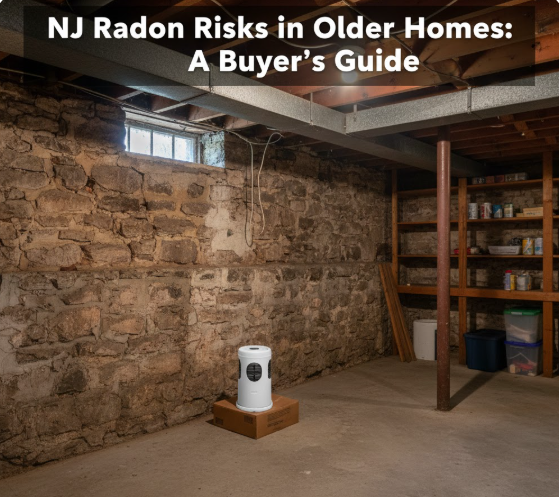
Older homes across New Jersey offer charm, character, and solid construction — but they can also come with hidden environmental risks, including radon.
Radon is a colorless, odorless radioactive gas that forms naturally from soil and rock. It can seep into homes through foundation cracks, sump pumps, and crawl spaces — and New Jersey has moderate to elevated radon levels in many areas.
Mary Murphy of The Murphy Group explains:
“Radon is one of those issues buyers don’t think about until an inspection flags it. The good news is that it’s very manageable when you know what to look for.”
Here’s what NJ buyers should understand about radon, especially when considering older homes.
☢️ 1. Why Older Homes Are More Vulnerable
Older homes are not inherently unsafe, but they often have features that increase radon entry:
- Foundation cracks and aging concrete
- Stone or block basements
- Crawl spaces without vapor barriers
- Older sump pump systems
- Less airtight construction
Mary notes:
“Older homes weren’t built with radon-resistant construction in mind. That doesn’t mean you shouldn’t buy — it just means you should test.”
🧪 2. Radon Testing in New Jersey
- Radon testing is not legally required statewide but is strongly recommended
- Most buyers test during the home inspection period
- Short-term tests are commonly used during transactions
- Results are measured in picocuries per liter (pCi/L)
The EPA recommends mitigation if radon levels are 4.0 pCi/L or higher.
Mary explains:
“Testing is simple and inexpensive compared to the long-term health risks of ignoring radon.”
🏠 3. What Happens If Radon Levels Are High?
High radon levels don’t mean the deal is dead.
Common solutions include:
- Sub-slab depressurization systems
- Sealing foundation cracks
- Improving ventilation in basements and crawl spaces
Most mitigation systems cost $1,200–$2,500 and are highly effective.
“Radon mitigation is one of the most straightforward fixes we see,” Mary says.
“It’s often negotiated into the deal.”
⚖️ 4. Negotiating Radon Issues as a Buyer
Buyers may:
- Request seller-paid mitigation
- Ask for a credit at closing
- Walk away if concerns aren’t addressed
Mary adds:
“In New Jersey, radon findings are commonly handled through negotiation — not deal breakers when approached properly.”
🛠️ 5. Common Radon Myths
❌ Only old homes have radon
❌ New construction eliminates radon risk
❌ You can smell or feel radon
✔ Radon can affect homes of any age
✔ Only testing confirms its presence
✔ Mitigation systems are effective long-term
“Radon is invisible, which is why education matters,” Mary notes.
💡 Buyer Tips for Older NJ Homes
✔ Always include radon testing in inspections
✔ Test the lowest livable level of the home
✔ Verify any existing mitigation system is working
✔ Use certified radon professionals
Mary emphasizes:
“Knowledge protects buyers. Radon should be part of every informed decision.”
📲 Buying an Older Home in NJ? Get Expert Guidance
From historic colonials to mid-century homes, New Jersey offers incredible housing options — and with the right inspections, buyers can move forward confidently.
Mary Murphy and The Murphy Group guide buyers through testing, negotiation, and mitigation, ensuring no surprises after closing.
Get expert help buying a home safely in New Jersey:
www.mgsellsarizona.com

Mary Murphy
Team Leader | The Murphy Group | eXp Realty, LLC | PLACE
or another way