

Categories
Camden County, Burlington County, Gloucester County, Home Buying Tips, Home Buying Guides, New Jersey Real Estate, NJ Housing, home inspection, resale valuePublished October 19, 2026
Should You Buy a South Jersey Home With a Converted Garage?

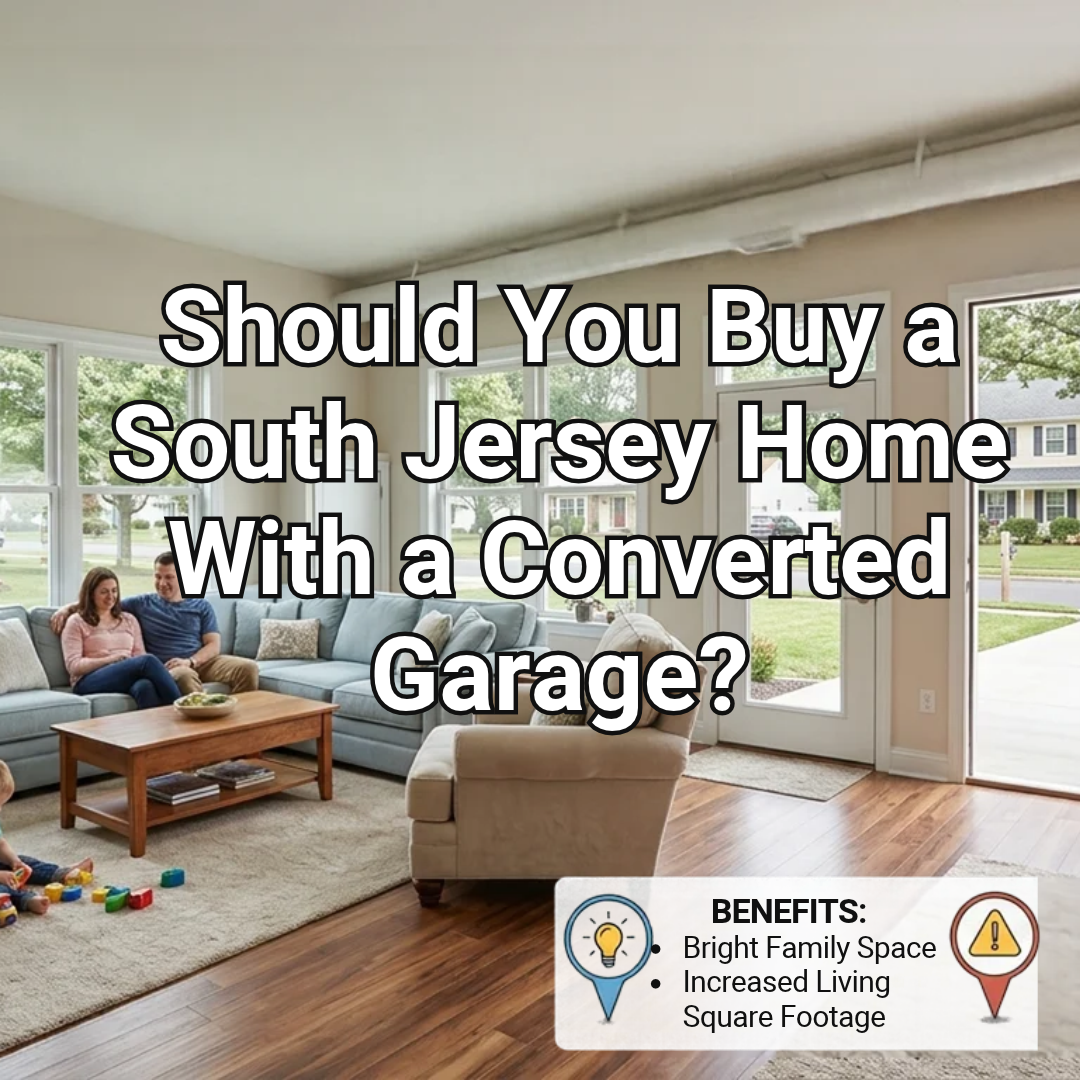
A converted garage can make a South Jersey home feel more spacious without increasing its footprint.
What was once used to park a car may now serve as a family room, home office, playroom, gym, guest space, or additional living area. For buyers who need more room but don't want to move into a larger house, that extra space can be appealing.
But there's an important question to ask before making an offer:
Was the garage converted properly, and does the finished space function as part of the home the way you expect?
A conversion that looks attractive in listing photos may have issues involving permits, insulation, heating, moisture, electrical work, or the loss of valuable parking and storage. In some cases, work may have been completed without the approvals required for the project.
As Mary Murphy of The Murphy Group explains:
“Extra living space can make a home more appealing, but buyers need to understand how that space was created. The goal is to recognize the benefits while making sure the property meets their needs today and in the future.”
Before buying a South Jersey home with a converted garage, here's what to evaluate.
🏡 1. Understand What the Garage Has Been Converted Into
Not every garage conversion serves the same purpose. The intended use can affect the level of scrutiny the space deserves.
Common conversions include:
- Family room: Additional space for relaxing, watching television, or entertaining.
- Home office: A dedicated workspace separate from the main living areas.
- Bedroom: Additional sleeping space for family members or guests.
- Playroom or hobby room: Flexible space for children's activities, crafts, or exercise.
- Guest suite: A more private area for visiting relatives or other guests.
- Expanded living area: An extension of the kitchen, dining room, or existing family room.
A conversion used as a casual sitting area may raise different questions from one advertised as a bedroom or separate living unit.
For example, a space that looks like a bedroom may not satisfy applicable requirements for emergency escape, ventilation, heating, or other features. A converted garage intended for independent living may also raise additional zoning, building, and occupancy questions.
Ask how the space has been used, whether the seller has documentation of the work, and whether the current configuration matches the approved plans, if available.
📋 2. Verify Whether the Garage Conversion Was Properly Permitted
One of the most important steps is checking the property's permit history.
Garage conversions can involve changes to a building's use, walls, insulation, electrical systems, heating, plumbing, windows, doors, and other components. Depending on the scope of work and applicable requirements, permits and inspections may have been necessary.
New Jersey's Uniform Construction Code governs construction and renovation requirements, with enforcement handled through the appropriate construction-code office. The state's guidance explains that permits are generally required for many types of building, structural, electrical, plumbing, and HVAC work. (New Jersey Uniform Construction Code; Building Permits and Inspections)
Before making an offer, ask for:
- Building permits related to the conversion
- Electrical, plumbing, and mechanical permits, if applicable
- Inspection records
- Approved plans, where available
- Final approvals or other relevant documentation
- Information about any outstanding code violations
You can also contact the municipality's construction department to ask what records are available and whether the conversion appears in the property's permit history.
A finished appearance does not establish that the work was approved. At the same time, missing documentation does not automatically tell you what corrective action will be required. The municipality can help clarify the property's status and the appropriate next steps.
⚠️ 3. Understand the Risks of an Unpermitted Conversion
An unpermitted garage conversion can create uncertainty for buyers.
Potential issues include:
- Work that does not comply with applicable construction requirements
- Electrical or plumbing installations that were not inspected
- Inadequate insulation or ventilation
- Improperly installed windows or exterior doors
- Unresolved zoning or occupancy questions
- Costs associated with inspections, corrections, or obtaining approvals where possible
Depending on the work and the municipality's findings, a buyer may need to make repairs, provide documentation, obtain additional approvals, or modify the space.
Do not assume that an unpermitted conversion can automatically be approved after the fact. The process and requirements depend on the project, applicable codes, the property's location, and the construction official's determination.
Before committing to a property, ask the seller for documentation and discuss any uncertainties with your real estate agent and attorney. If the conversion is a major selling point, consider resolving important permit questions before the transaction advances too far.
🌡️ 4. Check the Insulation and Temperature Control
Garages were generally designed for vehicles and storage, not necessarily for year-round residential comfort.
When a garage is converted, the original exterior walls, ceiling, floor, and garage door opening may require modifications to create a suitable living environment.
Look for signs that the space may be poorly insulated or difficult to heat and cool, such as:
- Temperatures that differ noticeably from the rest of the home
- Drafts around former garage-door openings
- Cold floors during winter
- Excessive heat during summer
- Condensation around windows
- Uneven heating or cooling
- High energy use relative to the home's size
In South Jersey, a poorly insulated conversion may be uncomfortable during cold winters and humid summers.
Ask whether the walls and ceiling were insulated, how the former garage opening was enclosed, and whether the heating and cooling system was designed to serve the added space.
An HVAC contractor can assess whether the existing equipment has adequate capacity and whether the conversion needs additional heating or cooling.
🧱 5. Examine the Floor and Foundation
Garage floors are often designed differently from the finished floors inside a house.
A converted garage may have a concrete slab that sits lower than the main living area, slopes toward a former garage entrance, or lacks the moisture protection expected in finished residential space.
During your inspection, pay attention to:
- Cracks in the concrete slab
- Uneven or sloping flooring
- Dampness or musty odors
- Signs of water intrusion near exterior walls
- Flooring installed over visibly uneven surfaces
- Changes in floor height between rooms
- Evidence of patched or concealed areas
Not every crack or height difference indicates a serious defect. However, moisture, significant settlement, or improper floor transitions may warrant further investigation.
Ask your home inspector whether a foundation specialist, contractor, or other qualified professional should evaluate any concerns.
Also determine whether the finished flooring conceals the original garage slab and whether there is documentation about moisture mitigation or related improvements.
💧 6. Look for Water Intrusion and Drainage Problems
Garage entrances are often close to driveway level, which can make drainage especially important after the opening has been enclosed.
If the driveway slopes toward the home, rainwater may collect near the former garage entrance or enter through vulnerable areas.
Potential warning signs include:
- Water stains near the base of walls
- Swollen baseboards or damaged flooring
- Peeling paint
- Musty odors
- Damp carpeting
- Discoloration along the former garage-door wall
- Evidence of repeated patching or repairs
Ask whether the property has experienced flooding, water intrusion, or recurring moisture problems.
During the inspection, have the inspector evaluate accessible areas and recommend further assessment if conditions suggest a drainage or moisture concern.
A converted garage should not be judged only by its interior finishes. The exterior grading, driveway slope, roof drainage, and foundation conditions also matter.
🪟 7. Evaluate Natural Light, Windows, and Emergency Exits
A garage conversion can feel very different from the rest of the house if it has limited windows or relies on artificial lighting.
Consider whether the space has enough natural light and ventilation for its intended purpose.
If the room is advertised or used as a bedroom, emergency escape and rescue opening requirements may be especially important. Applicable requirements depend on the building's configuration and the relevant code provisions.
Buyers should ask:
- Are the windows appropriate for the room's intended use?
- Can windows and doors be opened and operated properly?
- Is there a suitable exit route?
- Does the room feel dark or enclosed?
- Are there signs that the original garage opening was modified poorly?
- Does the space have adequate ventilation?
Do not assume that adding a window automatically makes a room suitable for sleeping. Have the relevant requirements verified by the local construction official or a qualified professional.
🔌 8. Inspect the Electrical Work
A garage that originally had only basic lighting and outlets may require substantial electrical changes when converted into living space.
Additional lighting, receptacles, appliances, heating equipment, and home-office technology can increase electrical demands.
Look for potential warning signs such as:
- Exposed wiring
- Loose outlets or switches
- Improvised extension-cord arrangements
- Flickering lights
- Missing or damaged outlet covers
- Unusual warmth or discoloration around electrical components
- Electrical panels or junction boxes that appear improperly enclosed
A standard home inspection can identify visible concerns, but it does not replace a full electrical evaluation.
Ask whether electrical work was performed by qualified professionals and whether the required permits and inspections were completed.
If the installation appears questionable, obtain an assessment from a licensed electrician before relying on the converted space for everyday use.
🚪 9. Consider the Loss of Garage and Storage Space
One of the biggest trade-offs is losing the garage's original function.
In South Jersey, an attached or detached garage may provide valuable space for vehicles, tools, lawn equipment, bicycles, and seasonal storage.
After conversion, the household may need to park outside and find alternative storage for items that previously stayed in the garage.
Ask yourself:
- Do I need covered parking?
- Is the driveway large enough for my vehicles?
- Will outdoor parking be practical during winter weather?
- Where will lawn equipment and seasonal items go?
- Is there another storage area on the property?
- Will the loss of garage space affect my daily routine?
A converted garage may be an excellent choice for someone who values additional living space more than covered parking. For another buyer, the trade-off may be too significant.
The important thing is to assess the property based on how you will actually use it—not just the total amount of finished space.
📐 10. Does the Conversion Count as Legal Living Area?
This is a critical question when comparing the home with other listings.
A room that has finished walls, flooring, lighting, and heating does not automatically qualify as approved living area for every real estate, appraisal, or municipal purpose.
How the space is classified may depend on its permitted use, construction, access, heating, and other applicable criteria.
Ask the listing agent how the converted space is represented in the listing and whether its status has been verified.
You should also compare the listing information with available property records and permit documentation.
If the conversion's legal status or treatment in the home's reported square footage is unclear, consult the appropriate municipal office, appraiser, or other qualified professional.
Do not assume that every finished square foot adds value in the same way as approved living area.
💰 11. How a Converted Garage Could Affect Resale Value
A garage conversion can make a home more appealing to buyers who need a home office, hobby room, playroom, or additional living area.
However, it may narrow the buyer pool if future purchasers place a high priority on covered parking or storage.
Its resale impact depends on several factors:
- Whether the conversion is properly approved
- The quality of the workmanship
- Whether the space feels integrated with the rest of the home
- The amount of usable parking remaining
- The home's overall layout
- Neighborhood expectations
- Comparable sales in the local market
For example, a thoughtfully converted garage that adds comfortable, documented living space may be attractive in a neighborhood where off-street parking remains plentiful.
In a neighborhood where buyers strongly expect attached garages, removing that feature may be a disadvantage.
There is no universal rule that a converted garage increases or decreases value. Ask your real estate agent to review comparable homes and consider how buyers in that specific area respond to similar conversions.
🏦 12. Could a Garage Conversion Affect Financing or Insurance?
Potentially, particularly if the conversion has unresolved safety, permit, or classification issues.
An older conversion with complete documentation and no significant defects may present fewer concerns than a conversion with questionable electrical work or unclear legal status.
Depending on the transaction, questions may arise during appraisal, underwriting, insurance review, or the property's due diligence.
Before proceeding, consider asking:
- Does the appraiser need documentation about the conversion?
- Is the space represented accurately in the listing and property records?
- Does the insurer need additional information about the home's layout?
- Are there unresolved violations or outstanding approvals?
- Could any required repairs affect the transaction timeline?
Requirements vary by lender, insurer, property, and transaction. Neither financing approval nor insurance eligibility should be assumed based solely on the room's appearance.
If the conversion is a substantial part of the home's advertised value, raise these questions early.
🛠️ 13. What If You Want to Convert the Garage Back?
Some buyers may prefer restoring the garage rather than keeping the additional living area.
That option may be worth exploring, but it should not be assumed to be simple or inexpensive.
Restoration could involve:
- Removing interior partitions or finishes
- Reinstalling an appropriate garage door and related components
- Modifying electrical or HVAC systems
- Correcting floor transitions or drainage details
- Addressing insulation or fire-separation requirements
- Obtaining applicable permits and inspections
The work required depends on how the original garage was modified and whether the structure can reasonably be returned to its prior use.
Before making an offer based on the assumption that the garage can be restored, obtain a contractor's assessment and verify the applicable requirements with the municipality.
This is particularly important if the property has limited driveway parking and restoring the garage would materially improve its functionality.
📝 14. Questions to Ask the Seller Before Making an Offer
A few targeted questions can help clarify the conversion's history and condition.
About the work
- When was the garage converted?
- Who completed the work?
- Were contractors used?
- Are permits and inspection records available?
- Was the conversion ever evaluated by the municipality?
About the space
- How is the room currently used?
- Does it have dedicated heating and cooling?
- Has the area experienced water intrusion?
- Are there known electrical or structural issues?
- Was the original garage floor modified?
About ownership and resale
- Is the space included in the reported square footage?
- Are there outstanding violations or unresolved approvals?
- How much parking remains on the property?
- Are there restrictions affecting the space's use?
Seller answers are useful starting points, but important claims should be verified through records, inspections, or professional evaluations where appropriate.
✅ 15. A Converted-Garage Homebuying Checklist
Before moving forward with a purchase, review these essentials:
- Confirm the garage conversion's permit and inspection history.
- Ask the municipality about any unresolved approvals or violations.
- Have the overall property professionally inspected.
- Evaluate the floor, foundation, drainage, and signs of moisture.
- Review insulation and heating and cooling performance.
- Ask about electrical and plumbing work, if applicable.
- Verify whether the space is approved for its intended use.
- Check how the space is represented in the listing and property records.
- Consider the loss of garage parking and storage.
- Obtain estimates for any necessary repairs or corrective work.
- Discuss material concerns with your real estate agent and attorney.
- Consider resale appeal in the context of the local market.
This checklist can help you distinguish between a well-executed conversion and a space that may require additional investment.
💼 How The Murphy Group Helps Buyers Evaluate Converted-Garage Homes
At The Murphy Group, buying a home means considering both its visible appeal and the details that may affect ownership after closing.
A converted garage can offer valuable flexibility, but its condition, approval status, and impact on parking deserve careful attention.
The Murphy Group helps buyers navigate these questions by:
- Identifying issues to investigate during showings
- Helping buyers organize questions about permits and property records
- Coordinating communication around inspection findings
- Encouraging appropriate specialist evaluations when concerns arise
- Considering parking, functionality, and comparable sales when evaluating the property's appeal
“Extra space can be a real advantage, but buyers should understand what that space represents,” Mary says. “When the details are clear, it's easier to decide whether the home is the right fit.”
📊 The Bottom Line
Buying a South Jersey home with a converted garage can be a smart choice when the added space is functional, well constructed, and appropriate for your needs.
But a conversion should not be evaluated on appearance alone.
Before making an offer, investigate whether the work was properly approved, whether the space is comfortable and safe, whether moisture or electrical concerns exist, and how losing the garage affects everyday parking and storage.
The best converted-garage purchase is one where the extra space adds genuine value without leaving you with unexpected problems, costs, or limitations.
📲 Thinking About Buying a Home in South Jersey?
The Murphy Group helps buyers evaluate property features, ask the right questions, and navigate the homebuying process with a clearer understanding of condition, functionality, and long-term ownership.
👉 Start here: www.mgsells.com

Mary Murphy
Team Leader | The Murphy Group | eXp Realty, LLC | PLACE
or another way