

Categories
Burlington County, Camden County, Gloucester County, Home Buying Guides, Home Buying Tips, Housing Guide, NJ Housing, New Jersey Real Estate, Real Estate Guides, South Jersey Real Estate, South Jersey home prices, South Jersey Market TrendsPublished October 5, 2026
How Neighborhood Turnover Can Change the Feel and Value of a South Jersey Community

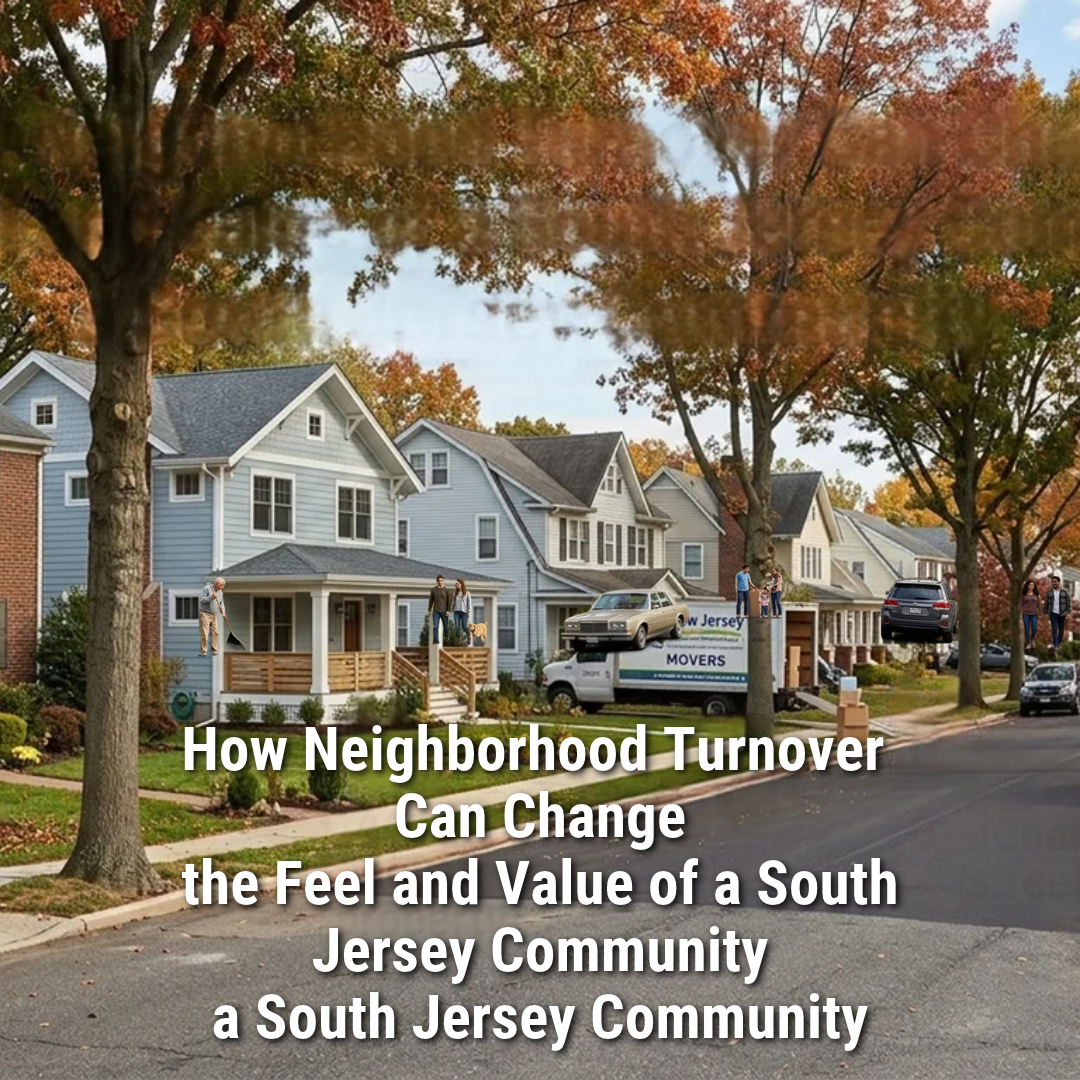
A neighborhood can look familiar for decades—and then gradually begin to change.
Homes that once belonged to longtime owners may start changing hands more frequently.
Older properties may be renovated.
New families may move in.
Some homes may be expanded, rebuilt, or completely redesigned.
Commercial areas may evolve.
And the overall personality of the community can slowly shift.
This process is often called neighborhood turnover.
It doesn't necessarily mean a neighborhood is becoming better or worse.
Instead, turnover can change the way a community looks, feels, functions, and competes for buyers.
And for South Jersey homeowners and buyers, understanding that change can provide useful context when evaluating a property's long-term potential.
As Mary Murphy of The Murphy Group explains:
“A neighborhood's value isn't just about what the homes look like today. It's also about how the community is evolving and what buyers may want from that area in the years ahead.”
🏘️ What Is Neighborhood Turnover?
Neighborhood turnover generally refers to the rate at which homes change ownership and residents move in and out of a community.
Some neighborhoods have:
- Many longtime homeowners
- Low annual sales activity
- Stable household patterns
Others may experience more frequent turnover because of:
- New construction
- Aging housing stock
- Downsizing
- Relocation
- Renovation activity
- Changing buyer demand
- New employment patterns
- Changes in nearby amenities
Turnover isn't inherently good or bad.
Its impact depends on why the turnover is occurring and what happens as homes change hands.
🔄 1. New Owners Can Change the Housing Stock
When homes change hands, new owners often make different decisions than previous owners.
One homeowner may leave a property largely unchanged.
Another may:
- Renovate the kitchen
- Update bathrooms
- Replace windows
- Improve landscaping
- Finish a basement
- Add outdoor living space
- Modernize mechanical systems
Over time, repeated improvements across multiple properties can change the physical appearance of an entire neighborhood.
🏡 2. Renovation Activity Can Raise Expectations
Imagine a street where most homes were built around the same period.
If several properties are renovated over a few years, buyers may begin expecting similar levels of:
- Modern finishes
- Updated kitchens
- Energy-efficient systems
- Finished spaces
- Improved curb appeal
That can influence how buyers perceive homes that haven't been updated.
A property's condition is always important, but the surrounding housing stock can influence the expectations buyers bring with them.
📸 3. Neighborhood Appearance Can Change Gradually
Turnover can affect more than individual homes.
New homeowners may invest in:
- Landscaping
- Exterior painting
- Fencing
- Driveways
- Lighting
- Porches
- Outdoor spaces
When these improvements occur across a street, the neighborhood can develop a noticeably different visual character.
This doesn't happen overnight.
It often happens one property at a time.
👨👩👧 4. The Household Mix Can Change
As homes change ownership, the types of households living in the neighborhood may change as well.
A community that once consisted primarily of longtime families might gradually attract:
- Younger households
- Empty nesters
- Professionals
- First-time buyers
- Multigenerational households
- Investors or landlords
The resulting change can affect how residents use shared spaces, local businesses, parks, schools, and neighborhood amenities.
🧑🤝🧑 5. Community Identity Can Evolve
Longtime residents often develop strong connections to their neighborhood.
They know:
- Their neighbors
- Local traditions
- Community routines
- Familiar businesses
- Local gathering places
As residents change, the social character of the community may evolve too.
Some traditions may remain.
Others may change.
New activities and community connections can also emerge.
Neighborhood identity isn't fixed.
It's continually shaped by the people who live there.
🏫 6. Local Amenities Can Become More Important
When a neighborhood attracts new residents, demand for nearby amenities can change.
Residents may value:
- Parks
- Restaurants
- Shopping
- Recreation
- Public transportation
- Schools
- Community facilities
- Walkable services
Changes in the surrounding population can influence what types of businesses and services are viable.
But buyers should distinguish between existing amenities and potential future development.
A proposed project isn't the same as a completed improvement.
🚗 7. Traffic and Parking Patterns Can Change
Neighborhood turnover can also affect daily logistics.
More households with multiple vehicles may increase parking pressure.
New development can change traffic patterns.
Renovations or additions can alter driveway configurations.
A neighborhood that once felt very quiet may gradually experience different levels of activity.
This doesn't automatically reduce value.
For some buyers, increased convenience and activity may be attractive.
For others, quiet streets and abundant parking may be more important.
🏗️ 8. Redevelopment Can Change the Character of a Street
Sometimes turnover involves more than individual homeowners.
Older properties may eventually be:
- Expanded
- Rebuilt
- Subdivided where legally permitted
- Replaced
- Converted
- Developed differently
When enough properties change, the physical character of a neighborhood can shift.
Buyers considering long-term ownership should pay attention to whether surrounding properties are likely to remain in their current form or whether redevelopment is already occurring.
💰 9. Turnover Can Influence Buyer Demand
A neighborhood experiencing active sales and renovation may attract attention from buyers who want:
- Established streets
- Existing infrastructure
- Larger lots
- Mature landscaping
- Character homes
- Opportunities to renovate
But turnover alone doesn't create demand.
Buyers still evaluate:
- Price
- Condition
- Location
- Taxes
- Housing costs
- Schools and amenities
- Commute
- Property features
Turnover is one factor within a much larger market.
📊 10. One Sale Doesn't Define a Neighborhood
This is important when interpreting real estate activity.
A single high sale doesn't necessarily mean every home in the neighborhood is suddenly worth more.
Likewise, one low sale doesn't necessarily establish a new market floor.
Buyers and sellers should look at:
- Multiple comparable sales
- Sale dates
- Property condition
- Renovation levels
- Lot characteristics
- Home size
- Location within the neighborhood
A neighborhood's market story is built from patterns—not isolated transactions.
🏚️ 11. Aging Housing Stock Can Accelerate Turnover
Older homes can eventually require significant investment.
As longtime owners decide to sell, new buyers may purchase properties specifically because they see opportunities to renovate.
That can create a cycle:
Older home → new buyer → renovation → updated home → new buyer expectations
Over time, this can gradually modernize the neighborhood's housing stock.
🛠️ 12. Turnover Can Reveal Which Homes Buyers Want to Improve
Not every property receives the same investment.
Some buyers may renovate extensively.
Others may make only basic improvements.
Over time, this can create a mixed neighborhood where:
- Some homes are highly updated
- Some remain largely original
- Others fall somewhere in between
That variation can create both opportunities and challenges for buyers and sellers.
🧭 13. Street-Level Location Still Matters
Neighborhood turnover doesn't affect every property equally.
A home on a:
- Quiet side street
- Corner lot
- Busy road
- Cul-de-sac
- Main neighborhood entrance
may experience a different buyer response than another home within the same broader community.
This is why ZIP codes and neighborhood names don't tell the entire story.
Micro-location matters.
🌳 14. Mature Landscaping Can Change With Turnover
Longtime neighborhoods often contain mature:
- Trees
- Gardens
- Hedges
- Shrubs
- Privacy plantings
New owners may preserve them—or replace them.
That can gradually change the visual character of the neighborhood.
In some cases, mature landscaping remains one of the community's strongest distinguishing features.
In others, homeowners may favor more modern, lower-maintenance designs.
🏠 15. Home Sizes and Additions Can Change
Turnover can also introduce different expectations about space.
New homeowners may add:
- Larger kitchens
- Family-room additions
- Garages
- Decks
- Patios
- Finished basements
- Home offices
Over time, these improvements can change the average functionality of the housing stock.
But buyers should remember that an addition's presence on one property doesn't mean a neighboring property can automatically make the same improvement.
Zoning and property-specific conditions still matter.
📈 16. Neighborhood Turnover Can Affect Resale—but Not in a Simple Formula
It's tempting to say:
“More turnover means higher values.”
That's too simplistic.
The relationship between turnover and value depends on what is driving the turnover.
For example, turnover associated with desirable renovations and strong buyer demand can create a different environment from turnover caused by widespread property deterioration or declining demand.
The quality and direction of change matter more than the turnover rate alone.
🔎 17. Buyers Can Look for Signs of Change
When evaluating a neighborhood, buyers can look for clues such as:
- Multiple homes recently sold
- Renovation activity
- New construction
- Homes being expanded
- Fresh landscaping
- Changing property conditions
- New businesses nearby
- Increased development activity
These clues don't predict exactly what will happen next.
But they can help buyers understand the neighborhood's current trajectory.
🧾 18. Public Records Can Help Tell the Story
Buyers and sellers can sometimes learn more by reviewing available public information.
Depending on the municipality and property, useful information may include:
- Property records
- Tax records
- Recent sales
- Permits
- Planning or zoning information
- Development applications
A real estate professional can help put this information into context.
For major development questions, buyers should verify information through the appropriate municipal or government source.
🏪 19. Commercial Changes Can Affect Residential Neighborhoods
Neighborhood turnover doesn't happen independently from the surrounding community.
Changes in nearby:
- Shopping
- Restaurants
- Office space
- Retail
- Industrial properties
- Transportation
can influence how residents experience an area.
Again, impact can vary.
A new restaurant may be a convenience for one buyer and a source of additional traffic for another.
The important question is how the change fits the buyer's priorities.
🧠 20. Buyers Should Ask Why Homes Are Turning Over
A high number of recent sales can mean many different things.
It could reflect:
- Normal life-stage changes
- Relocation
- Downsizing
- New construction
- Renovation opportunities
- Changing buyer preferences
- Market conditions
Buyers shouldn't automatically interpret turnover as either a positive or negative signal.
Instead, ask:
“What's causing the homes to change hands?”
That question provides much more useful information.
💵 21. Sellers Should Understand the Competitive Landscape
For sellers, neighborhood turnover can change the competitive environment.
If several nearby homes have recently been renovated, buyers may compare your property against those updated homes.
That doesn't necessarily mean you need to renovate everything.
Instead, sellers should understand:
- What buyers are seeing nearby
- Which features are becoming expected
- How their home's condition compares
- How pricing reflects those differences
- Which improvements are actually worthwhile
Sometimes presentation and strategic pricing can matter more than major renovations.
🏡 22. Turnover Can Create Opportunities for Buyers
Neighborhood change can sometimes create opportunities.
A buyer may find:
- An established neighborhood
- A property needing updates
- A larger lot than newer construction offers
- Mature trees
- Existing infrastructure
- Potential for personalization
The key is understanding the cost of bringing the property to the buyer's desired condition.
A low purchase price doesn't necessarily mean a low total cost.
🔄 23. Longtime Owners Can Also Be an Asset to a Neighborhood
Low turnover isn't necessarily a sign that a community lacks appeal.
Longtime homeowners can contribute:
- Stability
- Community knowledge
- Established relationships
- Property maintenance
- Local traditions
A neighborhood with low turnover may simply have a large number of residents who are comfortable staying.
That's why turnover should always be interpreted within context.
📍 24. The Best Way to Understand a Neighborhood Is to Experience It
Online listings can show:
- Homes
- Prices
- Photos
- Recent sales
But they can't fully communicate:
- Street activity
- Noise
- Traffic
- Neighbor interaction
- Parking patterns
- Evening atmosphere
- Weekend activity
Buyers considering long-term ownership should spend time in the neighborhood at different times of day.
📋 South Jersey Neighborhood Turnover Checklist
Before buying, consider:
Housing
- How many homes have sold recently?
- Are properties being renovated?
- Is new construction occurring?
Residents
- Does the neighborhood appear to have many longtime owners?
- Are household types changing?
Property Conditions
- Are homes generally well maintained?
- Are there many properties requiring major updates?
Development
- Are there active development or redevelopment projects?
- Are nearby commercial properties changing?
Daily Life
- How is traffic?
- What is parking like?
- How does the neighborhood feel at night?
Market
- How do recent sales compare?
- Are renovated homes attracting different prices?
- What types of properties appear to attract buyers?
Long-Term Fit
- Does the neighborhood's current direction align with your priorities?
- Would you still be comfortable there if the community changes over the next several years?
💼 How The Murphy Group Helps Buyers and Sellers Understand Neighborhood Change
At The Murphy Group, evaluating a property means looking beyond the individual house.
The team considers the broader context, including:
- Recent neighborhood sales
- Property condition
- Housing competition
- Local amenities
- Development activity
- Buyer preferences
- Micro-location
- Long-term resale considerations
“You aren't just buying a house,” Mary says. “You're buying into a neighborhood. Understanding how that neighborhood is changing can help you make a more informed decision about whether it fits your plans.”
📊 The Bottom Line
Neighborhood turnover can gradually change the feel and value of a South Jersey community.
As homes change hands, you may see:
- More renovations
- Different household patterns
- Changing property conditions
- New businesses
- Different traffic and parking patterns
- Redevelopment
- Evolving buyer expectations
But turnover itself isn't automatically positive or negative.
What matters is what is driving the change and how that change affects the qualities buyers and homeowners value.
For buyers, the goal isn't to predict the future perfectly.
It's to understand the neighborhood today, recognize the signs of change, and decide whether the community's direction fits the life you want to build there.
For sellers, understanding neighborhood turnover can provide valuable context when positioning a home against changing competition.
Because sometimes the most important thing about a property isn't changing inside the house.
It's what's changing around it.
📲 Thinking About Buying or Selling in South Jersey?
The Murphy Group helps buyers and sellers evaluate not only the home itself, but also the neighborhood characteristics, market activity, and local factors that can influence long-term value.
👉 Start here: www.mgsells.com

Mary Murphy
Team Leader | The Murphy Group | eXp Realty, LLC | PLACE
or another way