

Categories
Burlington County, Camden County, Gloucester County, Home Buying Guides, Housing Guide, New Jersey Real Estate, Real Estate Guides, South Jersey Real Estate, South Jersey neighborhoodPublished October 6, 2026
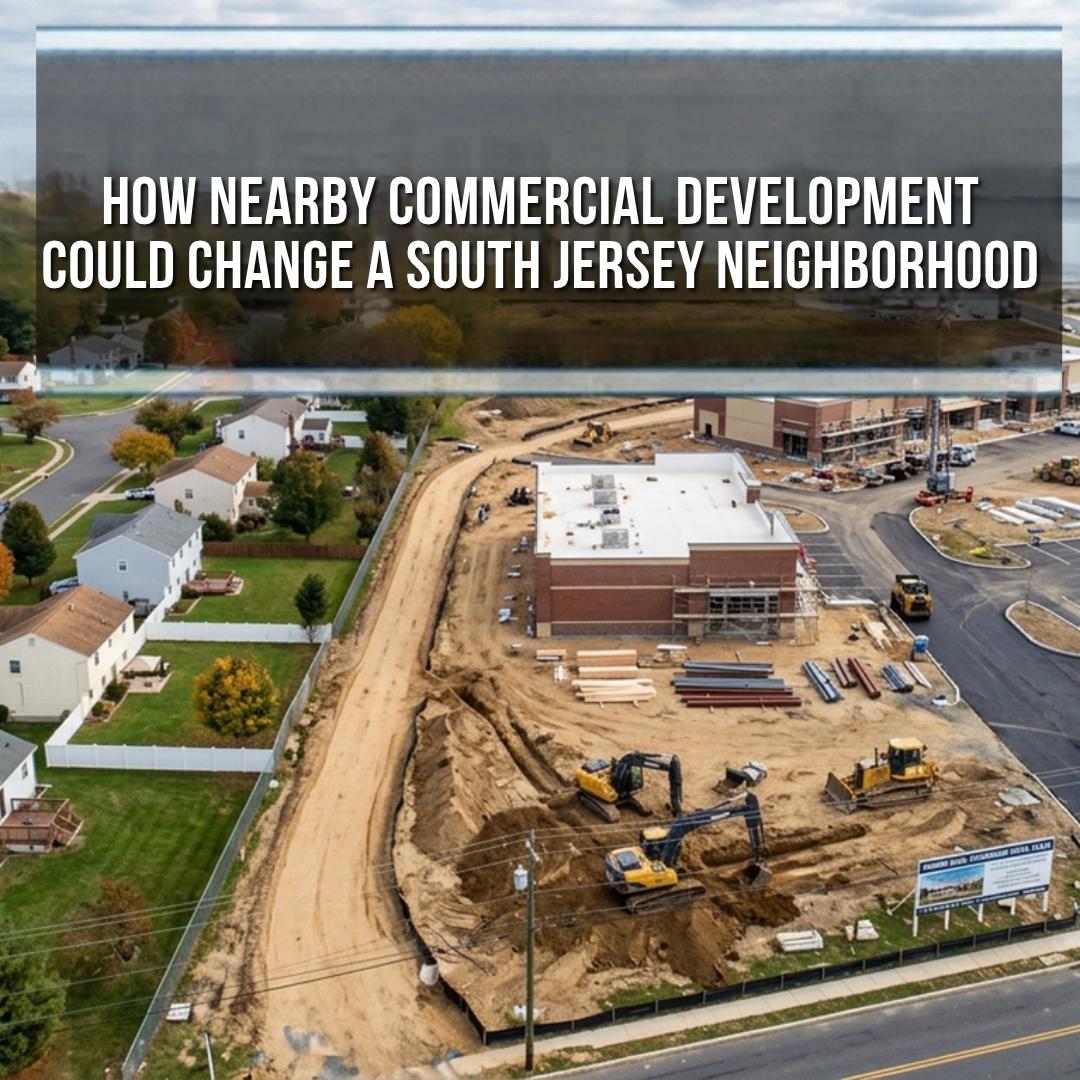
How Nearby Commercial Development Could Change a South Jersey Neighborhood

A new shopping center.
A grocery store.
A restaurant.
Office space.
A mixed-use development.
A new commercial project near a South Jersey neighborhood can change much more than the appearance of an empty parcel.
It can affect how people move through the area, where they shop, how much traffic a street receives, and how residents experience their surroundings.
For homeowners and buyers, that creates an important question:
Could nearby commercial development change the way this neighborhood feels—and potentially affect the value or appeal of the homes within it?
The answer isn't always positive or negative.
It depends on what is being developed, where it is located, how large it is, how it connects to surrounding roads, and how the community responds.
As Mary Murphy of The Murphy Group explains:
“Development isn't automatically good or bad for a neighborhood. The real question is how the project changes the experience of living there and whether those changes align with what buyers value.”
🏗️ What Counts as Commercial Development?
Commercial development can take many forms.
It might include:
- Grocery stores
- Restaurants
- Retail centers
- Medical offices
- Professional offices
- Hotels
- Mixed-use buildings
- Service businesses
- Shopping plazas
- Entertainment venues
Each type can affect a neighborhood differently.
A small neighborhood restaurant may have a very different impact from a large retail center with extensive parking and frequent vehicle traffic.
That's why buyers shouldn't evaluate a development simply by its label.
The details matter.
📍 1. Location Within the Neighborhood Matters
A commercial project a mile away may have little effect on a particular home.
A project directly behind the property could be much more noticeable.
Consider:
- Distance from the home
- Direction of the development
- Access roads
- Shared boundaries
- Existing buffers
- Elevation differences
- Whether homes back directly onto the site
The closer a project is to a property, the more important it becomes to understand its actual design.
🚗 2. Traffic May Be One of the Biggest Changes
Commercial development often brings more vehicle activity.
Depending on the project, that can mean:
- More cars
- Delivery trucks
- Employee traffic
- Customer traffic
- Turning movements
- New intersections
- Changes to existing roads
For some homeowners, increased traffic may be a drawback.
For others, improved access to nearby businesses may be worth the trade-off.
The important question is:
Where will the traffic actually go?
🛍️ 3. New Businesses Can Improve Convenience
Not every impact is negative.
A new commercial development can make everyday life easier by bringing services closer to residents.
Depending on the project, homeowners may gain easier access to:
- Grocery stores
- Restaurants
- Coffee shops
- Healthcare
- Fitness facilities
- Retail
- Professional services
Convenience can be an important part of neighborhood appeal.
A community that becomes easier to live in may attract buyers who value accessibility.
🔊 4. Noise Can Change the Residential Experience
Noise is highly dependent on the type and design of the development.
Potential sources include:
- Traffic
- Deliveries
- Outdoor dining
- Mechanical equipment
- Parking areas
- Construction
- Early-morning operations
- Evening activity
A commercial project operating during normal business hours may have a different impact from a restaurant, entertainment venue, or facility with extended hours.
Buyers should investigate operating patterns—not just the building itself.
💡 5. Lighting Can Affect Nearby Homes
Commercial properties typically require exterior lighting for safety and operations.
Depending on design and placement, lighting may affect:
- Backyard privacy
- Bedroom windows
- Nighttime views
- Street appearance
Buyers whose homes directly border a proposed development should pay attention to the project's lighting plans when available.
🚛 6. Delivery Traffic Is Easy to Overlook
Customers aren't the only vehicles associated with commercial development.
Depending on the business, there may also be:
- Delivery trucks
- Service vehicles
- Waste collection
- Employee vehicles
- Contractor traffic
The location of loading areas can matter significantly.
A project may look relatively quiet on a site plan while still creating activity at certain times of day.
🚧 7. Construction Can Affect the Neighborhood Before the Project Opens
The impact of development doesn't begin when the doors open.
Construction can bring:
- Heavy equipment
- Dust
- Noise
- Road closures
- Temporary traffic changes
- Construction workers
- Extended project timelines
For nearby homeowners, the construction period may last much longer than expected.
Buyers considering a property near an active project should understand the development timeline when possible.
🏡 8. Privacy Can Change
A vacant parcel may currently provide an open view from a backyard.
After development, that view could change.
A new commercial project may introduce:
- Buildings
- Parking areas
- Lighting
- Signage
- Increased activity
- Pedestrian traffic
That doesn't automatically reduce a property's value.
But it can change the experience of the property—and buyers should know that before purchasing.
🌳 9. Landscaping and Buffers Can Make a Major Difference
Commercial developments sometimes include landscaping, fencing, berms, or other buffers between commercial and residential uses.
These features can influence:
- Noise
- Privacy
- Visual appearance
- Lighting
- Separation between uses
A well-designed buffer can make a commercial project feel much less intrusive from nearby homes.
🛣️ 10. Road Improvements Can Create Benefits—and Trade-Offs
Development may lead to changes involving:
- Road widening
- New turn lanes
- Traffic signals
- Sidewalks
- Crosswalks
- Access points
- Intersection improvements
These changes can improve transportation and pedestrian access.
But they can also alter traffic patterns or increase activity along roads that were previously quieter.
The impact depends heavily on the project's design.
🚶 11. Walkability Could Improve
Commercial development can sometimes make a neighborhood more walkable.
If businesses are located within a reasonable walking distance and connected by sidewalks or other pedestrian infrastructure, residents may gain easier access to everyday services.
For some buyers, that can be a meaningful benefit.
But proximity alone isn't enough.
The actual pedestrian route matters.
🏘️ 12. A Neighborhood's Character Can Evolve
One of the more difficult changes to measure is neighborhood identity.
A primarily residential area may gradually become more mixed-use as development occurs nearby.
That could create:
- More activity
- Greater convenience
- More restaurants and services
- New gathering places
It could also mean:
- More traffic
- More commercial visibility
- Less quiet
- A different overall atmosphere
Whether that is positive depends on what residents and future buyers value.
📈 13. Property Values Don't All Respond the Same Way
It's tempting to assume:
“New development means property values will go up.”
Or the opposite:
“Commercial development will hurt every nearby home.”
Neither is guaranteed.
Property values can respond differently depending on:
- Type of development
- Distance from the property
- Traffic impact
- Noise
- Visual changes
- Convenience
- Neighborhood demand
- Overall market conditions
- Quality of the development
A new grocery store may be viewed differently from a large industrial or high-traffic commercial facility.
🏪 14. The Type of Business Matters
Consider how different uses may affect nearby homes.
Grocery or Retail
Potential benefits:
- Convenience
- Increased accessibility
- Nearby services
Potential concerns:
- Traffic
- Parking
- Deliveries
- Lighting
Restaurants
Potential benefits:
- Dining options
- Walkability
- Neighborhood activity
Potential concerns:
- Evening traffic
- Outdoor noise
- Deliveries
- Odors
Office Development
Potential benefits:
- Employment
- Daytime activity
- Professional services
Potential concerns:
- Commuter traffic
- Parking
- Building visibility
The same neighborhood can react differently depending on the use.
🏗️ 15. What Happens on the Property Next Door Matters
A buyer shouldn't stop at the phrase “commercial development.”
Find out:
- What is proposed?
- How large is the project?
- How many buildings?
- How much parking?
- Where are entrances?
- Where are loading areas?
- What are the operating hours?
- How tall are the buildings?
- What buffers are planned?
A site plan can reveal much more than a project name.
🗺️ 16. Maps Can Help Buyers See the Bigger Picture
Online maps and satellite imagery can help buyers understand how a proposed development fits into the surrounding area.
Look at:
- Existing roads
- Residential streets
- Commercial properties
- Vacant land
- Nearby intersections
- Parks
- Schools
- Natural features
But online maps are only a starting point.
Development plans and municipal records can provide more specific information.
📄 17. Buyers Should Research the Development Before Making an Offer
If a property is near a known development project, buyers should investigate what is actually planned.
Depending on the situation, useful sources may include:
- Municipal planning information
- Zoning information
- Planning or zoning board materials
- Public meeting agendas
- Development applications
- Approved site plans
The goal is to distinguish between:
A rumor about future development
and
A documented project moving through the approval process.
Those are very different things.
🧠 18. Don't Make a Decision Based on a Rumor
Real estate markets are full of statements like:
- “They're building a shopping center there.”
- “A new restaurant is coming.”
- “That whole area is going to be redeveloped.”
Some rumors eventually become reality.
Others never happen.
Before allowing a development rumor to influence a purchase decision, determine whether there is an actual proposal, application, approval, or construction activity.
🌎 19. Environmental and Drainage Changes Can Matter
Development can change how water moves across a site because construction may alter:
- Grading
- Impervious surfaces
- Drainage systems
- Stormwater management
- Landscaping
For buyers near major development, it can be worthwhile to understand how the project is designed to manage stormwater and how the surrounding properties may be affected.
This is especially important when the existing neighborhood already has drainage concerns.
🚘 20. Parking Can Change the Street Experience
A commercial project may provide designated parking, but the surrounding streets can still experience changes.
Potential effects include:
- More parked vehicles
- Employee parking
- Customer overflow
- Increased curb activity
For homeowners on nearby residential streets, parking patterns may matter almost as much as traffic volume.
🏡 21. Some Homes May Be More Sensitive to Development Than Others
The impact of a nearby project can vary dramatically from one home to another.
A property directly behind the development may experience changes that a home several blocks away barely notices.
Factors include:
- Lot orientation
- Backyard position
- Existing fencing
- Trees
- Elevation
- Window placement
- Distance from the project
- Access to surrounding roads
This is another reason buyers should evaluate the specific property, not just the neighborhood.
💰 22. Development Can Create Both Opportunity and Risk for Buyers
A nearby commercial project may eventually make an area more convenient and attractive.
But buyers shouldn't purchase solely because they expect future appreciation.
Likewise, they shouldn't automatically reject a home because development is nearby.
Instead, ask:
“Would I still want this home if the development is built exactly as proposed?”
That is a powerful test.
If the answer is yes, the purchase may still make sense.
If the answer is no, the development deserves much more consideration.
🔄 23. Think About Resale From the Future Buyer's Perspective
Imagine selling the home five or ten years from now.
What will the next buyer see?
Will they value:
- Nearby shopping?
- Restaurants?
- Improved roads?
- Walkability?
Or will they be concerned about:
- Traffic?
- Noise?
- Commercial visibility?
- Parking?
- Reduced privacy?
Thinking from the perspective of a future buyer can help you evaluate whether the development is likely to broaden or narrow the property's appeal.
📋 A Commercial Development Due-Diligence Checklist
Before buying a home near planned or active commercial development, consider researching:
The Project
- What is being built?
- How large is it?
- What businesses are proposed?
- What are the operating hours?
Traffic
- Where will vehicles enter and exit?
- Are roads being modified?
- Will delivery traffic increase?
Privacy
- Will the project be visible?
- Are buffers planned?
- Could lighting affect the property?
Noise
- What activities will occur?
- Will there be evening or early-morning operations?
Environment
- How will stormwater be managed?
- Will grading change?
Timeline
- Is the project proposed, approved, or under construction?
- When could construction begin?
- How long might it last?
Resale
- How might future buyers perceive the location?
💼 How The Murphy Group Helps Buyers Evaluate Neighborhood Changes
At The Murphy Group, location analysis goes beyond today's surroundings.
When buyers are considering a property near development, the conversation can include:
- Current neighborhood conditions
- Proposed projects
- Traffic and access
- Property positioning
- Future resale considerations
- Buyer lifestyle priorities
Mary Murphy explains:
“You can't predict every change a neighborhood will experience, but you can make a better decision when you understand what is actually planned and how it could affect the property.”
📊 The Bottom Line
Nearby commercial development can change a South Jersey neighborhood in many ways.
It can potentially bring:
- Greater convenience
- New businesses
- Better access
- More walkability
- New services
- Improved infrastructure
It can also introduce:
- Traffic
- Noise
- Construction
- Parking pressure
- Reduced privacy
- More activity
The impact depends on the type, size, location, design, and surrounding infrastructure of the development.
That's why buyers shouldn't simply ask:
“Is there development nearby?”
They should ask:
“What exactly is being developed, how will it affect this property, and would I still love this home after the project is completed?”
That question can turn a vague concern into useful due diligence.
📲 Thinking About Buying Near Development in South Jersey?
The Murphy Group helps buyers look beyond the current listing and understand the neighborhood, property, and potential changes that could influence a home's long-term appeal.
👉 Start here: www.mgsells.com

Mary Murphy
Team Leader | The Murphy Group | eXp Realty, LLC | PLACE
or another way