

Categories
Burlington County, Camden County, Gloucester County, Home Buying Guides, Home Buying Tips, Housing Guide, New Jersey Real Estate, NJ Housing, Real Estate Guides, South Jersey Real Estate, South Jersey Market Trends, South Jersey Buyer InsightsPublished October 5, 2026
Why the Street You Live On Can Matter as Much as the Town You Choose in South Jersey

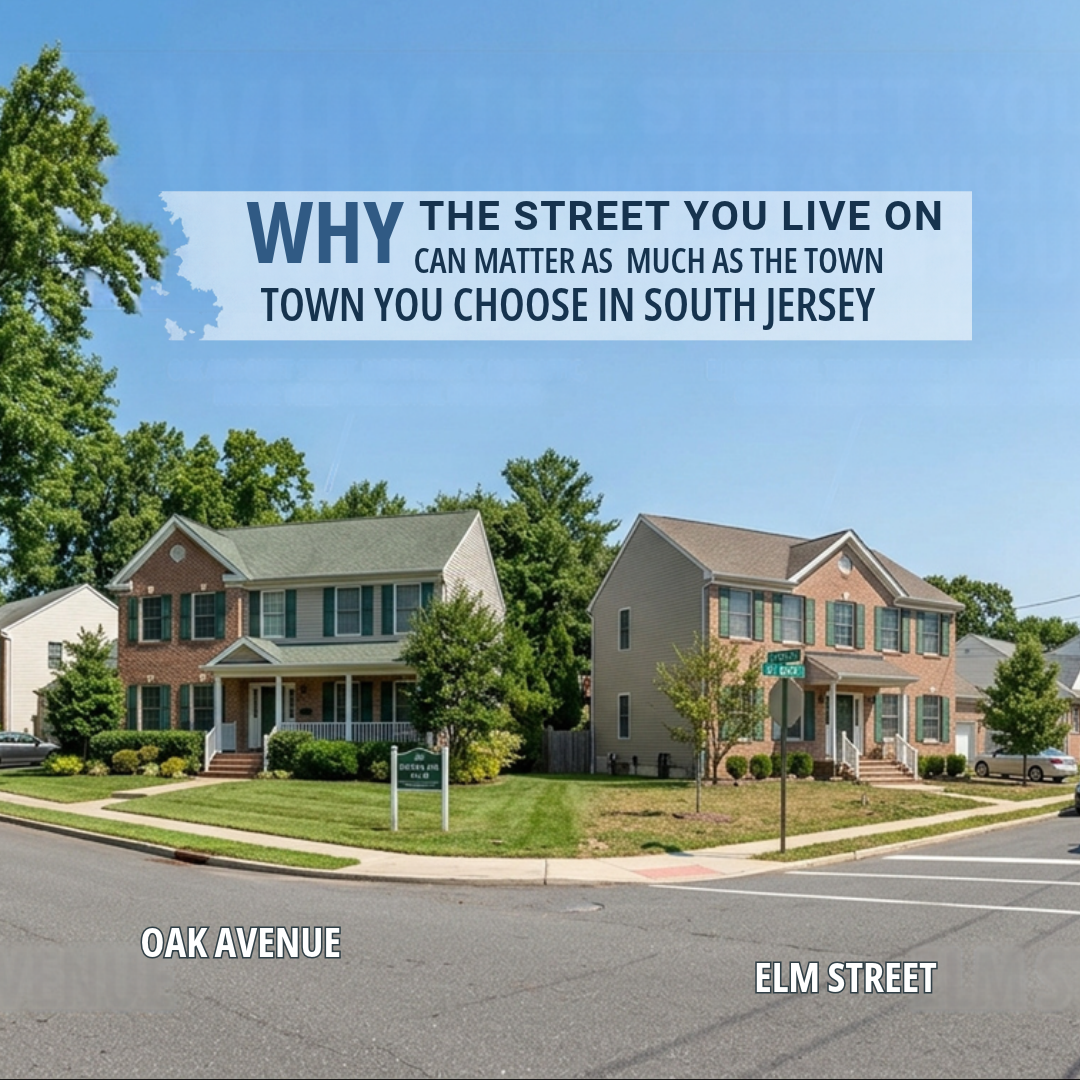
When buyers search for a home in South Jersey, they often start with the same question:
“Which town do we want to live in?”
That matters—but it may only be the beginning.
Two homes can be located in the same town, share the same school district, and even have similar prices, yet feel completely different once you arrive.
Why?
Because the street itself can change the experience of living there.
Traffic patterns.
Parking.
Noise.
Privacy.
Lot placement.
Nearby homes.
Sidewalks.
Access to major roads.
Even what happens at the end of the block.
As Mary Murphy of The Murphy Group explains:
“Buyers often start their search by choosing a town, but the street is where they actually experience the home every day. That smaller piece of the location deserves just as much attention.”
📍 Town vs. Street: What's the Difference?
A town gives buyers a broad picture.
It can tell you about:
- General location
- Schools and municipal services
- Major roads
- Shopping and restaurants
- Parks and recreation
- Overall housing market
- Property taxes and other community-level factors
But the street tells you what your daily environment may actually feel like.
A home on a quiet residential street can provide a very different experience from a similar home a few blocks away on a heavily traveled road.
That's why buyers should evaluate both levels of location.
Town = the broader environment.
Street = the day-to-day experience.
🚗 1. Traffic Can Change the Feel of a Neighborhood
A street may look quiet during one showing and completely different during another part of the day.
Traffic can vary based on:
- Morning commuting
- School drop-off and pickup
- Afternoon rush hour
- Weekend activity
- Nearby businesses
- Cut-through traffic
A road that seems peaceful at 11 a.m. may be considerably busier at 5 p.m.
For buyers, this makes timing important.
Visit the property more than once when possible—and consider seeing it during the hours when you would normally be coming and going.
🔊 2. Noise Is a Street-Level Issue
Noise isn't always something buyers can understand from an online listing.
A home's noise environment can be affected by:
- Traffic
- Nearby intersections
- Commercial activity
- Trains
- Emergency vehicle routes
- Neighboring properties
- Outdoor recreation
- Construction
Even within the same town, one street may be noticeably quieter than another.
That's why buyers shouldn't assume that the entire town has the same noise profile.
🏡 3. The Position of the Home on the Street Matters
Even on an attractive residential road, one property may have a different experience depending on where it sits.
Consider whether the home is:
- Near a corner
- Across from an entrance or intersection
- Near a stop sign
- Adjacent to an open lot
- Near a commercial property
- At the end of a cul-de-sac
- Along a heavily traveled section
These factors can influence traffic, privacy, parking, and overall activity around the property.
🚘 4. Parking Can Become a Daily Quality-of-Life Issue
Parking is easy to overlook during a short showing.
But after living in a home for years, it can become one of the details you notice every day.
Ask:
- Is there a driveway?
- How many vehicles can it accommodate?
- Is street parking common?
- Are there restrictions?
- Do neighbors regularly park along the street?
- Is parking difficult during evenings or weekends?
A home with excellent interior features can still create frustration if parking doesn't work for the household.
🌳 5. Privacy Can Vary From One Block to the Next
Privacy isn't determined solely by lot size.
It can also depend on:
- Home spacing
- Lot orientation
- Mature trees
- Fencing
- Neighboring structures
- Backyard positioning
- Street visibility
Two properties with similar square footage can provide very different levels of privacy.
For buyers who value quiet outdoor space, this can be especially important.
☀️ 6. Light and Street Orientation Can Affect Daily Living
The position of a home relative to the street, neighboring properties, and surrounding trees can affect how much natural light reaches different areas of the property.
Look beyond the listing photographs.
During a showing, consider:
- Which rooms receive morning light?
- Which areas get afternoon sun?
- Do neighboring homes block portions of the yard?
- Are mature trees shading the property?
- How does the outdoor space feel at different times of day?
These details may not appear in a listing description but can significantly affect how the property feels.
🛣️ 7. Convenience Can Be Great—Until It Becomes Too Much
Being close to a major road can be convenient.
It may make commuting, shopping, or accessing nearby communities easier.
But proximity can also bring:
- More traffic
- More noise
- More headlights
- More congestion
- Greater pedestrian or vehicle activity
The key isn't automatically deciding that proximity is good or bad.
It's determining whether the trade-off works for your lifestyle.
🗺️ 8. Use Maps to Understand the Block
Online maps can help buyers investigate a property before making an offer.
Look at:
- Nearby roads
- Intersections
- Commercial properties
- Parks
- Rail lines
- Schools
- Shopping areas
- Open land
- Other neighborhood connections
Satellite imagery can also provide useful context about:
- Lot size and shape
- Backyard positioning
- Neighboring homes
- Parking arrangements
- Trees and outdoor structures
The goal isn't to make a decision based solely on a map.
It's to identify questions worth investigating in person.
🏘️ 9. Neighboring Properties Matter
You aren't buying only the house.
You're also buying into the environment immediately surrounding it.
Look at the properties next door and across the street.
Consider:
- Property maintenance
- Home spacing
- Fences
- Driveways
- Outdoor structures
- Landscaping
- Commercial uses
- Future development potential
One property's surroundings can influence how another property is perceived.
🚶 10. Walkability Is Often Block-Specific
A town may advertise itself as convenient or walkable, but the actual experience can vary considerably by street.
Ask:
- Are sidewalks nearby?
- Can you safely walk to parks or stores?
- Are crossings convenient?
- Is there a steep hill or busy road between the home and destination?
- Do you feel comfortable walking the route?
A destination that appears close on a map isn't necessarily convenient on foot.
🏫 11. School Proximity Is Different From School Assignment
Buyers sometimes combine two separate questions:
“Which school district is this home in?”
and
“How close is the home to the school?”
They aren't the same.
A home can have a particular school assignment while being located relatively close to or far from the relevant school.
Buyers should verify current school assignments and transportation information rather than relying solely on assumptions based on the town or neighborhood name.
🏗️ 12. Look at What Could Change Around the Street
A quiet street today may not look exactly the same years from now.
Buyers should consider whether there are:
- Vacant parcels
- Major development proposals
- Road projects
- Commercial redevelopment
- New housing nearby
- Infrastructure changes
Not every proposed project will happen, and plans can change.
Still, understanding what is happening around a property can provide valuable context before making a long-term purchase.
🌧️ 13. Drainage and Topography Can Be Highly Local
Environmental conditions can vary significantly even between nearby properties.
Pay attention to:
- Low-lying areas
- Yard grading
- Water flow
- Drainage structures
- Basement moisture
- Nearby streams or waterways
- How neighboring properties handle stormwater
A town-wide reputation doesn't tell you everything about one specific property.
The actual lot and surrounding street deserve individual evaluation.
🏠 14. Street Character Can Influence Resale Appeal
When it eventually comes time to sell, buyers won't just evaluate the house.
They'll evaluate the location surrounding it.
A property's resale appeal can be influenced by factors such as:
- Street traffic
- Parking
- Privacy
- Home spacing
- Noise
- Curb appeal
- Convenience
- Overall neighborhood environment
These characteristics don't guarantee a particular future sale price, but they can shape the pool of buyers who find the property attractive.
💰 15. The Same Town Can Contain Very Different Value Stories
One of the biggest mistakes buyers can make is assuming:
“Homes in this town should all be worth roughly the same.”
They aren't.
Within a single municipality, properties can differ substantially because of:
- Lot size
- Street location
- Property condition
- Home design
- Traffic exposure
- Privacy
- Parking
- Renovations
- Proximity to amenities
- Surrounding development
This is why comparable properties should be evaluated carefully.
A nearby sale isn't automatically a perfect comparable simply because it shares the same town.
🧠 16. The Street Can Shape Your Emotional Reaction
There is also a less measurable component.
You may arrive at a property and immediately think:
“I could see myself living here.”
Or you may feel the opposite.
Sometimes that reaction comes from the house.
Sometimes it comes from the street.
The sounds.
The pace.
The spacing between homes.
The amount of activity.
The feeling of arriving home.
That emotional response shouldn't replace due diligence—but it is part of how buyers experience a property.
🔍 What Buyers Should Check Before Making an Offer
Before committing to a home, consider creating a simple street-level checklist:
🚗 Traffic
- How busy is the street?
- Does traffic change during the day?
🔊 Noise
- What can you hear from inside and outside?
🚘 Parking
- Is the driveway sufficient?
- Is street parking reliable?
🌳 Privacy
- How close are neighboring homes?
- Is the backyard exposed?
🗺️ Surroundings
- What businesses, roads, parks, or infrastructure are nearby?
🏗️ Future Changes
- Are there known development or infrastructure plans worth researching?
🌧️ Drainage
- How does water move through the property and surrounding area?
🏡 Resale
- Would another buyer likely appreciate the same street characteristics?
🕐 Visit the Street at Different Times
One of the simplest ways to understand a property's micro-location is to visit more than once.
Try:
- Morning
- Afternoon
- Evening
- Weekday
- Weekend
You may notice differences in:
- Traffic
- Parking
- Noise
- Lighting
- Neighborhood activity
- Privacy
A five-minute showing provides only one snapshot.
Living in a home means experiencing the location repeatedly.
💼 How The Murphy Group Helps Buyers Look Beyond the Town
At The Murphy Group, evaluating a home means looking beyond the basic town or ZIP code.
The process can include examining:
- Street-level characteristics
- Property positioning
- Surrounding homes
- Traffic and access
- Neighborhood context
- Comparable properties
- Potential resale considerations
- Buyer lifestyle priorities
Mary Murphy puts it simply:
“The right home isn't just in the right town. It needs to be in the right setting for the way you actually live.”
That broader perspective can help buyers ask better questions before making a major financial commitment.
📊 The Bottom Line
Choosing a South Jersey town is important.
But don't stop there.
The specific street can influence:
- Noise
- Traffic
- Parking
- Privacy
- Convenience
- Natural light
- Neighborhood feel
- Outdoor enjoyment
- Resale appeal
Two homes in the same town can offer completely different living experiences.
That's why smart homebuyers evaluate the town, neighborhood, block, street, and individual property—not just the address on the listing.
Because when you're buying a home, you're not simply choosing a house.
You're choosing the place you'll come home to every day.
📲 Thinking About Buying in South Jersey?
The Murphy Group helps buyers evaluate homes from more than just the listing price—including location, neighborhood context, property characteristics, and long-term considerations.
👉 Start here: www.mgsells.com

Mary Murphy
Team Leader | The Murphy Group | eXp Realty, LLC | PLACE
or another way