

Categories
Burlington County, Camden County, Gloucester County, Home Buying Tips, Home Buying Guides, New Jersey Real Estate, Real Estate Guides, South Jersey Real Estate, South Jersey Market TrendsPublished September 21, 2026
Why Shared Driveways Can Create Unexpected Problems for South Jersey Homebuyers

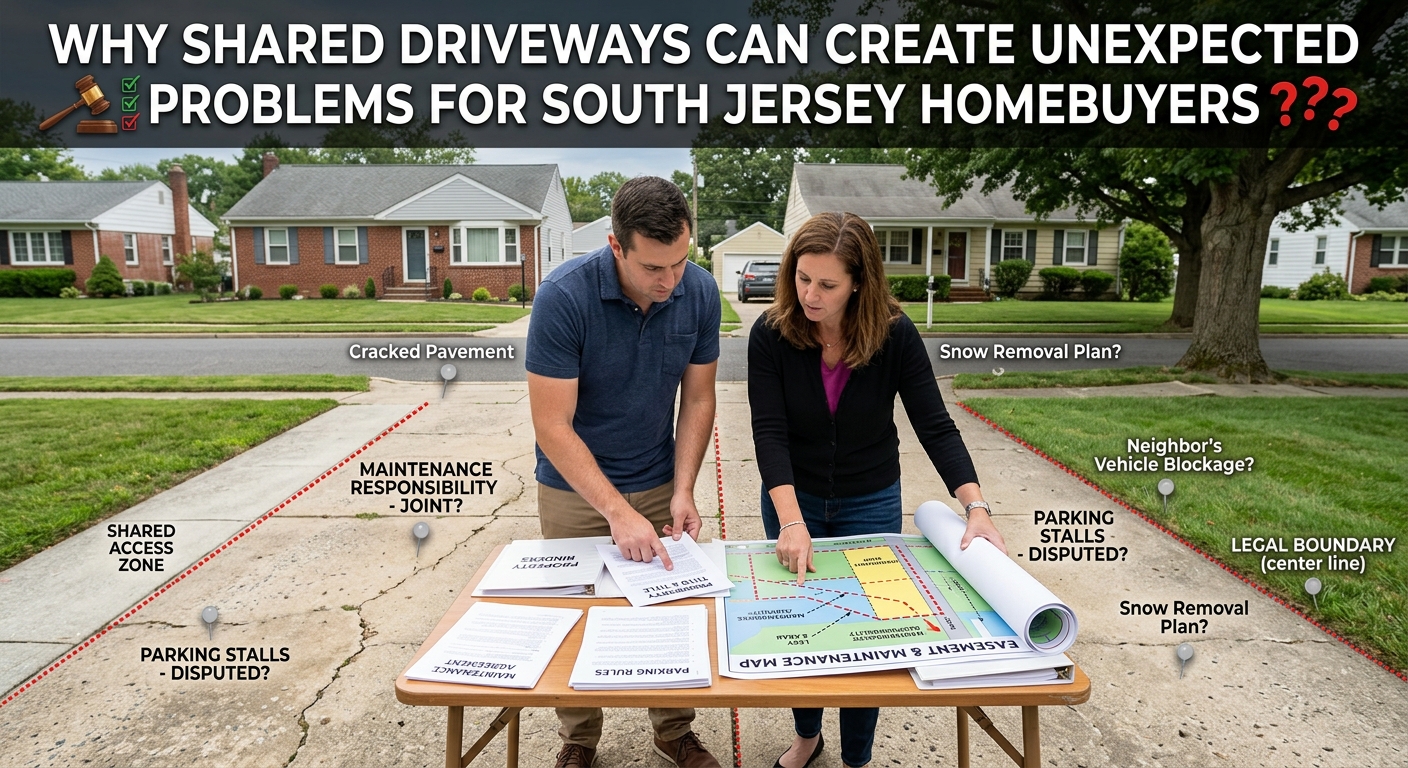
A shared driveway may look like a minor detail when you're touring a South Jersey home.
You pull into the driveway.
You see the house.
Everything appears normal.
Then you discover:
The driveway isn't entirely yours.
Maybe a neighbor uses the same entrance. Maybe part of the driveway crosses another property. Maybe your property has an easement allowing access over land owned by someone else.
Suddenly, questions start appearing:
- Who is responsible for repairs?
- Who pays when the driveway needs resurfacing?
- Can your neighbor park there?
- Can you widen or change the driveway?
- What happens if the other owner refuses to cooperate?
- What exactly does your deed or easement allow?
These aren't necessarily reasons to walk away from a property.
But they are reasons to understand the arrangement before closing.
New Jersey property records and easement documents can establish rights involving access, maintenance, and use of land. NJDOT's right-of-way guidance, for example, specifically recognizes that access and maintenance rights may need to be spelled out in easement language rather than assumed.
As Mary Murphy of The Murphy Group explains:
“A shared driveway isn't automatically a problem. The important thing is making sure buyers understand who has the right to use it, who maintains it, and what the documents actually say before they purchase the property.”
🚗 What Is a Shared Driveway?
A shared driveway is an access route used by two or more properties.
The ownership arrangement can vary.
For example:
Scenario 1: One Owner Owns the Driveway
One property owner may own the land underneath the driveway while another property has an easement allowing access.
Scenario 2: The Driveway Crosses Multiple Parcels
The driveway may physically extend across property boundaries, with each owner holding rights to portions of the access route.
Scenario 3: Multiple Properties Share Access
Several homes may depend on the same private driveway for access to their properties.
Scenario 4: The Ownership Is More Complicated Than It Appears
The driveway may involve easements, rights-of-way, old deeds, recorded agreements, or other title documents.
That is why buyers shouldn't determine ownership simply by looking at the pavement.
The legal description matters more than the appearance.
🧾 1. The First Question: Who Actually Owns the Driveway?
One of the easiest mistakes is assuming:
“I use it, so I own it.”
That isn't necessarily true.
A driveway can be physically connected to a property while the underlying land belongs partly or entirely to another owner.
Before closing, buyers should understand:
- Where the property boundary is
- Who owns the driveway
- Whether the buyer has an easement
- Whether another property has an easement
- Where the easement begins and ends
- What rights the easement provides
A survey and title review can help clarify these relationships.
New Jersey survey standards recognize the importance of identifying easements and rights-of-way affecting property interests.
📜 2. An Easement Can Give You Rights Without Giving You Ownership
This distinction is extremely important.
An easement generally gives someone a legal right to use another person's property for a specified purpose.
For a driveway, that purpose may involve access to and from a property.
So a buyer might own the house and surrounding land but still rely on an easement over another parcel to reach the public road.
That can work perfectly well.
But the exact terms matter.
A buyer should understand whether the recorded easement addresses:
- Access
- Maintenance
- Repairs
- Reconstruction
- Parking
- Obstructions
- Utilities
- Snow removal
- Other permitted uses
The existence of an easement doesn't automatically tell you everything about how the driveway is supposed to be used.
Read the actual document.
🛠️ 3. Who Pays When the Driveway Needs Repairs?
This is one of the biggest practical questions.
Driveways don't last forever.
Eventually there may be:
- Cracks
- Potholes
- Drainage problems
- Asphalt deterioration
- Concrete damage
- Edge erosion
- Snow and ice damage
If several properties use the driveway, the next question becomes:
Who pays?
Sometimes a recorded agreement specifically addresses maintenance responsibilities.
Sometimes the arrangement is less clear.
And sometimes neighbors have simply operated under an informal understanding for years.
That's where buyers need to be careful.
A friendly verbal arrangement may work until someone disagrees.
NJDOT's right-of-way guidance illustrates an important general principle: maintenance responsibilities should be specifically addressed when they are intended to be part of an easement or right.
For a private residential transaction, the buyer's attorney should review the actual recorded documents and advise on what they mean.
❄️ 4. Snow Removal Can Become a Bigger Issue Than Expected
South Jersey winters may not be predictable, but snow and ice are still part of homeownership.
With a private shared driveway, buyers should ask:
Who clears it?
And:
Who pays for it?
Possible arrangements include:
- One homeowner handles it
- Owners split the cost
- A property owner contracts with a snow-removal company
- The responsibility is addressed in a recorded agreement
- Neighbors informally coordinate
The important thing is knowing the arrangement before you move in.
You don't want your first snowstorm to become the first disagreement with a neighbor.
🚘 5. Parking Can Become a Source of Conflict
A driveway may be shared for access—but that doesn't necessarily mean everyone can park wherever they want.
Consider a narrow shared driveway.
One neighbor leaves a vehicle near the entrance.
Another homeowner needs to get out.
Suddenly, what seemed like a simple driveway becomes a daily negotiation.
Buyers should determine whether the documents or established rules address:
- Parking
- Blocking access
- Guest vehicles
- Deliveries
- Temporary storage
- Vehicle turnaround areas
Access and parking are not automatically the same thing.
📏 6. Can You Widen or Change the Driveway?
Imagine buying a home and deciding:
“I'd like to make the driveway wider.”
That may sound simple.
But if another property owner has rights involving the driveway—or if part of the driveway sits on another parcel—you may not have unlimited freedom to modify it.
Potential changes could involve:
- Widening
- Repaving
- Relocating
- Adding drainage
- Installing gates
- Adding landscaping
- Changing the entrance
- Installing fencing
Depending on the circumstances, those changes could affect another owner's access rights.
Before making improvements, homeowners should determine what the recorded documents allow and whether municipal approval is required.
🌧️ 7. Drainage Problems Can Affect Everyone
Driveways aren't just about vehicles.
They're also part of how water moves across a property.
A change to the driveway can affect:
- Stormwater runoff
- Yard drainage
- Neighboring property
- Erosion
- Standing water
- Basement moisture
If one owner repaves or changes the slope, another property may experience drainage problems.
This is another reason shared-driveway improvements should not be treated as purely cosmetic projects.
🏠 8. The Driveway May Be Part of Your Property's Access—but Not Its Ownership
Here's a scenario buyers sometimes overlook:
The house may have no direct frontage on the public street.
Instead, the property depends on a private access route across another parcel.
That access right can be extremely important.
Without the appropriate legal access, the practical value of the property could be very different from what a buyer assumes.
That's why title and easement review matters.
NJDEP survey guidance specifically recognizes the need to identify easements and rights-of-way affecting parcels and their location or extent.
🔍 9. A Property Survey Can Reveal What Photos Can't
Listing photos show the house.
They don't necessarily show the legal relationship between:
- The driveway
- The property line
- Neighboring parcels
- Easements
- Fences
- Encroachments
- Access routes
A survey can provide a much clearer picture of the physical relationship between the property and surrounding land.
For a property with an unusual driveway arrangement, buyers should discuss with their attorney and surveyor whether an updated survey is appropriate for the transaction.
🧑⚖️ 10. Title Review Is Especially Important
A title search can uncover recorded documents affecting a property.
Depending on the property, that may include:
- Easements
- Rights-of-way
- Restrictions
- Covenants
- Prior agreements
- Other recorded interests
The key is not simply discovering that an easement exists.
It's understanding what it allows and what it requires.
A buyer may be surprised to learn that the property comes with responsibilities as well as rights.
🤝 11. The Neighbor Relationship Can Matter
Shared-driveway ownership isn't only a legal issue.
It's also a practical one.
You're potentially sharing part of your daily access with another property owner.
That means disagreements can arise over:
- Repairs
- Snow removal
- Landscaping
- Parking
- Guests
- Delivery vehicles
- Drainage
- Construction
- Driveway appearance
Most shared-driveway relationships may operate without serious conflict.
But buyers should understand the arrangement rather than assuming everyone will always agree.
💰 12. Shared Driveways Can Affect Future Buyers
Think beyond the day you purchase the property.
Eventually, you may sell.
A future buyer may ask the same questions you're asking today:
- Who owns the driveway?
- Is there an easement?
- Who maintains it?
- Are there shared expenses?
- Are there restrictions?
- Has there ever been a dispute?
If the documentation is clear, those questions may be easier to answer.
If the arrangement is informal or poorly documented, the uncertainty can become part of the next buyer's decision.
🏦 13. Financing and Insurance Questions Should Be Addressed Early
A shared driveway doesn't automatically create a financing or insurance problem.
But unusual access arrangements can create additional questions during a transaction.
Buyers should not wait until the last minute to discover that a lender, title company, or insurer needs additional documentation.
New Jersey's standard residential contract materials also emphasize that buyers should obtain appropriate casualty and liability insurance and that insurance should be in place by closing when required by the lender.
If access to the property depends on a private easement, buyers should make sure the relevant documents are understood and that any insurance or lender questions are addressed early.
📄 14. Don't Rely on “Everyone Has Always Done It This Way”
This is one of the most important lessons for buyers.
A seller might say:
“We've never had a problem.”
A neighbor might say:
“We've always shared the driveway.”
Those statements may be useful background.
But they aren't a substitute for reviewing the legal documents.
The better question is:
“What does the recorded agreement actually say?”
If there is a conflict between an informal understanding and the written property rights, the buyer needs professional legal guidance to understand the situation.
🚨 15. Watch for Signs of an Existing Dispute
Buyers should pay attention to clues that the driveway arrangement may already be contentious.
For example:
- Multiple signs about parking
- Fences placed unusually close to the driveway
- Gates or barriers
- Different paving materials
- Visible damage
- Neighbors discussing access
- Unusual driveway configurations
- Seller reluctance to explain the arrangement
None of these automatically means there's a legal dispute.
But they can justify asking more questions.
🏡 16. What Buyers Should Ask Before Making an Offer
If a South Jersey home has a shared driveway, consider asking:
Ownership
- Who owns the driveway?
- Where are the property boundaries?
Access
- What properties have access rights?
- Is the access recorded?
Maintenance
- Who repairs the driveway?
- How are expenses divided?
- Who handles snow removal?
Use
- Can anyone park there?
- Are there restrictions on guests or deliveries?
- Can the driveway be modified?
Documentation
- Is there a recorded easement?
- Is there a maintenance agreement?
- Are there other recorded restrictions?
History
- Have there been disputes?
- Has the driveway recently been repaired?
- Are there planned improvements?
These questions can reveal issues before they become expensive surprises.
🔎 17. What Buyers Should Review During Due Diligence
Once you're seriously considering the property, your due-diligence process may include reviewing:
- Deed
- Title commitment
- Recorded easements
- Rights-of-way
- Survey
- Property disclosure
- Existing maintenance agreements
- Municipal records where relevant
- Any available documentation concerning the driveway
The exact documents and review process will depend on the property.
Your New Jersey real estate attorney and title professionals can explain the legal significance of the documents affecting your specific purchase.
⚠️ 18. A Shared Driveway Isn't Automatically a Dealbreaker
This distinction matters.
Many properties function perfectly well with shared access.
A shared driveway can be completely manageable when:
- Rights are clearly documented
- Responsibilities are understood
- Maintenance expectations are reasonable
- Access is adequate
- Neighbor relationships are workable
The problem isn't necessarily sharing.
The problem is uncertainty.
A buyer should know what they're agreeing to before taking ownership.
🧠 19. Why These Issues Are Easy to Miss During a Showing
Buyers naturally focus on the house:
- Kitchen
- Bedrooms
- Bathrooms
- Basement
- Yard
- Garage
The driveway may receive only a few seconds of attention.
But the driveway is part of how you access the property every single day.
That's why buyers should look beyond the interior.
Ask yourself:
“How does this property actually connect to the public road?”
That simple question can uncover a much more important conversation.
📋 The South Jersey Shared Driveway Checklist
Before closing on a property with shared driveway access, buyers should understand:
🚗 Access
- Who can use the driveway?
- Is access legally recorded?
- Is the access route adequate for daily use?
📜 Documents
- Is there an easement?
- What does it permit?
- Are there restrictions?
🛠️ Maintenance
- Who pays for repairs?
- Who handles snow?
- Who is responsible for resurfacing?
🅿️ Parking
- Where can vehicles park?
- Can guests use the driveway?
- Can someone block access?
🏡 Improvements
- Can the driveway be repaved?
- Can it be widened?
- Are gates or fences permitted?
⚖️ Legal and Financial
- Has the title company identified any concerns?
- Has your attorney reviewed the easement?
- Does your lender need additional documentation?
- Does your insurance provider have any questions?
If you can't answer these questions, it's worth investigating before closing.
💼 How The Murphy Group Helps Buyers Navigate Properties With Shared Driveways
At The Murphy Group, the goal is not simply to help buyers find a house they love.
It's to help them understand the property they're actually purchasing.
When a home has a shared driveway or unusual access arrangement, that means encouraging buyers to ask the right questions early.
That can include:
- Identifying potential access concerns
- Reviewing available property information
- Encouraging appropriate title and survey review
- Helping buyers recognize questions to raise with their attorney
- Keeping unusual property details from becoming last-minute surprises
“The driveway may seem like a small part of the property,” Mary says. “But if it affects how you enter, maintain, and use your home, it's worth understanding before you close.”
📊 The Bottom Line
A shared driveway isn't automatically a problem.
But it can create unexpected questions about:
- Ownership
- Easements
- Access
- Maintenance
- Snow removal
- Parking
- Repairs
- Drainage
- Improvements
- Neighbor responsibilities
- Future resale
The most important lesson for South Jersey homebuyers is simple:
Don't judge a shared driveway by what you can see. Understand the legal and practical arrangement behind it.
Before closing, make sure you know:
Who can use it.
Who owns it.
Who maintains it.
Who pays for it.
And what you're actually allowed to do with it.
A few questions during due diligence can prevent years of confusion later.
📲 Buying a South Jersey Home With a Shared Driveway?
The Murphy Group helps South Jersey buyers look beyond the obvious details of a property and identify the questions worth asking before moving forward.
👉 Start here: www.mgsells.com

Mary Murphy
Team Leader | The Murphy Group | eXp Realty, LLC | PLACE
or another way