

Categories
Burlington County, Camden County, Gloucester County, South Jersey Real Estate, Real Estate Guides, NJ Housing, NJ InspectionPublished November 9, 2026
What Sellers Should Know Before Converting a Bedroom Into a Home Office

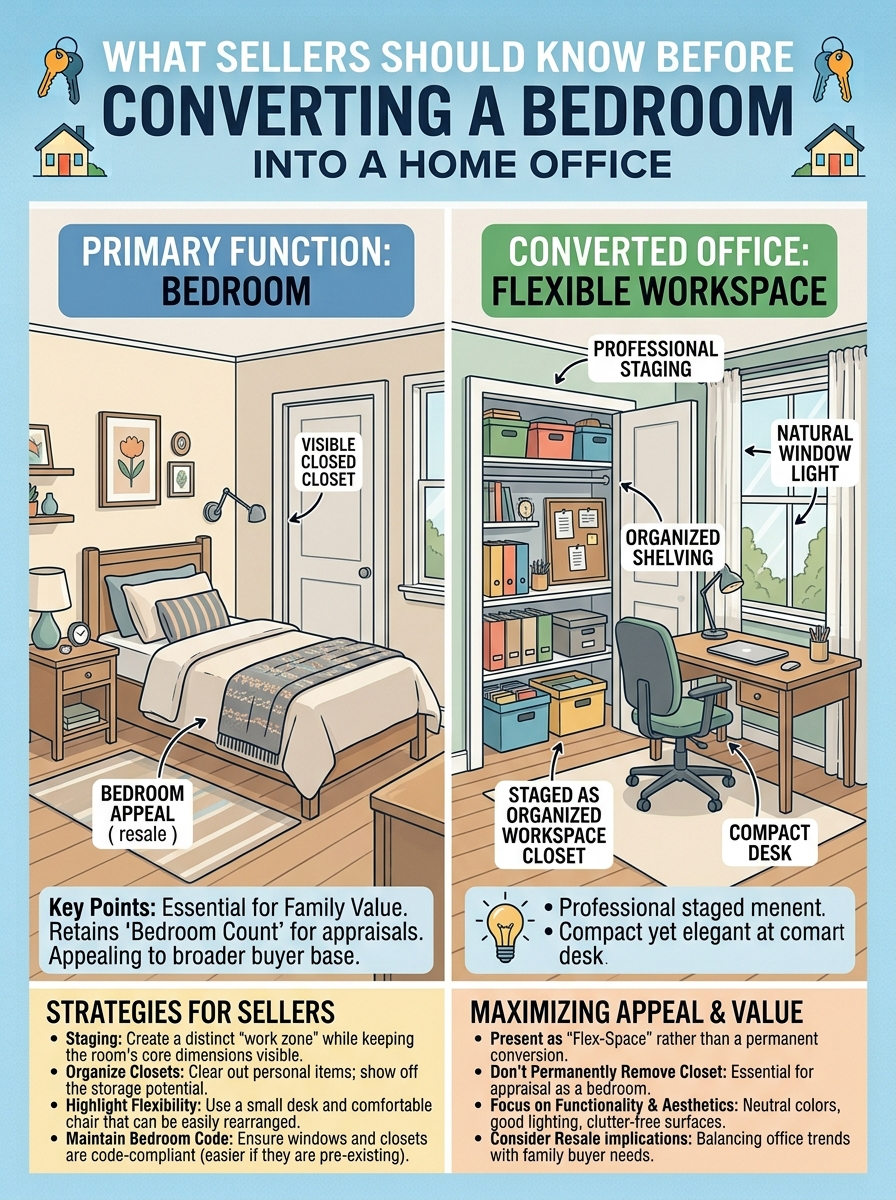
As remote and hybrid work continue to influence how people use their homes, a dedicated home office has become an attractive feature for many buyers.
For homeowners preparing to sell in South Jersey, converting an extra bedroom into a workspace may seem like a practical way to make the property more appealing.
A thoughtfully designed office can help buyers imagine working from home, managing daily responsibilities, and enjoying a more organized lifestyle.
But there's one important consideration sellers should not overlook:
A bedroom converted into an office may change how buyers perceive the home's available sleeping space.
A property advertised with four bedrooms may attract a different audience than one presented with three bedrooms and a dedicated office.
As Mary Murphy of The Murphy Group explains:
"A home office can be a wonderful selling feature, but sellers need to think about how buyers will evaluate the space. The goal is to highlight flexibility without making the home feel like it has lost an important bedroom."
Before making permanent changes, here's what South Jersey homeowners should consider.
🏡 1. Understand How Buyers View a Bedroom Versus a Home Office
Bedrooms and home offices serve different purposes, even when they occupy the same physical space.
A bedroom offers flexibility for:
- Children
- Overnight guests
- Multigenerational households
- Additional sleeping arrangements
- Future household needs
A home office, on the other hand, appeals to buyers who need a dedicated place for:
- Remote work
- Video meetings
- Business administration
- Studying
- Personal projects
The challenge is that converting a bedroom into a permanent office may make some buyers question whether the home still offers enough sleeping space.
For example, a family searching for a four-bedroom home may be less interested in a property that appears to have only three bedrooms and a dedicated workspace.
Other buyers may appreciate the office but still want the option to use the room as a bedroom.
The best strategy is often to present the room in a way that communicates both possibilities.
📊 2. Consider Whether the Conversion Could Affect the Advertised Bedroom Count
One of the most important issues is how the room is represented in the listing.
A room does not necessarily stop being a bedroom simply because the owner places a desk, office chair, and bookshelves inside it.
However, whether a space qualifies as a bedroom can depend on applicable building-code requirements, property characteristics, and how the listing is represented.
Relevant considerations may include:
- Room dimensions
- Ceiling height
- Emergency escape and rescue openings, where required
- Light and ventilation requirements
- Access and layout
- Applicable local requirements
Sellers should avoid assuming that every room currently used as an office automatically qualifies as a legal bedroom.
Likewise, they should not automatically remove a room from the advertised bedroom count simply because it has been furnished as an office.
Before marketing the property, confirm the appropriate bedroom count with the listing professional and, where necessary, the local construction office or qualified professional.
Accurate representation helps prevent misunderstandings during showings and negotiations.
🪑 3. Keep the Office Flexible Instead of Making It Too Permanent
One of the biggest mistakes sellers can make is designing a home office that limits how buyers can use the room.
Permanent built-ins, oversized desks, custom cabinetry, and fixed partitions may look attractive, but they can make it harder for buyers to picture alternative uses.
Instead, consider a flexible arrangement.
Practical ideas include:
- A movable desk
- A compact office chair
- Freestanding bookshelves
- Neutral wall colors
- Removable storage
- Minimal decorative accessories
- A layout that leaves room for a bed
The goal is to show buyers that the room can function as an office today while remaining adaptable for future needs.
💻 4. Highlight Features That Make the Workspace Functional
A home office should feel comfortable and practical, not simply like a bedroom with a desk added.
Buyers may pay attention to details that make working from home easier.
Consider highlighting:
Natural lighting
A room with good natural light can feel more welcoming and comfortable throughout the workday.
Electrical outlets
Conveniently positioned outlets help accommodate computers, monitors, printers, and other office equipment.
Internet connectivity
Reliable internet access is important to many remote workers. If the property has wired networking or other useful connectivity features, mention them accurately.
Privacy
A room located away from busy household areas may offer a quieter work environment.
Storage
Shelving, filing cabinets, and organized closets can make the workspace more functional.
Comfort
Adequate heating, cooling, and ventilation help create a more usable environment.
These features can make the office feel like a genuine advantage rather than an improvised arrangement.
🎨 5. Choose a Design That Appeals to More Than One Type of Buyer
Not every buyer works remotely.
Some may need a traditional bedroom, while others may want a hobby room, study area, or guest space.
That is why neutral and adaptable staging is so important.
Consider:
- Light, neutral wall colors
- Simple furniture
- Coordinated storage
- Minimal wall decorations
- A clean and uncluttered desk
- Comfortable lighting
- Flooring that complements the rest of the home
Avoid overly personalized themes or designs that make the space feel intended for only one specific purpose.
A professional-looking office should help buyers imagine themselves using the room without making them feel that they must keep the current setup.
📐 6. Think Carefully Before Removing a Closet or Changing the Layout
Some homeowners take their office conversion further by removing closets, changing walls, or incorporating built-in furniture.
While these modifications may create a more customized workspace, they can also affect how buyers evaluate the room.
A closet may be important to buyers who want to use the space as a bedroom.
Similarly, removing or relocating walls can change the room's dimensions, circulation, and overall functionality.
Before making structural changes, consider:
- Whether the closet can remain
- Whether built-in furniture can be removed
- Whether the room's original layout can be preserved
- Whether any wall changes require permits
- Whether the work could affect electrical or HVAC systems
In many cases, a simple furniture arrangement can create an attractive office without permanently changing the room.
🛠️ 7. Check Permit Requirements Before Making Renovations
Not every bedroom-to-office conversion requires a building permit.
Simply changing the furniture or using a bedroom as a workspace generally differs from undertaking construction or altering the home's systems.
However, permit requirements may apply if the project involves:
- Removing or relocating walls
- Installing new electrical circuits
- Adding or relocating outlets
- Changing HVAC systems
- Modifying windows or exterior openings
- Making structural alterations
New Jersey's Uniform Construction Code regulates construction and alterations, and the specific permit requirements depend on the work being performed. Sellers should confirm applicable requirements with their local municipal construction office before beginning significant renovations.
Useful references include the New Jersey Department of Community Affairs' current construction codes and its building permit information.
Keep records of completed work, including permits, inspection approvals, and contractor documentation when applicable.
💰 8. Consider Whether the Conversion Is Worth the Investment
A dedicated home office can improve the property's appeal, but an expensive renovation does not necessarily translate into an equivalent increase in resale value.
Before investing in a permanent conversion, consider:
- The home's current bedroom count
- The demand for additional bedrooms in the area
- The size and layout of the room
- The quality of existing finishes
- The cost of renovation
- Whether the room can easily be restored to a bedroom
- Comparable properties in the neighborhood
For example, converting a rarely used fourth bedroom into a simple office may make sense if the home still offers enough sleeping space for its likely buyers.
However, permanently transforming a three-bedroom home into a two-bedroom property could narrow the audience interested in the listing.
The best approach is to compare the potential benefit of an office against the flexibility and appeal of retaining the original bedroom arrangement.
📸 9. Make Sure Listing Photos Communicate the Room's Flexibility
Online presentation plays a major role in how buyers evaluate a home before scheduling a showing.
If the office is photographed as a highly specialized workspace, buyers may assume the room has limited alternative uses.
Instead, photograph the space in a way that communicates its size, layout, and flexibility.
Consider:
- Showing the entire room from a wide angle
- Keeping furniture appropriately scaled
- Avoiding excessive desk accessories
- Highlighting windows and natural light
- Showing available closet space
- Keeping walkways clear
- Including a view that demonstrates how a bed could fit, if appropriate
If the room can function as both a bedroom and office, the listing description should communicate that accurately.
Good photography should help buyers understand the possibilities without exaggerating the room's dimensions or functionality.
🏡 10. Think About the Buyers Most Likely to Appreciate the Office
A home office may appeal to several different buyer groups.
Remote professionals
Buyers who work from home may appreciate having a separate workspace that offers privacy and convenience.
Small business owners
A dedicated room may provide a practical place to handle administrative tasks, client calls, and business planning.
Families
Parents may appreciate a flexible room that can serve as a homework area, study room, or shared workspace.
Students and multigenerational households
A quiet room can support studying, personal projects, or other household needs.
Hybrid workers
Buyers who work partly from home may prefer a dedicated office without requiring an entire room to be permanently customized.
Understanding these potential audiences can help sellers determine how to stage and market the space.
⚠️ 11. Avoid These Common Bedroom-to-Office Conversion Mistakes
Before listing, review the room and make sure the conversion has not created unnecessary disadvantages.
Common mistakes include:
Removing the closet unnecessarily
A closet may help preserve the room's usefulness for future sleeping arrangements.
Installing oversized furniture
Large desks and cabinets can make a room appear smaller than it actually is.
Over-customizing the workspace
Highly personalized designs may not appeal to a broad range of buyers.
Ignoring lighting
Poor lighting can make even a spacious room feel uncomfortable.
Leaving visible cables and clutter
Disorganized wiring, paperwork, and office equipment can distract buyers.
Misrepresenting the bedroom count
The listing should accurately describe the property's rooms and applicable bedroom classification.
Spending too much on permanent upgrades
Expensive built-ins or structural changes may not produce enough additional buyer appeal to justify their cost.
A thoughtful, flexible office arrangement can often achieve the desired effect without a major renovation.
📋 12. Seller Checklist Before Listing a Home With a Converted Bedroom
Before photographing and marketing your property, consider the following:
Room functionality
- Confirm the room's appropriate bedroom classification.
- Keep the layout open and easy to understand.
- Preserve closet space when practical.
- Make sure the room has adequate lighting
- Check that outlets and visible electrical components are in good condition.
Office presentation
- Use appropriately sized furniture.
- Keep the desk and shelving organized.
- Remove unnecessary office equipment
- Use neutral colors and simple decorations.
- Leave enough open space to demonstrate flexibility.
Renovation documentation
- Review records for structural or electrical modifications.
- Confirm applicable permit requirements.
- Keep contractor and inspection documentation
- Address visible maintenance issues.
Marketing preparation
- Discuss the room's presentation with your listing agent.
- Use accurate bedroom and room descriptions.
- Include photos that show the room's full dimensions.
- Highlight the workspace without limiting other possible uses.
💼 How The Murphy Group Helps Sellers Position Flexible Spaces
At The Murphy Group, successful home marketing involves understanding how buyers evaluate the property's layout, functionality, and lifestyle potential.
A converted bedroom can be an appealing feature, but the way it is presented matters.
The Murphy Group helps sellers:
- Evaluate how room conversions may affect buyer perception
- Identify opportunities to improve staging
- Highlight flexible spaces and functional layouts
- Present home offices in a way that appeals to multiple buyer groups
- Prepare listing descriptions that accurately communicate the property's features
- Position the home based on local market conditions and buyer expectations
"The goal is to help buyers see possibilities," Mary says. "A well-presented home office can add appeal while still allowing buyers to imagine how the room could serve their own needs."
📊 The Bottom Line
Converting a bedroom into a home office can make a South Jersey home more appealing to buyers who value remote work, productivity, and flexible living spaces.
But before making permanent changes, sellers should consider:
- Whether the conversion affects the home's advertised bedroom count
- Whether the room can still function as a bedroom
- How the office will appeal to different buyer groups
- Whether construction permits are required
- Whether the renovation cost is justified
- How the room will be presented in listing photographs
The strongest strategy is often to create a home office that feels purposeful without sacrificing the room's flexibility.
In today's market, buyers appreciate homes that adapt to their lifestyles. A well-designed workspace can be a selling point—but preserving options can be just as valuable.
📲 Thinking About Selling Your South Jersey Home?
Whether you're preparing a spare bedroom, updating your home's layout, or deciding which improvements are worth making before listing, The Murphy Group can help you position your property to attract qualified buyers.
👉 Start here: www.mgsells.com

Mary Murphy
Team Leader | The Murphy Group | eXp Realty, LLC | PLACE
or another way