

Categories
real estate negotiation, NJ multiple offers, Burlington County, Camden County, Gloucester County, Home Buying GuidesPublished September 14, 2026
What Really Happens When a South Jersey Home Gets Multiple Offers

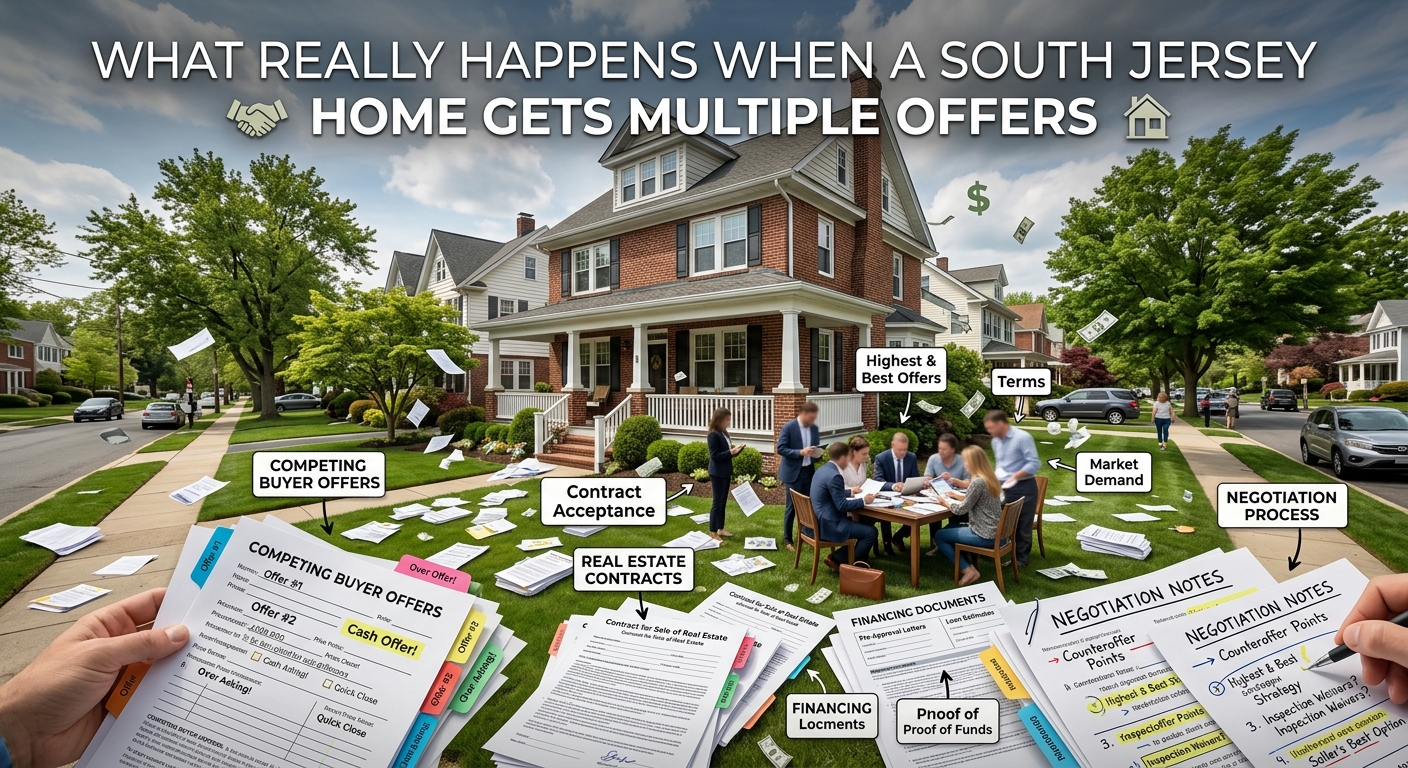
You list your South Jersey home.
Buyers start coming through.
Then the offers arrive.
One offer becomes two.
Two becomes three.
Suddenly, the question isn't:
“Will we get an offer?”
It's:
“Which offer should we choose?”
Multiple offers can be one of the strongest positions a seller can find themselves in—but it can also create more complexity than many homeowners expect.
The highest offer isn't always the strongest offer.
A buyer offering more money may have financing concerns, a complicated contingency structure, or a timeline that doesn't work for the seller.
Another buyer may offer slightly less but provide a cleaner path to closing.
As Mary Murphy of The Murphy Group explains:
“Multiple offers are exciting, but the goal isn't simply to pick the biggest number. It's to understand the strength, risk, and overall value of every offer.”
🏡 What Actually Happens When Multiple Offers Arrive?
When several buyers submit offers around the same time, the seller and their real estate professional have to evaluate more than the purchase price.
Each offer creates a different combination of:
- Price
- Financing
- Contingencies
- Timeline
- Earnest money
- Inspection terms
- Appraisal considerations
- Closing flexibility
- Overall buyer strength
The real question becomes:
Which offer gives the seller the best combination of value and certainty?
💰 1. The Highest Offer Gets Attention—But Not Automatically the Deal
Imagine three offers:
Buyer A: $650,000
Buyer B: $640,000
Buyer C: $630,000
At first glance, Buyer A appears to be the obvious choice.
But what if Buyer A has several contingencies while Buyer B has stronger financing and a more flexible closing timeline?
The difference between the offers isn't just $10,000.
It's also the level of risk associated with each transaction.
That's why sellers should evaluate the entire offer package, not just the headline number.
📊 2. The Seller May Compare Every Term Side by Side
When multiple offers arrive, the details become extremely important.
A seller may compare:
- Purchase price
- Down payment
- Financing type
- Pre-approval strength
- Earnest money deposit
- Inspection provisions
- Appraisal terms
- Sale-of-home contingencies
- Closing date
- Possession timing
- Seller concessions
- Other requested terms
This is where having a structured comparison becomes valuable.
Two offers that look similar on the first page can be dramatically different once all the terms are considered.
🏦 3. Financing Strength Matters
A buyer's financing profile can influence how comfortable a seller feels moving forward.
For example, sellers may want to understand:
- Is the buyer fully pre-approved?
- How much are they financing?
- How much cash are they bringing?
- Is the lender responsive?
- Are there unusual financing conditions?
A stronger financing position can reduce uncertainty.
But every transaction is different, and sellers should evaluate financing terms with appropriate professional guidance.
🔍 4. Contingencies Can Change the Value of an Offer
An offer isn't simply a promise to pay a price.
It's also a set of conditions.
Buyers may include contingencies involving:
- Inspection
- Financing
- Appraisal
- Sale of another property
- Other contractual conditions
A seller needs to understand how each contingency could affect the transaction timeline and the likelihood of reaching closing.
Sometimes the offer with the slightly lower price has substantially fewer obstacles.
🧾 5. Inspection Terms Become Especially Important
In a multiple-offer situation, inspection provisions can influence how attractive an offer appears.
Some buyers may structure their offer differently regarding inspection-related requests.
Others may seek broader protections.
The important thing for sellers is to understand exactly what the buyer is proposing rather than assuming that “as-is” or similar language means there will be no future negotiations.
Contract terms matter.
🏦 6. The Appraisal Can Still Matter Even When Buyers Compete
Multiple offers can push the accepted price higher.
But if the buyer is financing the purchase, the appraisal process may become an important consideration.
Suppose a home receives an offer significantly above comparable sales.
The seller may love the number.
But the buyer's lender may still require an appraisal.
That creates a question:
What happens if the appraised value doesn't support the contract price?
Depending on the contract terms, the parties may have to determine how to address the difference.
This is one reason experienced offer analysis looks beyond the initial offer amount.
⏰ 7. Timing Can Become a Negotiation Tool
Multiple offers can give sellers more flexibility around timing.
One buyer might want:
- A fast closing
- A longer closing
- Specific possession timing
Another might be willing to adapt to the seller's schedule.
For sellers who are purchasing another home, relocating, or coordinating a move, timing can be almost as important as price.
The “best” offer depends partly on what the seller needs.
💵 8. Earnest Money Can Signal Commitment
The amount and structure of a buyer's deposit can provide additional context when comparing offers.
A larger deposit may demonstrate stronger commitment, although it doesn't eliminate every transaction risk.
Sellers should look at the deposit alongside the rest of the offer rather than treating it as a standalone measure of buyer strength.
🔄 9. Sellers May Have Different Ways to Respond
When multiple offers arrive, sellers aren't necessarily limited to:
Accept Offer A or reject everything.
Depending on the circumstances and applicable rules, a seller may consider different negotiation strategies.
Those could include:
- Accepting an offer
- Rejecting an offer
- Countering
- Requesting revised terms
- Working with a multiple-offer strategy through the listing agent
The exact approach should be guided by the seller's agent and applicable contract, legal, and brokerage requirements.
🧠 10. The Emotional Pressure Can Be Surprisingly High
Multiple offers sound like a dream.
But sellers can quickly feel overwhelmed.
Suddenly, they're comparing:
$X more
versus
fewer contingencies
versus
better timing
versus
stronger financing
versus
less uncertainty.
The temptation is to focus entirely on the largest number.
That's where strategic thinking matters.
A strong offer should be evaluated based on what the seller actually wants to accomplish.
🏡 11. Buyer Competition Can Reveal What the Market Values
Multiple offers can provide sellers with useful information.
If several buyers are willing to compete, it can indicate that the property is attracting strong demand.
It may validate:
- Pricing
- Presentation
- Location
- Condition
- Marketing
- Property features
But sellers should avoid assuming that every multiple-offer situation means the price should simply continue increasing.
The goal is to maximize the opportunity while maintaining a realistic path to closing.
📸 12. Strong Marketing Often Creates the Conditions for Competition
Multiple offers rarely happen by accident.
They can result from a combination of:
- Strategic pricing
- Professional photography
- Strong listing presentation
- Effective online exposure
- Proper launch timing
- Accurate positioning
- Buyer demand
When a home attracts multiple qualified buyers, the seller has more choices.
That doesn't mean every listing can or should generate a bidding war.
But thoughtful preparation can help maximize the property's opportunity to compete.
⚠️ 13. A Multiple-Offer Situation Doesn't Guarantee a Smooth Closing
This is important.
Receiving multiple offers is a great milestone.
It isn't the finish line.
The accepted buyer still has to move through:
- Contract deadlines
- Inspections
- Appraisal
- Financing
- Title work
- Final preparations
- Closing
A strong strategy continues after the offer is accepted.
🧠 14. Sellers Should Know What They Value Most
Before reviewing multiple offers, sellers should identify their priorities.
Is it:
Maximum price?
Or perhaps:
Maximum certainty?
Or:
A specific closing date?
Or:
Minimal negotiation after inspection?
There isn't one universally correct answer.
A seller relocating for work may value speed.
A seller purchasing another property may prioritize timing.
Another seller may be focused almost entirely on net proceeds.
Knowing those priorities makes the decision much easier.
💲 15. Look at the Net, Not Just the Contract Price
A $700,000 offer isn't necessarily better than a $690,000 offer.
Why?
Because the final financial picture may be affected by:
- Seller concessions
- Credits
- Repairs
- Closing-related expenses
- Other negotiated terms
That's why sellers should evaluate the estimated net proceeds, not simply the contract price.
🤝 16. The Buyer's Agent and Lender Can Matter Too
Transactions involve people, not just paperwork.
Communication and responsiveness can make a difference during a complex transaction.
A buyer with a strong offer but poor communication may create more friction than a buyer whose entire team is organized and responsive.
Again, this isn't about judging people.
It's about understanding the practical risk and coordination involved in getting from contract to closing.
🔐 17. Sellers Should Avoid Making Assumptions About What Buyers Will Do
A seller might think:
“If this buyer doesn't get the house, they'll come back with more money.”
Maybe.
Maybe not.
Another buyer may enter the market.
Interest rates may change.
Inventory may change.
Buyer motivation may change.
A multiple-offer situation should therefore be handled strategically rather than assuming competition will remain indefinitely.
📈 How The Murphy Group Helps Sellers Navigate Multiple Offers
At The Murphy Group, the focus is on helping sellers understand the full value of each offer, not simply ranking them by purchase price.
That means evaluating:
- Price
- Financing
- Contingencies
- Timing
- Buyer strength
- Potential transaction risks
- Estimated net proceeds
- Seller priorities
“When multiple offers come in, sellers need clarity more than excitement,” Mary says. “Our job is to help them understand what each offer really means and choose the strategy that best protects their goals.”
🏆 What Sellers Should Remember
If your South Jersey home receives multiple offers, take a breath.
This is a strong position to be in.
But don't let the excitement cause you to overlook the details.
Ask:
✔ What is the buyer actually offering?
✔ How strong is the financing?
✔ What contingencies are included?
✔ How does the timeline fit my plans?
✔ What could create complications later?
✔ What are the estimated net proceeds?
✔ Which offer gives me the best combination of price and certainty?
The answer may not be the highest number.
🚀 The Bottom Line
Multiple offers can completely change the dynamics of a South Jersey home sale.
But the real advantage isn't simply having buyers compete.
It's having choices.
Choices about:
- Price
- Terms
- Timing
- Risk
- Certainty
The strongest seller strategy is to understand every part of those choices before making a decision.
Because the best offer isn't always the one that looks biggest on paper.
It's the one that best balances value, certainty, and the seller's goals.
📲 Wondering How Your South Jersey Home Could Perform in Today's Market?
The Murphy Group helps South Jersey sellers prepare strategically, attract qualified buyers, and evaluate offers with the bigger picture in mind.
👉 Start here: www.mgsells.com

Mary Murphy
Team Leader | The Murphy Group | eXp Realty, LLC | PLACE
or another way