

Categories
home appraisal, Burlington County, Camden County, Gloucester County, Home Buying Tips, Home Buying Guides, Housing Guide, New Jersey Real Estate, Real Estate Guides, NJ Housing, South Jersey Real EstatePublished September 22, 2026
What Happens When a South Jersey Home Appraises for Less Than the Contract Price?

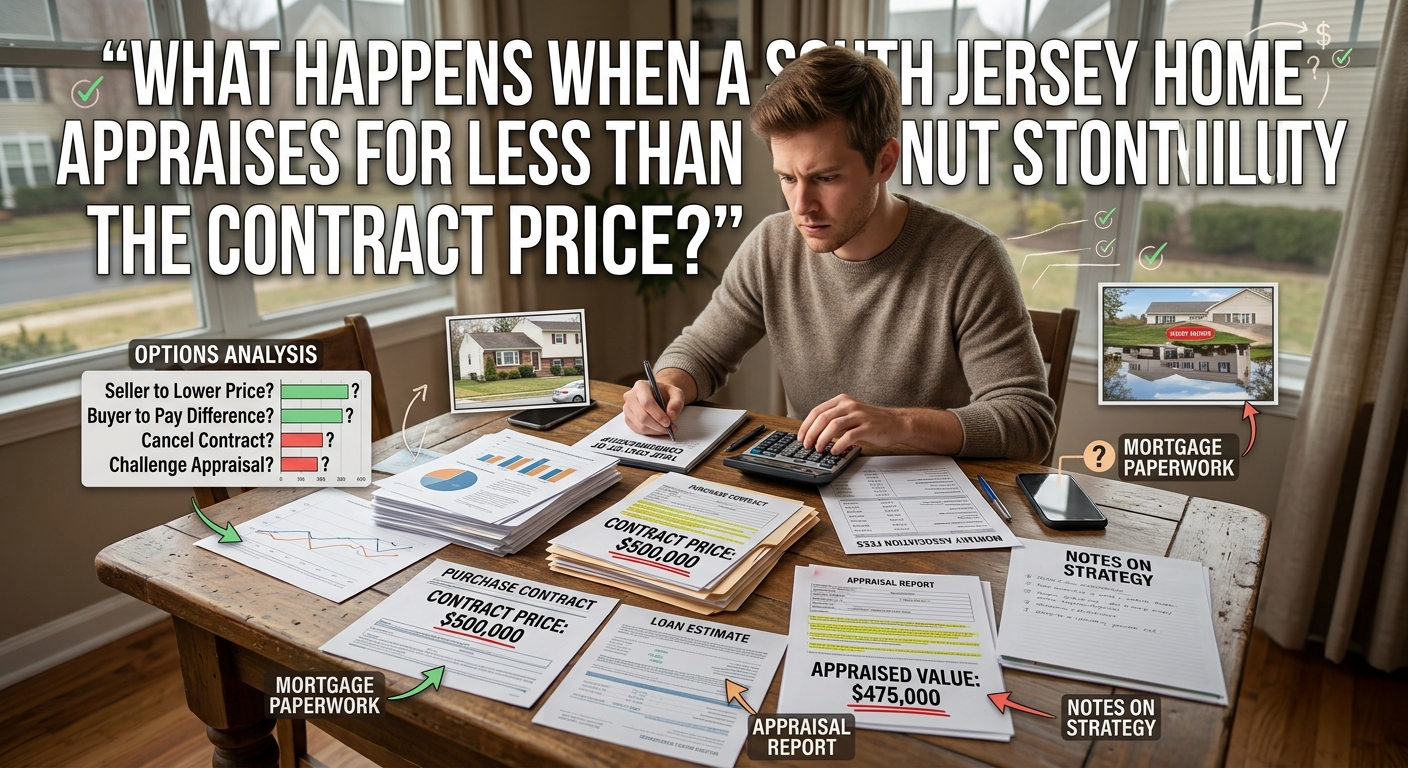
You found the home.
You negotiated the price.
The seller accepted your offer.
Everyone is moving toward closing.
Then the appraisal comes back.
The home appraised for less than the contract price.
Suddenly, a $500,000 purchase may have an appraised value of $475,000.
That $25,000 difference is called an appraisal gap, and it can create an important financial question:
👉 Who is responsible for making up the difference?
The answer isn't always simple.
Depending on the financing, contract terms, appraisal, and negotiations between the buyer and seller, the parties may have several options.
New Jersey's Housing and Mortgage Finance Agency explains that lenders order appraisals during loan processing to assess the home's fair market value.
And according to the Consumer Financial Protection Bureau, when an appraisal comes in below the sale price, buyers should review the appraisal and discuss their options with their lender and real estate professional.
As Mary Murphy of The Murphy Group explains:
“An appraisal gap doesn't automatically mean the deal is over. It means everyone needs to understand what the valuation means, what the financing requires, and what options are available before deciding how to move forward.”
🧠 What Is an Appraisal Gap?
An appraisal gap occurs when:
Contract Price > Appraised Value
For example:
- Contract price: $500,000
- Appraised value: $475,000
- Appraisal gap: $25,000
The buyer and seller agreed to $500,000.
But the appraiser's professional opinion of the property's market value came in at $475,000.
That doesn't necessarily mean the home is objectively “worthless” at $500,000.
An appraisal is an opinion of value based on the appraiser's analysis, including comparable sales and property characteristics.
The bigger issue is that the lender uses the appraisal as part of evaluating the property securing the mortgage.
🏦 1. Why Does the Appraisal Matter to the Lender?
A mortgage lender isn't simply financing the buyer.
The home itself serves as collateral for the loan.
That's why the lender wants an independent assessment of the property's value.
Fannie Mae explains that when an appraised value is below the purchase price, the lender may not approve the requested loan amount or may not lend the full amount originally anticipated.
This can change the amount of money the buyer needs to bring to the transaction.
And that's where an appraisal gap can become a real problem.
📊 2. A Low Appraisal Doesn't Automatically Cancel the Sale
This is one of the biggest misconceptions buyers have.
A low appraisal does not automatically mean the transaction is dead.
Instead, the parties may need to determine how to address the difference.
Possible paths can include:
- Seller reducing the purchase price
- Buyer increasing the down payment
- Buyer and seller splitting the difference
- Buyer bringing additional cash
- Challenging or requesting reconsideration of the appraisal when appropriate
- Restructuring the transaction
- Terminating the agreement if the contract permits it
The specific options depend on the financing and the terms of the purchase agreement.
That's why buyers should discuss the appraisal with their lender and real estate attorney or other appropriate professionals before making a decision.
💰 3. The Buyer May Need to Bring More Cash
Consider a simplified example.
The contract price is:
$500,000
The appraisal is:
$475,000
The lender may calculate the loan based on the lower value rather than simply financing the percentage the buyer expected from the contract price.
That could mean the buyer needs to contribute more cash.
Fannie Mae specifically identifies increasing the down payment as one possible response when a low appraisal affects the approved loan amount.
For some buyers, that extra cash may be manageable.
For others, it could make the transaction financially impractical.
🤝 4. The Seller May Agree to Reduce the Price
One of the most straightforward solutions is renegotiation.
Suppose:
Contract price: $500,000
Appraisal: $475,000
The buyer may ask the seller to reduce the purchase price.
The seller could agree.
Or the seller could reject the request.
The seller's decision can depend on factors such as:
- How strong the buyer's financing is
- Whether other interested buyers exist
- How long the property has been on the market
- Whether the seller believes the appraisal is accurate
- How much equity the seller has
- Whether comparable sales support the contract price
The CFPB notes that buyers can often use a lower appraisal as a basis for negotiating a lower sales price.
⚖️ 5. The Buyer and Seller Could Split the Gap
Another possible solution is compromise.
For example:
$25,000 appraisal gap
The buyer contributes:
$12,500
The seller reduces the price by:
$12,500
This can allow the transaction to continue while sharing the financial impact.
But neither side is automatically required to accept this arrangement.
It is a negotiation.
🔎 6. What If the Buyer Thinks the Appraisal Is Wrong?
Sometimes the buyer or seller may believe the appraisal doesn't accurately reflect the property.
Perhaps:
- Important upgrades weren't considered
- The wrong comparable properties were used
- A recent sale wasn't included
- The appraiser missed a significant feature
- Property information was inaccurate
- The report contains factual errors
In those circumstances, the buyer can discuss the appraisal with the lender.
Fannie Mae identifies a Reconsideration of Value (ROV) as one possible option when an appraisal is believed to be unsupported, inaccurate, or deficient.
New Jersey also provides information regarding appraisal discrimination and explains that consumers may request reconsideration when they believe an appraisal is inaccurate or discriminatory.
The important point is that a reconsideration request should be based on relevant information and supported evidence—not simply because the buyer dislikes the valuation.
🏡 7. Why Might a South Jersey Home Appraise Below the Contract Price?
There are several possible reasons.
Limited Comparable Sales
If there aren't many recently sold homes that are truly comparable, determining value can be more difficult.
Rapidly Changing Market Conditions
The contract price may reflect very recent buyer competition while available comparable sales reflect earlier transactions.
Unique Property Features
A home with an unusual layout, extensive customization, or uncommon features may be harder to compare with nearby sales.
Aggressive Offer
Multiple buyers may have competed for a property, pushing the winning offer above what the available comparable sales support.
Differences in Condition
Two homes may appear similar online but differ substantially in renovation quality, maintenance, systems, or overall condition.
Incorrect or Missing Information
An appraisal can be affected if relevant property information isn't accurately reflected.
The CFPB explains that valuations can differ because they may rely on different comparable sales, timing, property information, or valuation methods.
📱 8. Multiple Offers Can Create Appraisal Pressure
Imagine a South Jersey home receives several offers.
The seller accepts the strongest offer at:
$525,000
But the comparable sales available to the appraiser support a value closer to:
$500,000
The winning buyer may have been willing to pay $525,000 because they wanted the property more than competing buyers did.
But the lender still needs to evaluate the collateral.
This creates an important distinction:
What a buyer is willing to pay isn't always identical to what an appraiser concludes the property is worth.
That difference can become especially important in competitive transactions.
💵 9. A Buyer May Decide to Pay the Difference
Sometimes a buyer still wants the property badly enough to cover some or all of the appraisal gap with additional cash.
For example:
Contract: $500,000
Appraisal: $475,000
The buyer may decide to bring additional funds to keep the transaction together.
But this decision deserves careful consideration.
The buyer should understand:
- How much additional cash is required
- How much money remains after closing
- Whether the financing changes
- Whether the property still fits the buyer's budget
- Whether the appraisal concerns reveal broader valuation questions
The CFPB warns that purchasing for more than the appraised value carries risk.
🧮 10. The Appraisal Can Change the Buyer's Loan Picture
A lower appraisal can affect more than the purchase price negotiation.
It may also affect the buyer's financing structure.
A lender may revise loan terms or estimates when important information changes during the mortgage process.
The CFPB specifically lists a lower-than-expected appraisal as a circumstance that can lead to a revised Loan Estimate.
That's another reason buyers shouldn't wait until the last minute to understand the appraisal.
The sooner the issue is identified, the more time the parties have to evaluate their options.
⏳ 11. A Low Appraisal Can Delay Closing
Even when everyone wants to proceed, an appraisal gap can add another layer of negotiation.
The parties may need to:
- Review the appraisal
- Discuss comparable sales
- Contact the lender
- Determine financing changes
- Negotiate a new price
- Prepare an amendment
- Recalculate funds needed at closing
That can put pressure on an already tight closing timeline.
And if financing needs to be reworked, additional lender review may be necessary.
📄 12. The Contract Matters More Than Buyers Realize
One of the most important questions after a low appraisal is:
What does the purchase agreement say?
Some contracts contain appraisal-related provisions or contingencies.
Those terms can influence what happens if the appraised value is below the agreed price.
A buyer shouldn't assume that a low appraisal automatically gives them the right to cancel.
Likewise, a seller shouldn't assume that the buyer must automatically bring additional cash.
The actual contract controls the parties' rights and obligations, subject to applicable law.
That's why legal questions about cancellation, deposits, deadlines, or contract rights should be reviewed with the buyer's or seller's attorney.
🏠 13. Sellers Should Prepare for the Possibility Too
Appraisal gaps aren't only a buyer problem.
Sellers can also be affected.
A seller may have accepted a strong offer based on the assumption that the transaction will close at that price.
Then the appraisal comes in lower.
Now the seller may have to decide whether to:
- Reduce the price
- Split the difference
- Wait for the buyer to bring more cash
- Challenge the appraisal
- Consider another buyer if the transaction terminates
For sellers, this is one reason pricing a home appropriately from the beginning matters.
A strong offer is valuable.
But the transaction still needs to survive financing and appraisal.
🧠 14. A Low Appraisal Doesn't Always Mean the Contract Price Was “Wrong”
This distinction is important.
An appraisal is an estimate of market value.
The contract price reflects an actual negotiated agreement between a buyer and seller.
Those numbers can differ.
A buyer may willingly pay more because:
- The property has personal importance
- The buyer strongly prefers the location
- Competition pushed the price higher
- The buyer believes future value will justify the purchase
- The property has features that are difficult to quantify
At the same time, the appraisal provides an important independent valuation for the lender.
Both numbers matter—but they serve different purposes.
🔍 15. What Buyers Should Do When the Appraisal Comes in Low
Don't panic.
Start by understanding exactly what happened.
Step 1: Get and review the appraisal
The lender generally must provide the buyer with a copy.
Step 2: Talk to the lender
Ask how the lower valuation affects:
- Loan amount
- Down payment
- Cash required
- Loan-to-value considerations
- Closing timeline
Step 3: Review the comparable sales
Look at the properties used in the valuation and the reasoning behind the adjustments.
Step 4: Discuss the situation with your real estate professional
Your agent can help you understand the market context and negotiation possibilities.
Step 5: Ask whether a reconsideration is appropriate
If there are factual errors or relevant information that wasn't considered, ask the lender about the available process.
Step 6: Review the contract
Have your attorney explain the appraisal-related provisions and deadlines that apply to your transaction.
Step 7: Decide based on the full financial picture
Don't focus only on the difference between two numbers.
Consider the entire purchase.
📋 South Jersey Appraisal Gap Checklist
If a home appraises below the contract price, buyers should ask:
☐ What was the contract price?
☐ What was the appraised value?
☐ How large is the gap?
☐ How does the appraisal affect my loan amount?
☐ How much additional cash would I need?
☐ What comparable sales were used?
☐ Are there factual errors in the report?
☐ Are there relevant improvements that weren't considered?
☐ Is a reconsideration of value appropriate?
☐ Will the seller negotiate?
☐ What does my purchase agreement say?
☐ Could the closing date be affected?
☐ What would my total cash-to-close become?
☐ Does the purchase still make financial sense?
💼 How The Murphy Group Helps Navigate Appraisal Gaps
An appraisal issue can become emotional very quickly.
The buyer doesn't want to overpay.
The seller doesn't want to reduce the agreed price.
The lender needs to protect the financing.
And everyone wants to keep the transaction moving.
At The Murphy Group, the focus is on understanding the numbers and communicating clearly throughout the process.
That can include:
- Reviewing the market context
- Helping identify relevant comparable sales
- Communicating with the parties involved
- Helping buyers understand their available paths
- Helping sellers evaluate negotiation options
- Keeping the transaction focused on practical solutions
As Mary Murphy explains:
“The appraisal is an important piece of the transaction, but it's not the entire transaction. The key is understanding what caused the gap and what options make sense from there.”
📊 The Bottom Line
A South Jersey home appraising for less than the contract price can create a significant obstacle—but it doesn't automatically end the deal.
The parties may have several potential paths:
- Renegotiate the purchase price
- Share the appraisal gap
- Bring additional cash
- Request reconsideration when appropriate
- Restructure the financing
- Exercise contractual rights if the transaction cannot be resolved
The right path depends on the appraisal, financing, contract terms, and the circumstances of the buyer and seller.
The most important thing is not to treat the appraisal gap as just a number.
👉 It can change the financing, negotiation, cash requirements, and ultimately whether the transaction reaches closing.
Understanding it early gives buyers and sellers more information to make informed decisions.
📲 Dealing With an Appraisal Gap in South Jersey?
The Murphy Group helps buyers and sellers navigate the moving parts of South Jersey real estate transactions—from pricing and comparable sales to negotiation and the path toward closing.
👉 Start here: www.mgsells.com

Mary Murphy
Team Leader | The Murphy Group | eXp Realty, LLC | PLACE
or another way