

Categories
Burlington County, Camden County, Gloucester County, Home Buying Tips, Housing Guide, NJ Housing, Real Estate Guides, South Jersey Buyer Insights, South Jersey Real EstatePublished October 5, 2026
What Buyers Should Look for When a South Jersey Home Has a Finished Attic

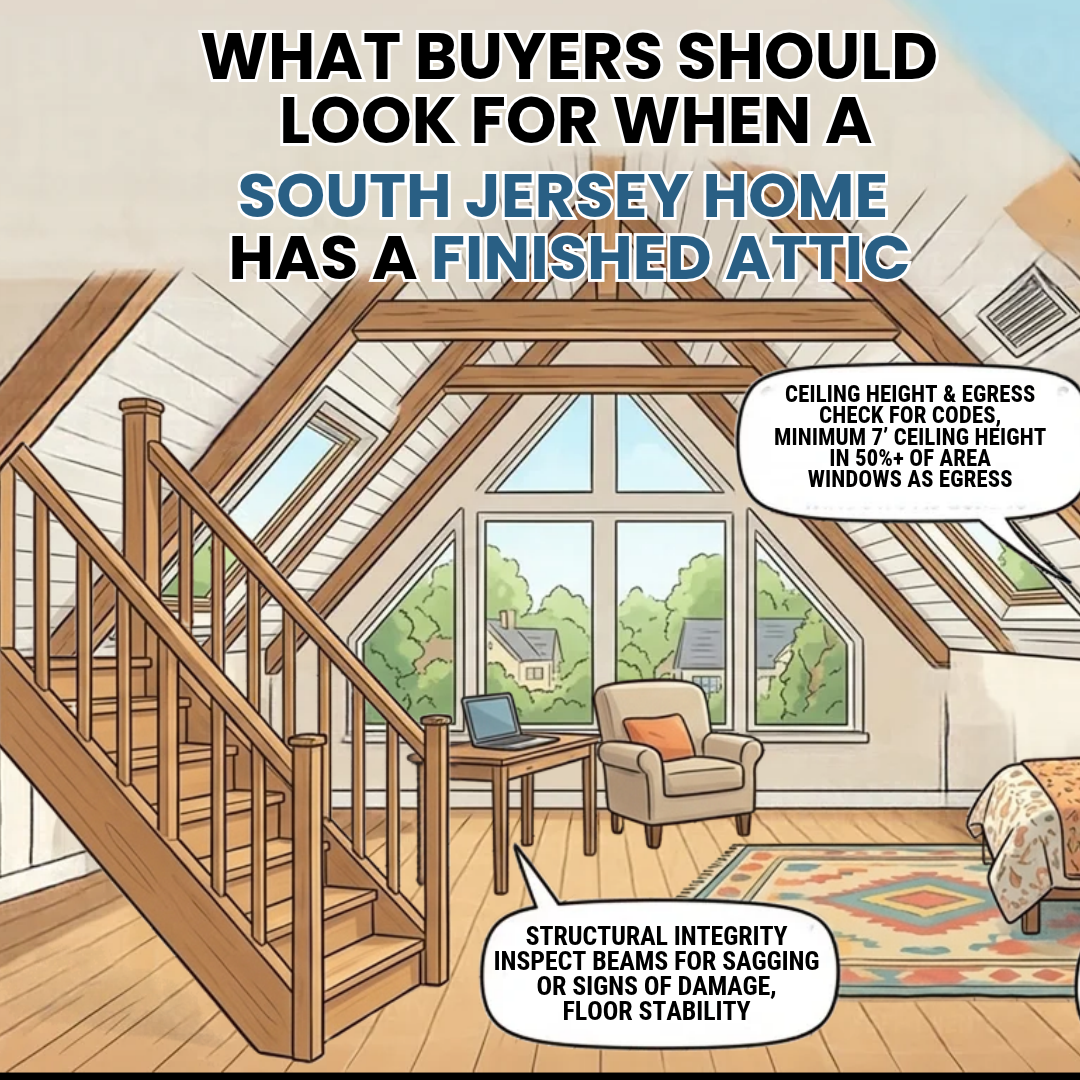
A finished attic can be one of the most appealing features in a South Jersey home.
What once looked like unused storage space may now appear to be:
- A bedroom
- Home office
- Guest suite
- Playroom
- Workout area
- Media room
- Flexible living space
And when buyers see finished walls, flooring, lighting, and comfortable furniture, it's easy to think:
“That's an extra room.”
But there's an important distinction buyers should understand:
👉 A finished attic isn't automatically the same thing as legally recognized living space.
Before assigning value to that additional area, buyers should look beyond the finished appearance and understand how the space was constructed, permitted, heated, ventilated, and intended to be used.
As Mary Murphy of The Murphy Group explains:
“A finished attic can add incredible flexibility to a home, but buyers should understand exactly what that space represents before counting it as another bedroom or assuming it can be used for anything they want.”
🏠 1. First Ask: What Is the Attic Actually Being Used For?
The first thing buyers should determine is how the current homeowner uses the space.
It might function as:
- A bedroom
- Office
- Den
- Storage area
- Playroom
- Studio
- Hobby room
But the way a seller uses a room doesn't necessarily establish its official classification.
A space can look like a bedroom without meeting all of the requirements applicable to a bedroom or habitable space.
That's why buyers should separate appearance from official use and compliance.
📜 2. Ask Whether the Finished Attic Was Permitted
One of the most important questions is:
Was the attic conversion properly permitted?
A finished attic may involve work affecting:
- Electrical systems
- Framing
- Insulation
- HVAC
- Plumbing
- Structural components
- Stairs
- Windows
- Fire safety
Depending on the scope of the work, permits and inspections may have been required.
Buyers should not assume that because the work looks professionally finished, all required approvals were obtained.
🏛️ 3. Check Municipal Records
If a finished attic is a major part of the home's appeal, buyers should investigate the property's municipal records.
Depending on the municipality and type of work, records may help determine whether improvements were documented or permitted.
Questions to ask may include:
- Was the attic conversion documented?
- Were permits pulled?
- Were inspections completed?
- Does the municipal record reflect the improvement?
- Is the finished area included in the property's official information?
The exact records available can vary by municipality.
When something is unclear, buyers can ask their real estate professional, attorney, inspector, or municipality for guidance.
📐 4. Ceiling Height Matters
Attic spaces often have unusual ceiling geometry.
The center of the room may have plenty of headroom while the edges slope sharply downward.
That can affect how much of the space is realistically usable.
Buyers should consider:
- Ceiling height
- Sloped ceilings
- Low-clearance areas
- Usable floor area
- Furniture placement
A finished attic can have a substantial floor area while offering much less practical standing space.
🧱 5. Look at the Floor Structure
An attic wasn't necessarily designed to function as a conventional living floor.
That's why buyers should have the structure evaluated appropriately.
Questions may include:
- Was the floor originally designed for storage?
- Has the structure been modified?
- Are there signs of movement or deflection?
- Does the flooring appear properly supported?
A qualified home inspector can help identify conditions that deserve further evaluation.
If structural concerns arise, additional professional assessment may be appropriate.
🪜 6. Pay Close Attention to the Stairs
Access to an attic is another important consideration.
Some finished attics are reached through:
- Full staircases
- Narrow stairways
- Steep stairs
- Pull-down stairs
- Unusual access configurations
If buyers expect the space to function as everyday living space, they should consider whether the access is practical and appropriate for the intended use.
Stairs are also relevant to safety and code compliance.
🚪 7. Don't Assume a Finished Attic Is a Legal Bedroom
This is one of the biggest mistakes buyers can make.
A room containing:
- A bed
- Closet
- Flooring
- Finished walls
- Lighting
may look like a bedroom.
But bedroom requirements can involve additional considerations, including issues such as:
- Emergency escape and rescue openings
- Ceiling height
- Access
- Light and ventilation
- Heating
- Fire safety
Requirements can vary based on the applicable code and circumstances.
Therefore, buyers should verify whether a finished attic is actually recognized as a bedroom rather than relying on how the listing describes it.
🪟 8. Check Egress and Emergency Escape
If the attic is being marketed or used as a sleeping area, emergency escape and rescue provisions deserve particular attention.
Buyers should look at:
- Window size
- Window location
- Accessibility
- Whether an appropriate exit route exists
- Whether the space meets applicable requirements
A small decorative attic window isn't necessarily equivalent to an appropriate emergency escape opening.
This is an area where buyers should rely on qualified professionals and applicable local requirements rather than assumptions.
🔥 9. Find Out How the Attic Is Heated and Cooled
Comfort is one thing.
Heating and cooling capacity is another.
Buyers should determine:
- Is there a dedicated HVAC supply?
- Is the attic connected to the home's existing system?
- Is there a ductless mini-split?
- Does the space stay comfortable year-round?
- Was the HVAC system designed to accommodate the additional area?
A finished attic that becomes extremely hot in summer or difficult to heat in winter may be less functional than it appears during a pleasant-weather showing.
❄️ 10. Insulation Can Make a Major Difference
Attic spaces are directly affected by the roof assembly and exterior temperatures.
Buyers should pay attention to:
- Insulation
- Air sealing
- Ventilation
- Signs of temperature extremes
- Moisture
- Condensation
Proper insulation and ventilation can affect comfort, energy use, and the long-term condition of the space.
If the attic was converted recently, buyers may want documentation showing what improvements were made.
💨 11. Ventilation Is Easy to Overlook
A finished attic doesn't eliminate the importance of proper roof and attic ventilation.
Depending on the construction, buyers may want to understand how the roof assembly is ventilated.
Potential concerns can include:
- Excess heat
- Moisture accumulation
- Condensation
- Mold
- Roof-related deterioration
This is especially important because finished walls and ceilings can make some areas difficult to visually inspect.
A qualified inspector can help identify conditions that may require further investigation.
💧 12. Look for Signs of Moisture
Water intrusion is another major issue buyers should investigate.
Look for:
- Ceiling stains
- Discoloration
- Peeling finishes
- Musty odors
- Damp areas
- Mold-like growth
- Signs of previous repairs
Even if the attic looks beautiful today, evidence of past moisture should be investigated rather than simply painted over mentally.
🏚️ 13. Examine the Roof From the Attic Side
One advantage of an accessible attic is that it can provide another perspective on the roof system.
Buyers may want their inspector to look for:
- Water staining
- Improper ventilation
- Visible deterioration
- Structural concerns
- Signs of previous leaks
- Areas that are difficult to access
This doesn't replace a professional roof inspection when one is warranted.
But it can provide useful information about the relationship between the finished attic and the roof above it.
⚡ 14. Don't Ignore the Electrical Work
Finished attics often contain additional:
- Lighting
- Outlets
- Switches
- HVAC equipment
- Fans
- Electronics
Buyers should have the electrical work evaluated as part of the inspection process.
If the attic was finished as part of a renovation, documentation regarding electrical work may also be worth reviewing.
🛁 15. Be Especially Careful With Attics That Contain Plumbing
Some finished attics go beyond a simple bedroom or office and include:
- Bathrooms
- Kitchenettes
- Wet bars
- Laundry areas
Plumbing adds another layer of complexity.
Buyers should investigate:
- Water supply
- Drainage
- Venting
- Water damage
- Proper installation
- Permit history
An attic bathroom can be a fantastic feature—but buyers shouldn't assume that every visible fixture was installed with the appropriate approvals.
📏 16. Ask How the Finished Area Is Included in the Listing
This is an important conversation before making an offer.
Buyers should ask:
Is the finished attic included in the home's reported living area?
There can be differences between:
- Finished area
- Gross building area
- Above-grade living area
- Storage area
- Official property records
- MLS measurements
The answer can affect how buyers compare the home with other properties.
💰 17. Don't Automatically Assign Full Bedroom Value to the Space
If a finished attic isn't officially recognized as a bedroom or isn't comparable to conventional living space, buyers should be cautious about valuing it exactly like another bedroom on the main levels.
Instead, consider what the space actually provides.
It may still offer significant value as:
- Office space
- Hobby space
- Guest area
- Recreation room
- Storage
- Flexible living space
The point is not to discount it.
It's to value it accurately.
🏡 18. Finished Attics Can Still Be Excellent Flexible Space
A finished attic doesn't have to qualify as a bedroom to be useful.
For many buyers, the flexibility is the real benefit.
Imagine using it as:
A home office
A quiet space separated from the main living areas.
A creative studio
A dedicated area for hobbies or projects.
A media room
A private entertainment space.
A guest area
A place for visitors to stay, depending on the space's suitability and applicable requirements.
A playroom
A dedicated area away from the main living room.
That flexibility can be valuable even when the space isn't counted as another bedroom.
🧾 19. Ask for Documentation Before Assuming Anything
If the finished attic is one of the home's major selling points, buyers can ask for documentation related to the work.
Potentially useful information may include:
- Building permits
- Inspection records
- Contractor documentation
- Receipts
- Renovation plans
- HVAC information
- Electrical documentation
- Municipal records
Not every document will exist for every property.
But the more significant the renovation, the more useful documentation can be.
🔍 20. Compare the Finished Attic With the Rest of the Home
A finished attic shouldn't be evaluated separately from the entire property.
Ask:
- Does it improve the home's functionality?
- Does it solve a real space problem?
- Is the access convenient?
- Is it comfortable year-round?
- Does it provide privacy?
- Is it expensive to maintain?
- Does the space justify the asking price?
A beautiful attic can be a meaningful advantage—but only if it works for the buyer's needs.
🧠 21. Look for Signs That the Space Was Finished as an Afterthought
Not every finished attic renovation is equal.
Buyers may notice:
- Exposed or awkward ductwork
- Inconsistent flooring
- Low-quality finishes
- Limited outlets
- Improvised lighting
- Unusual electrical installations
- Poor temperature control
- Difficult access
None of these automatically means the work is defective.
But they can signal that the space deserves closer inspection.
🏚️ 22. Older South Jersey Homes May Require Extra Due Diligence
Older homes can contain multiple generations of renovations.
A finished attic might have been completed:
- Decades ago
- By a previous owner
- As a DIY project
- During a larger renovation
- Without documentation that is readily available today
That doesn't automatically make the space problematic.
But buyers should avoid assuming that age alone proves compliance—or noncompliance.
Documentation and professional evaluation are more useful than assumptions.
🏦 23. Financing and Appraisal Can Make the Details Matter
When a buyer is financing a home, the lender and appraisal process can involve the property's characteristics, condition, and reported living area.
If a significant portion of the home's perceived value comes from a finished attic, buyers should make sure the space is accurately represented.
Questions about how the area is classified or valued may be worth discussing with the lender, appraiser, and real estate professionals involved in the transaction.
🔄 24. Think About Future Resale
Buyers should also consider how a future buyer may perceive the attic.
A properly finished, comfortable, documented space may be an attractive feature.
An attic that is marketed as a bedroom but has unclear permitting, limited access, poor ventilation, or questionable usability could create more questions during a future sale.
The best approach is to understand the space accurately now.
📋 Finished Attic Buyer Checklist
Before making an offer on a South Jersey home with a finished attic, ask:
Legal & Documentation
- Was the work permitted?
- Are permits available?
- Does the municipal record reflect the improvement?
- Is the space officially recognized for the intended use?
Structure
- Was the floor designed for living space?
- Are there signs of structural movement?
- Are stairs safe and practical?
Comfort
- Is the space heated and cooled?
- Is insulation adequate?
- Is ventilation appropriate?
Safety
- Is there appropriate emergency escape and rescue access where required?
- Are smoke and carbon-monoxide safety provisions appropriate?
Condition
- Are there signs of leaks or moisture?
- What does the roof look like from inside?
- Are electrical systems properly installed?
Value
- Is the area included in the reported living space?
- Is it actually comparable to conventional living space?
- How much value does the flexibility provide?
💼 How The Murphy Group Helps Buyers Look Beyond the Finished Appearance
At The Murphy Group, the goal is to help buyers understand what they're actually purchasing—not simply what looks impressive during a showing.
That means paying attention to:
- Finished versus officially recognized space
- Property records
- Renovation history
- Condition
- Functionality
- Potential maintenance costs
- Resale considerations
“A finished attic can be one of the most exciting spaces in a home,” Mary says. “We just want buyers to understand the details behind that extra space so they can make an informed decision.”
For questions involving permits, code compliance, structural concerns, or legal classification, buyers should consult the appropriate municipality and qualified professionals.
📊 The Bottom Line
A finished attic can add meaningful flexibility to a South Jersey home.
But buyers should look beyond:
“It's finished.”
Instead, ask:
- Was it permitted?
- Is it safe?
- Is it structurally appropriate?
- Is it properly heated and ventilated?
- Does it have adequate insulation?
- Is there appropriate emergency escape access?
- Is it officially recognized as living space?
- How is it represented in the property's records?
- Does its actual functionality justify the value being assigned to it?
The best finished attic isn't necessarily the one with the fanciest flooring or newest paint.
It's the one that is comfortable, functional, properly documented, and genuinely useful to the homeowner.
📲 Thinking About Buying a South Jersey Home?
The Murphy Group helps buyers look beyond the listing photos to understand the details that can affect a home's usability, value, and long-term ownership experience.
👉 Start here: www.mgsells.com

Mary Murphy
Team Leader | The Murphy Group | eXp Realty, LLC | PLACE
or another way