

Categories
South Jersey Real Estate, South Jersey neighborhood, Home Buying Guides, Home Buying Tips, buying a home in South Jersey, Camden County, Burlington County, Gloucester CountyPublished September 14, 2026
The 10 Questions Smart Homebuyers Ask Before Choosing a South Jersey Neighborhood

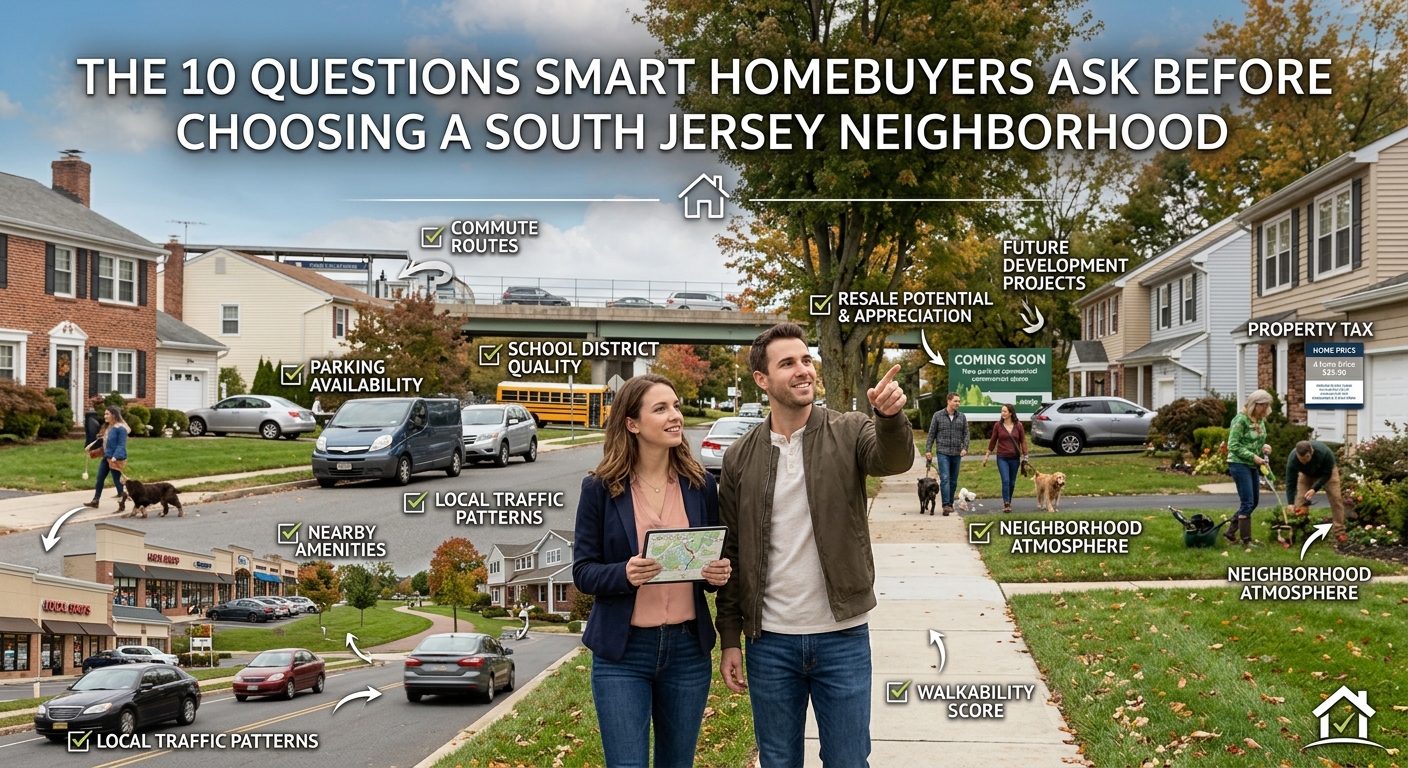
Finding the right South Jersey home isn't just about finding the right house.
It's about finding the right place to live.
A beautiful kitchen can be renovated.
Paint colors can be changed.
Flooring can be replaced.
But you can't renovate the neighborhood.
That's why smart homebuyers look beyond the listing photos and ask deeper questions before deciding where they want to live.
They consider the commute, surrounding properties, traffic, schools, taxes, amenities, noise, future development, and what daily life will actually feel like.
As Mary Murphy of The Murphy Group explains:
“Buyers aren't just purchasing a house. They're choosing a neighborhood where they'll spend their everyday lives. The right questions can reveal whether a property truly fits them.”
🧭 1. “How Will My Daily Commute Actually Feel?”
A neighborhood may look perfect on a map.
But what matters is how it functions during your actual schedule.
Before buying, consider:
- Typical commute times
- Access to major highways
- Public transportation options
- Traffic patterns
- Alternative routes
- Distance to work or school
South Jersey provides access to major transportation corridors, which can be a major advantage for commuters.
But proximity to a highway doesn't automatically mean an easy commute.
Traffic patterns can change dramatically depending on the time of day.
Try the commute before you buy.
Drive it during the hours you'd normally be traveling.
🏡 2. “What Is the Neighborhood Like at Different Times of Day?”
A neighborhood can feel completely different at:
- 7:00 AM
- Noon
- 5:30 PM
- 9:00 PM
- Weekends
One quick showing can't reveal everything.
Visit more than once if possible.
Look for:
- Street activity
- Parking
- Traffic
- Noise
- Lighting
- General upkeep
- Evening activity
The goal isn't to search for perfection.
It's to understand what normal life actually looks like.
🚗 3. “Will Parking Be Easy?”
Parking is one of those details buyers may overlook until they live in the home.
Ask:
- Does the property have a garage?
- Is the driveway large enough?
- Is street parking common?
- Are there restrictions?
- Where do guests park?
- Does parking become difficult during busy hours?
This can be especially important for households with multiple vehicles.
A home with a beautiful interior can become frustrating if everyday parking is difficult.
🔊 4. “What Will I Hear From This Neighborhood?”
Noise can have a major effect on how comfortable a home feels.
Consider whether the property is near:
- Major roads
- Highways
- Railroad tracks
- Commercial areas
- Schools
- Parks
- Busy intersections
- Industrial properties
A location close to transportation may provide convenience while also introducing more traffic noise.
Neither is automatically a dealbreaker.
It's about knowing what you're comfortable with.
🛒 5. “How Convenient Is Everyday Life Here?”
Buyers often focus heavily on the distance to work.
But everyday convenience matters too.
Ask how close you'll be to:
- Grocery stores
- Pharmacies
- Restaurants
- Medical offices
- Gyms
- Parks
- Shopping
- Banking
- Childcare
A neighborhood that saves you 15 minutes on everyday errands can have a surprisingly large impact on your quality of life over several years.
🏫 6. “What About Schools and Other Community Services?”
For buyers with children—or buyers who may have children in the future—schools can be an important consideration.
But smart buyers should look beyond a simple school rating.
Consider:
- School assignment
- District boundaries
- Transportation
- Program availability
- Nearby childcare
- Libraries
- Parks and recreation
School boundaries can be specific, so buyers should verify current information rather than relying solely on assumptions about a neighborhood.
💰 7. “What Will It Cost Me to Live Here?”
The purchase price is only one part of affordability.
Smart buyers consider the broader cost of living in the property and community.
That can include:
- Property taxes
- Homeowners insurance
- Utilities
- HOA or association fees
- Maintenance
- Commuting expenses
Two homes with identical prices can have very different monthly ownership costs.
That's why comparing total housing expenses can be more useful than comparing listing prices alone.
🌳 8. “Will This Neighborhood Still Fit My Lifestyle in Five Years?”
This is one of the most overlooked questions.
Your needs can change.
Maybe you're:
- Starting a family
- Working remotely
- Planning to downsize
- Expecting aging parents to move closer
- Looking for more outdoor space
- Becoming more interested in walkability
A neighborhood that fits perfectly today may not be the best fit five years from now.
Think beyond your current lifestyle.
Think about where you're heading.
🏗️ 9. “What's Changing Nearby?”
One of the smartest things buyers can do is look beyond what exists today.
Ask about:
- New residential development
- Road improvements
- Commercial projects
- Redevelopment
- New businesses
- Infrastructure changes
- Planned construction
Development isn't automatically positive or negative.
A new project could bring convenience, services, and investment.
It could also create temporary construction, increased traffic, or changes to the character of an area.
The important thing is knowing what's coming.
📈 10. “How Could This Neighborhood Affect My Future Resale?”
Even if you're planning to stay for many years, resale value still matters.
You don't need to predict the future.
Instead, look for characteristics that tend to support broad buyer appeal, such as:
- Desirable location
- Convenient transportation
- Strong community amenities
- Well-maintained surroundings
- Functional housing
- Access to services
- Consistent buyer demand
Ask yourself:
“If I needed to sell this home five or ten years from now, who would want to buy it?”
That simple question can change how you evaluate a neighborhood.
🧠 The Questions Buyers Often Forget
Beyond the ten major questions, there are smaller details worth investigating.
What does the street look like after a storm?
Water management can matter.
How difficult is it to get onto the main road?
A short distance on a map doesn't always mean easy access.
Are there sidewalks?
This can matter for walking, children, pets, and recreation.
Is the neighborhood quiet enough for you?
Visit at different times.
How close are you to emergency and medical services?
Convenience can matter more as circumstances change.
Do the surrounding homes appear well maintained?
The condition of nearby properties can influence how buyers perceive a neighborhood.
These details rarely appear in a listing's headline.
But they can matter enormously once you live there.
📍 Don't Judge a Neighborhood From One Showing
One of the biggest mistakes buyers make is falling in love with a house before fully investigating its surroundings.
Instead:
Drive the neighborhood.
Walk the surrounding streets.
Check the commute.
Visit at different times.
Look at nearby properties.
Research planned development.
Think about your daily routine.
You're not just buying the property.
You're buying access to everything around it.
🗺️ Why Location Requires More Than a Map Pin
Online maps are extremely useful for understanding a property's surroundings.
But a map can't always communicate:
- How loud traffic feels
- How busy a street becomes
- How easy parking is
- What the neighborhood feels like at night
- How pedestrians use the area
- What daily life actually feels like
Use online tools as a starting point.
Then experience the neighborhood in person.
🧠 The “Five-Minute Life” Test
Here's a useful exercise for buyers.
Imagine that you live in the home.
Now ask:
What can I reach within five minutes?
Can you:
- Get coffee?
- Buy groceries?
- Reach a main road?
- Walk somewhere?
- Get to a park?
- Pick up dinner?
- Access essential services?
The easier your daily routine feels, the more valuable the neighborhood may feel to you personally.
⚠️ Don't Let a Beautiful House Distract You From the Location
This happens frequently.
A buyer walks into a gorgeous home.
The kitchen is perfect.
The primary suite is impressive.
The basement is finished.
Everything feels exciting.
Then the buyer realizes later that:
- The commute is frustrating
- Parking is difficult
- The road is noisy
- Amenities are inconvenient
- The neighborhood doesn't fit their lifestyle
The house may still be excellent.
It just may not be the right home for that particular buyer.
💼 How The Murphy Group Helps Buyers Evaluate South Jersey Neighborhoods
At The Murphy Group, the goal isn't simply to help buyers find attractive properties.
It's to help them understand the bigger picture.
That means encouraging buyers to evaluate:
- Location
- Commute
- Neighborhood characteristics
- Everyday convenience
- Property taxes and ownership costs
- Future development
- Resale considerations
- Lifestyle fit
“The right home isn't just the one that looks great during a showing,” Mary says. “It's the one that still makes sense when buyers picture their everyday life there.”
📊 A Simple Neighborhood Scorecard
Before making a decision, buyers can score each neighborhood from 1–5 on:
| Category | Score |
|---|---|
| Commute | /5 |
| Parking | /5 |
| Noise | /5 |
| Everyday convenience | /5 |
| Schools/community services | /5 |
| Outdoor recreation | /5 |
| Taxes and ownership costs | /5 |
| Future development | /5 |
| Lifestyle fit | /5 |
| Resale potential | /5 |
The goal isn't to find a perfect 50/50 score.
It's to make your priorities visible.
Sometimes the neighborhood that looks less impressive on paper turns out to be the one that fits your actual life best.
🚀 The Bottom Line
Smart homebuyers don't ask only:
“Do I like this house?”
They ask:
“Do I like living here?”
That distinction matters.
Before choosing a South Jersey neighborhood, investigate:
- Your commute
- Parking
- Noise
- Daily convenience
- Schools and services
- Total ownership costs
- Future development
- Lifestyle changes
- Long-term resale considerations
Because countertops can be replaced.
Paint can be changed.
Fixtures can be upgraded.
The neighborhood is the part you are buying into.
Choose the house you love—but make sure you love the life that comes with it.
📲 Looking for the Right South Jersey Neighborhood?
The Murphy Group helps buyers evaluate homes, neighborhoods, and long-term considerations so they can make confident decisions based on more than just listing photos.
👉 Start here: www.mgsells.com

Mary Murphy
Team Leader | The Murphy Group | eXp Realty, LLC | PLACE
or another way