

Categories
South Jersey Real Estate, NJ Inspection, Home Buying Tips, home maintenance cost, home maintenance costsPublished October 12, 2026
Buying a South Jersey Home With a Retaining Wall: What Should You Inspect First?

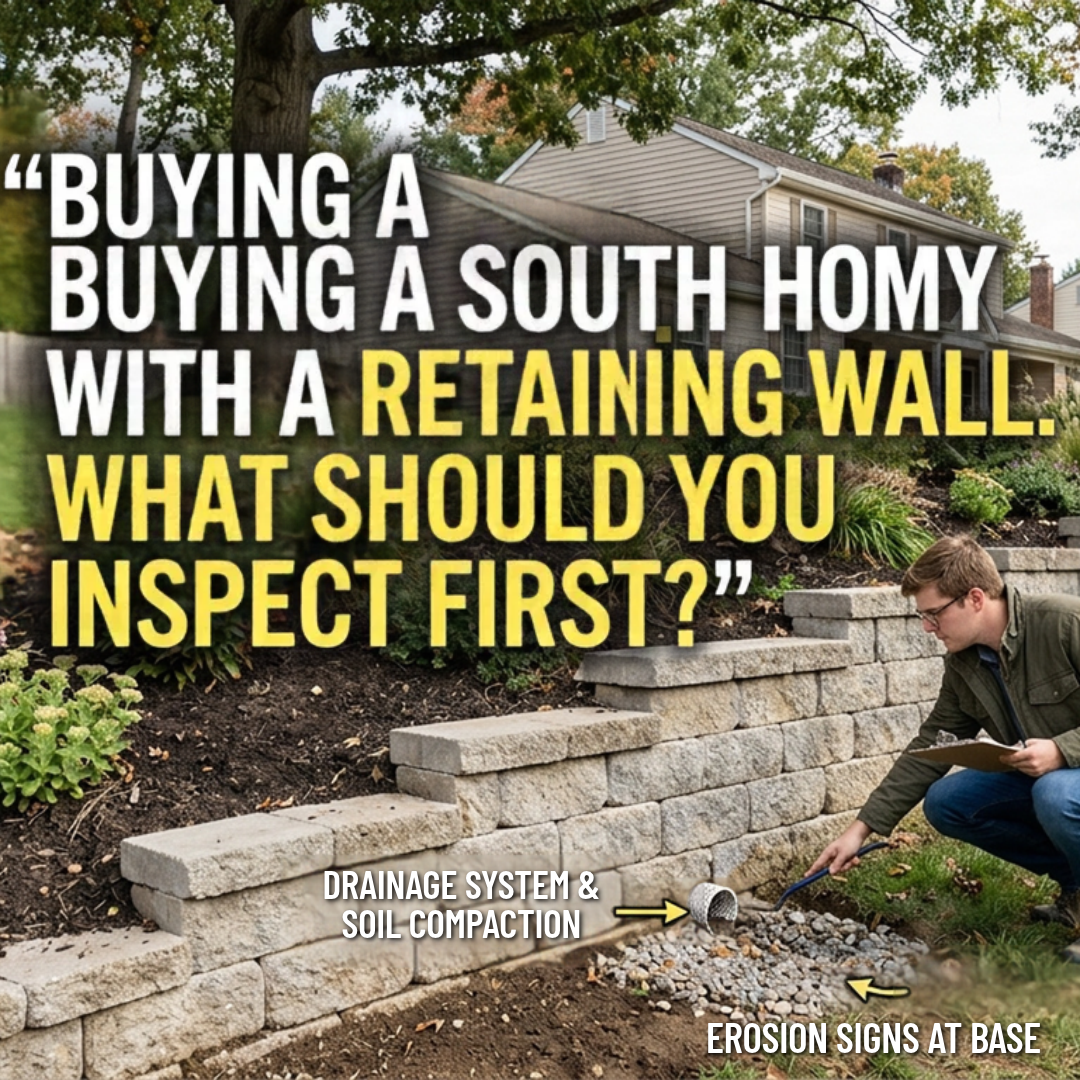
A home with a sloped backyard, terraced garden, elevated patio, or neatly defined outdoor space can make a strong first impression.
Retaining walls often make these features possible. They help manage changes in elevation, support soil, and create usable areas that might otherwise be difficult to landscape or access.
But when you're buying a South Jersey home with a retaining wall, there is an important question to ask before focusing on the landscaping:
Is the wall simply attractive, or is it also functioning properly?
A retaining wall can look perfectly fine from a distance while concealing drainage problems, soil movement, deteriorating materials, or pressure building behind the structure.
Depending on its height, design, location, and the amount of soil it supports, a retaining wall may also represent a significant future maintenance or repair expense.
For buyers, that matters because a problem with the wall may affect more than the wall itself. It could influence the yard, driveway, patio, fencing, nearby structures, or the property's overall usability.
As Mary Murphy of The Murphy Group explains:
“When evaluating a property, buyers should look beyond what makes the backyard attractive. Understanding how important exterior features function—and what they may require over time—can help buyers make more informed decisions.”
The good news is that you don't need to be a structural expert to know what deserves attention.
By recognizing visible warning signs, asking the right questions, and arranging appropriate professional evaluations when necessary, you can better understand the condition of a retaining wall before moving forward with a purchase.
🧱 1. Start by Understanding What the Retaining Wall Supports
Before evaluating the wall's condition, determine what it is actually holding back.
Retaining walls are designed to resist pressure from soil and, depending on the site, additional forces from water, nearby structures, vehicles, or sloped ground.
A small decorative wall around a garden bed may have relatively limited responsibilities.
A taller wall supporting a driveway, elevated patio, neighboring property, or substantial slope may have much greater structural importance.
During your initial walkthrough, look at what sits above and below the wall.
Ask yourself:
- Is the wall holding back a steep slope?
- Is a driveway or parking area located directly behind it?
- Is there a patio, deck, shed, or other structure nearby?
- Does the wall separate two significantly different elevations?
- Could movement affect a walkway, fence, or neighboring property?
These details help establish the level of attention the wall deserves.
Why it matters: The consequences of a retaining-wall failure depend partly on what the wall supports and what could be affected if it moves.
A professional should evaluate walls where the potential consequences or visible conditions warrant further investigation.
🔎 2. Look for Cracks, Gaps, and Separation
Cracks are among the first visible conditions buyers may notice.
However, not every crack means a retaining wall is failing.
The material, crack location, pattern, width, and whether the crack appears to be changing all matter.
Pay attention to:
- Cracks running through concrete
- Gaps between masonry blocks
- Separation between the wall and adjoining structures
- Cracked mortar joints
- Sections that appear to have shifted
- Cracks accompanied by bulging or leaning
A small surface crack in concrete may have a different significance from a large, widening crack associated with movement.
Likewise, cracks that appear alongside water seepage, displaced blocks, or uneven wall sections deserve closer attention.
If you notice a concerning crack, photograph it and ask a qualified professional to assess its significance.
Don't assume that a crack is harmless simply because the seller has painted over it or applied patching material.
📐 3. Check Whether the Wall Is Leaning or Bulging
A retaining wall should be evaluated for changes in alignment.
From a safe viewing position, look along the face of the wall.
Does it appear reasonably consistent, or do certain sections seem to project outward?
Potential warning signs include:
- A wall that visibly leans forward
- Sections that bow outward
- Uneven alignment between blocks
- A top edge that appears wavy or displaced
- Portions that have shifted relative to neighboring sections
Leaning or bulging can indicate that the wall is experiencing pressure or movement beyond what it was designed to accommodate.
Possible contributing factors include water buildup, soil pressure, inadequate drainage, foundation problems, or deterioration.
The underlying cause matters because repairing the visible surface alone may not correct the condition causing the movement.
If the wall appears significantly displaced, avoid climbing on it or walking close to unstable sections. Request a professional evaluation before relying on it as a safe boundary or support structure.
💧 4. Inspect Drainage Before Anything Else Looks Wrong
Water management is one of the most important considerations when evaluating a retaining wall.
Soil behind a wall can become saturated during heavy rain. Depending on the wall's design and drainage provisions, water buildup may increase pressure against the structure.
Over time, inadequate drainage can contribute to movement, cracking, deterioration, or erosion.
Look for:
- Water collecting behind the wall
- Persistent wet spots
- Soil that remains unusually saturated
- Water flowing over the wall in concentrated streams
- Blocked or damaged drainage outlets
- Signs of repeated water staining
- Areas where runoff appears to undermine the base
Also inspect nearby gutters and downspouts.
A downspout that discharges directly behind a retaining wall may direct more water toward the structure than intended.
Likewise, an uphill driveway or sloped lawn may channel runoff toward the wall during storms.
A professional may need to determine whether the wall has an appropriate drainage system and whether it is functioning as intended.
Important: The absence of visible water during a sunny showing doesn't establish that drainage is adequate. If possible, review the property after rainfall or ask the seller about its behavior during heavy storms.
🌧️ 5. Look for Signs of Water Pressure Behind the Wall
Drainage problems don't always present as obvious puddles.
Water can accumulate behind a wall even when the front-facing surface appears relatively dry.
Look for clues such as:
- Persistent dampness along sections of the wall
- Water emerging through unexpected cracks
- Rust-colored staining
- White mineral deposits on masonry
- Repeated erosion near the base
- Soil washing through joints
- Sections that appear to move after wet weather
Some retaining-wall designs intentionally allow water to escape through drainage openings. The presence of an outlet is not automatically a defect.
The question is whether the drainage arrangement is appropriate for the wall's design and whether it is functioning properly.
Ask whether the wall has a documented drainage system, when it was last serviced, and whether the owner has experienced recurring water problems.
If the wall is visibly moving or showing multiple signs of water-related distress, have the cause evaluated before proceeding.
🌱 6. Examine the Soil Above and Below the Wall
The surrounding ground can reveal important clues about the wall's performance.
Look for changes in the soil surface near the top of the wall, particularly where the ground should meet the structure.
Potential concerns include:
- Depressions or sinkholes
- Soil pulling away from the top of the wall
- Freshly exposed roots
- Erosion channels
- Soil accumulating unevenly
- Voids near the base
- Areas that appear to have settled
These conditions may indicate runoff problems, erosion, or movement of soil behind or beneath the wall.
Pay attention to the land immediately below it as well. Soil washing away from the base can affect the support provided to the structure.
Fresh landscaping can sometimes conceal earlier erosion or settlement, so ask whether the grade has been changed or the area recently repaired.
A retaining wall should be evaluated as part of the larger landscape—not as an isolated object.
🧱 7. Identify the Wall's Construction Material
Retaining walls can be built from a variety of materials, and each has different maintenance considerations.
These are preliminary visual checks, not a diagnosis.
Material alone does not determine whether a wall is structurally sound. Its design, age, construction, drainage, soil conditions, and maintenance history all matter.
📏 8. Pay Special Attention to Taller Retaining Walls
Wall height can affect the amount of pressure the structure must resist and the complexity of its design.
A taller retaining wall may require more substantial foundations, reinforcement, drainage, or engineering than a short decorative wall.
The risk can be greater when the wall supports a steep slope, driveway, building, or other surcharge above it.
During your inspection, determine:
- Approximately how tall the wall is
- Whether the height changes along its length
- Whether multiple tiers work together to retain the slope
- Whether structures or vehicles sit above it
- Whether there are signs of movement or water problems
Don't assume that a tall wall is defective simply because it is tall.
Instead, recognize that its structural role may justify a more specialized evaluation, especially when documentation is missing or visible concerns are present.
🚗 9. Check for Driveways, Patios, and Structures Above the Wall
A retaining wall may support more than soil.
The area above it could contain a driveway, parking pad, patio, outdoor kitchen, shed, or other structure.
These features can add loads that affect the wall's design requirements.
For example, a wall supporting soil below a frequently used driveway may face different demands from one supporting a lightly landscaped garden.
Look for:
- Cracks in nearby pavement
- Settlement along the driveway edge
- Gaps between a patio and the ground
- Fence posts that have shifted
- Uneven steps
- Separation between nearby structures and the wall
These conditions don't necessarily prove that the retaining wall is responsible.
They do, however, provide reasons to ask whether the wall and adjacent surfaces have moved or settled.
If the wall supports a driveway or structure, a qualified engineer may need to evaluate both the wall and the surrounding conditions.
🌳 10. Evaluate Trees and Large Roots Near the Wall
Mature trees can add considerable appeal to a South Jersey property.
However, trees and large root systems near retaining walls deserve attention.
Depending on the species, root growth, soil conditions, and wall construction, roots may contribute to displacement or interfere with drainage.
Look for:
- Large roots pressing against the wall
- Roots growing through masonry joints
- Trees leaning near a visibly moving wall
- Soil displacement around the trunk
- Root growth near drainage outlets
Tree roots are not automatically a problem, and removing a mature tree can introduce its own risks and costs.
If a tree appears to be affecting the wall, consult an appropriate tree professional and, where structural concerns exist, a qualified retaining-wall specialist or engineer.
Avoid cutting large roots or removing established trees without understanding the potential consequences for both the tree and the slope.
🛠️ 11. Ask Whether the Retaining Wall Has Been Repaired Before
A wall's repair history can provide useful context.
Ask the seller whether the wall has experienced:
- Cracking
- Leaning
- Drainage problems
- Erosion
- Settlement
- Partial reconstruction
- Repeated patching
If repairs were performed, request available documentation.
Useful records may include:
- Contractor invoices
- Engineering reports
- Repair proposals
- Permits and approvals, where applicable
- Drainage work records
- Warranties
- Before-and-after photographs
A repaired wall is not automatically a problem. Properly designed and completed repairs may address an earlier issue.
The important question is whether the cause was identified, whether the work was appropriate, and whether the problem has returned.
A fresh coat of paint or new landscaping may improve appearance without explaining the wall's underlying condition.
📄 12. Verify Permits and Local Requirements When Applicable
Depending on its height, location, design, and surrounding conditions, a retaining wall may be subject to municipal construction requirements or other approvals.
New Jersey requirements can depend on the project and applicable code provisions. Local zoning, grading, drainage, or other requirements may also be relevant.
Ask the seller whether the wall was professionally designed or installed and whether permits, approvals, or inspections were required and obtained.
You can also ask the municipality's construction office or other appropriate department about available records.
Consider questions such as:
- Was a permit required for the original wall?
- Are permit records available?
- Were later modifications approved when required?
- Was an engineer involved?
- Were any conditions attached to the approval?
- Are there unresolved municipal notices?
Do not assume that every retaining wall requires a permit—or that a wall without readily available paperwork is automatically illegal.
Requirements depend on the specific circumstances. Verify them with the municipality rather than relying on a general rule or the seller's recollection.
🗺️ 13. Check Property Boundaries and Wall Ownership
A retaining wall located near a property line can introduce questions about ownership, maintenance, and responsibility.
This is particularly important if the wall separates neighboring yards or supports land on both sides of a boundary.
Before buying, establish:
- Where the property line is located
- Whether the wall sits entirely on the property
- Whether any easements affect the area
- Whether a neighbor uses or relies on the wall
- Whether there are written maintenance agreements
- Whether access is needed from adjoining land for repairs
A fence, landscaping edge, or old marker does not necessarily establish the legal boundary.
If the location is uncertain, review the available survey and consider whether a licensed surveyor or real estate attorney should be consulted.
Do not assume that the homeowner automatically owns or is solely responsible for every wall visible within the yard.
🏘️ 14. Consider the Impact on Neighboring Properties
Retaining walls can affect more than the property where they are located.
A wall may support soil near a neighboring driveway, yard, building, or shared access area.
If movement or drainage problems develop, the consequences may extend beyond the wall itself.
Look for:
- A neighboring driveway close to the wall
- Signs of erosion on either side
- Shared fences attached to the structure
- Water flowing onto adjoining property
- Evidence of past disputes or repair arrangements
Ask whether the seller knows of any complaints, agreements, or recurring problems involving the wall.
If responsibility or access is unclear, seek clarification before closing.
This is not about assuming that a neighbor will create problems. It is about understanding the property's physical and legal circumstances before taking ownership.
🌧️ 15. Consider South Jersey's Rainfall and Drainage Conditions
South Jersey properties can vary considerably in topography, soil conditions, drainage patterns, and proximity to waterways.
Some homes have relatively flat yards, while others have sloped lots or landscaping that relies on retaining walls to create usable outdoor space.
During due diligence, consider how water moves across the property.
Questions worth asking include:
- Does runoff flow toward the wall?
- Does the yard remain wet after rain?
- Are nearby downspouts directed away from the structure?
- Has the owner experienced erosion or standing water?
- Are drainage improvements documented?
- Does the wall sit near a low-lying area or watercourse?
A retaining wall is not automatically a flood-risk indicator, and a property outside a mapped flood zone can still experience localized drainage problems.
Evaluate the actual site conditions and, where relevant, review available flood and drainage information separately from the wall's structural assessment.
💰 16. Understand the Potential Cost of Repair or Replacement
One of the most important questions for buyers is what happens if the wall needs work.
Repair costs can vary significantly depending on:
- Wall height and length
- Construction material
- Accessibility
- Amount of soil retained
- Drainage requirements
- Whether engineering is necessary
- Nearby structures
- Extent of movement or deterioration
- Whether partial repair is feasible
A small, localized masonry repair is very different from rebuilding a tall wall that supports a driveway or steep slope.
In some situations, correcting drainage may be part of the solution. In others, the wall may require reinforcement, partial reconstruction, or complete replacement.
Avoid relying on a casual estimate from someone who has only viewed the wall from a distance.
If the condition could materially affect your purchase decision, obtain a written evaluation and cost estimate from appropriately qualified professionals.
This information can help you determine whether the property remains within your budget and whether further negotiations are warranted.
🏠 17. Don't Assume a Standard Home Inspection Is Enough
A general home inspection can be valuable for identifying visible concerns around a property.
However, the scope of a standard inspection may not include a detailed structural engineering analysis of a retaining wall.
If the inspector identifies leaning, bulging, significant cracking, drainage concerns, or other signs of movement, ask whether a specialist should evaluate the wall.
Depending on the situation, the appropriate professional may be:
- A licensed professional engineer with relevant experience
- A qualified retaining-wall contractor
- A drainage specialist
- A licensed surveyor for boundary questions
- A municipal official for permit and approval questions
The right professional depends on the concern.
For example, a contractor may provide a repair proposal, while an engineer can assess structural performance and the underlying cause of movement.
When structural stability is in question, an engineering assessment may be particularly important.
📝 18. Ask These Questions Before Making an Offer
You don't need to wait until the inspection period to begin gathering information.
If a retaining wall is an important part of the property's layout, ask the seller or listing agent about its history and maintenance.
Useful questions include:
- Approximately when was the wall built?
- Who designed or installed it?
- Are plans or engineering documents available?
- Were permits or approvals required and obtained?
- Has the wall ever leaned, cracked, or moved?
- Has water collected behind or around it?
- Has the wall been repaired or rebuilt?
- Are drainage outlets or other drainage features present?
- Does the wall support a driveway, patio, or other structure?
- Is the wall near or on a property boundary?
- Are there shared maintenance responsibilities?
- Have any contractors or engineers recommended additional work?
Not every seller will have complete records, especially for older properties.
Missing documentation does not automatically mean the wall is defective, but it may increase the importance of a professional assessment.
🔍 19. What Should You Do If the Inspection Finds a Problem?
Discovering a concern doesn't necessarily mean you must walk away from the property.
The next step is to understand the issue and its implications.
Depending on the purchase agreement and the nature of the finding, buyers may explore options such as:
- Requesting a specialist evaluation
- Obtaining repair estimates
- Asking the seller for additional records
- Negotiating repairs or other terms
- Evaluating the likely cost of future work
- Proceeding with a clearer understanding of the risk
Your options depend on the contract, applicable deadlines, and the seller's willingness to negotiate.
Consult your real estate agent and, when appropriate, your attorney before making decisions that affect contractual rights.
The objective is not to demand repairs for every cosmetic imperfection. It is to determine whether the wall is safe, functional, and financially manageable for your intended ownership.
🚩 20. Warning Signs That Deserve Prompt Professional Attention
Some conditions warrant a more cautious approach than routine maintenance.
Arrange a prompt professional evaluation if you observe:
- Significant leaning or bulging
- Large or widening cracks
- Rapidly changing alignment
- Soil visibly escaping from behind the wall
- A sinkhole or void near the wall
- Severe erosion beneath the structure
- Separation near a supported driveway or building
- Multiple signs of water-related damage and movement
If the wall appears unstable, keep people away from the affected area and avoid placing additional loads above it until it has been assessed.
These conditions do not establish the exact cause or required repair, but they are reasons not to rely on appearance alone.
📋 Retaining-Wall Buyer Checklist
Before moving forward with a South Jersey home, use this checklist to organize your due diligence.
Visible condition
-
No obvious significant leaning or bulging
-
Cracks and displaced sections have been evaluated where necessary
-
No unexplained soil loss or severe erosion
-
Nearby pavement, fencing, and structures appear stable
Drainage
-
Water flow around the wall has been considered
-
Downspouts and surface runoff have been reviewed
-
Drainage outlets have been examined where accessible
-
Past water or erosion issues have been discussed
Documentation
-
Available construction and repair records have been reviewed
-
Relevant permits and approvals have been checked when applicable
-
Property boundaries and shared responsibilities are understood
-
Any recommended professional assessment has been completed
Financial planning
-
Potential repairs have been estimated when needed
-
Future maintenance has been considered
-
Any unresolved concerns have been discussed before contractual deadlines
💼 How The Murphy Group Helps Buyers Look Beyond the Surface
At The Murphy Group, evaluating a home means considering more than its finishes, layout, and curb appeal.
Exterior structures, drainage, property boundaries, maintenance history, and potential future expenses can all influence the ownership experience.
When a property includes a retaining wall, buyers may benefit from identifying visible concerns early, gathering available documentation, and coordinating appropriate professional evaluations before making a final decision.
Mary Murphy explains:
“A beautiful property should also make sense from a practical standpoint. Understanding the condition of the features that support and protect the property helps buyers make decisions with greater confidence.”
The Murphy Group helps buyers navigate the questions that arise during the home search and connect property concerns to the broader purchasing decision.
📊 The Bottom Line
When buying a South Jersey home with a retaining wall, start by looking beyond the landscaping.
Pay attention to:
- Cracks and movement
- Leaning or bulging
- Drainage and water pressure
- Soil erosion
- Nearby driveways and structures
- Construction and repair history
- Permits and property boundaries
- Potential repair and maintenance costs
A retaining wall is not automatically a liability. A properly designed, maintained, and functioning wall can be an important part of a property's usable outdoor space.
The key is understanding what the wall supports, how it manages water, whether there are signs of movement, and what professional evaluation may be appropriate.
Before you buy, make sure the wall is more than visually appealing. Make sure you understand its condition, responsibilities, and potential costs.
📲 Thinking About Buying a South Jersey Home?
The Murphy Group helps buyers evaluate properties with a practical, informed approach—so you can look beyond first impressions and ask the right questions before making an offer.
👉 Start here: www.mgsells.com

Mary Murphy
Team Leader | The Murphy Group | eXp Realty, LLC | PLACE
or another way