

Categories
buyer tips, Burlington County, Camden County, Gloucester County, Home Buying Tips, Home Buying Guides, NJ Housing, New Jersey Real Estate, Real Estate Guides, South Jersey Real Estate, property valuePublished October 19, 2026
Buying a Home Near Farmland in South Jersey: Everyday Benefits and Potential Trade-Offs

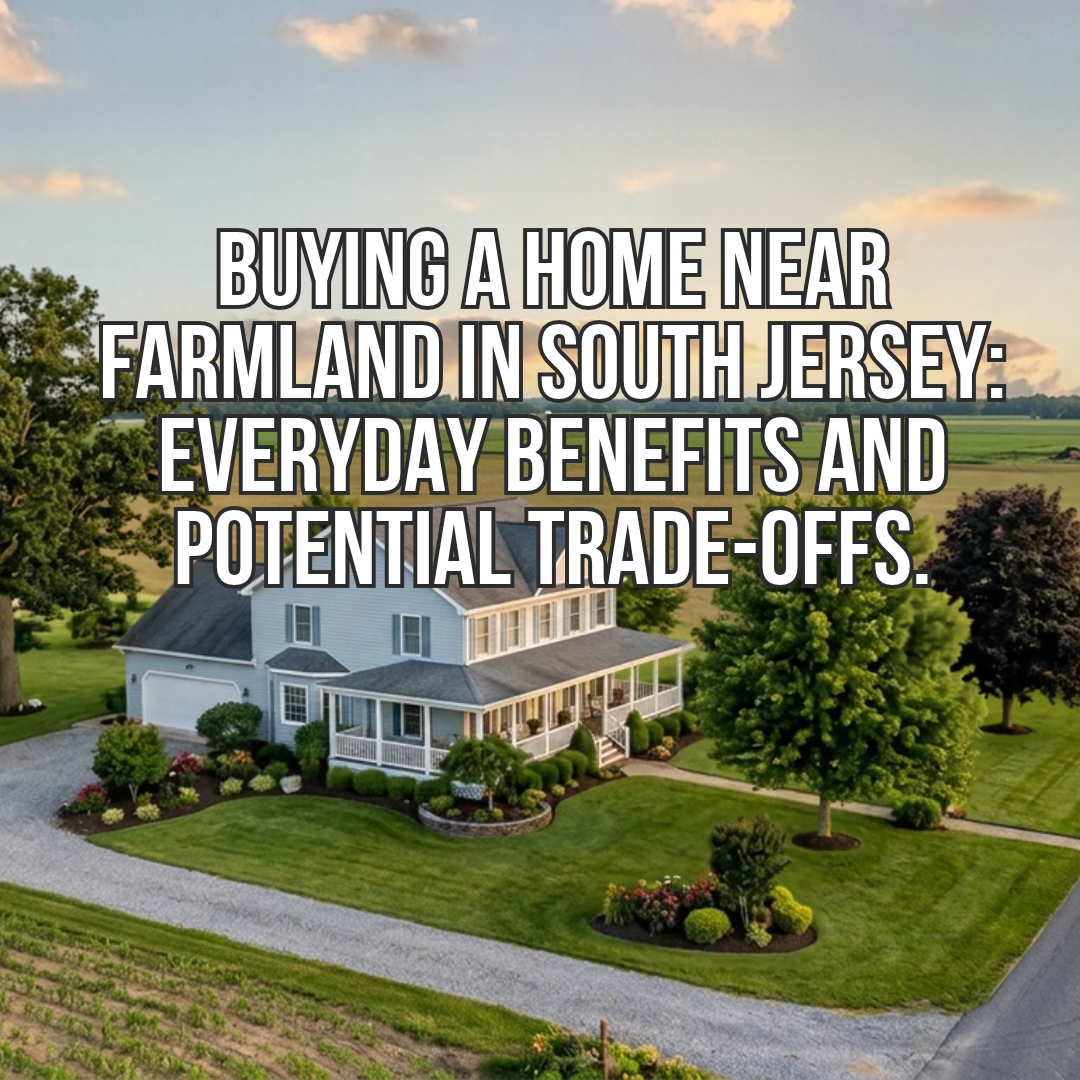
Imagine waking up to open fields, expansive views, and a quieter setting than you might find in a more densely developed neighborhood.
For some homebuyers, living near farmland in South Jersey offers exactly the lifestyle they want. The surrounding landscape can feel spacious, scenic, and connected to the region's agricultural heritage.
But buying a home near an active farm also means understanding how agricultural operations may affect everyday life. Seasonal machinery, early-morning activity, farm odors, dust, and changes in nearby land use can all influence the ownership experience.
The important distinction is that a home near farmland can offer a wonderful lifestyle, but buyers should understand both the property's surroundings today and the possibilities for the land nearby.
As Mary Murphy of The Murphy Group explains:
"Location is about more than the town or neighborhood name. It's also about what surrounds a property, how that environment fits your lifestyle, and what you should understand before making a long-term commitment."
Here's what South Jersey buyers should consider before purchasing a home near farmland.
🌾 1. Enjoy More Open Views and a Less Developed Setting
One of the most appealing features of a home near farmland is the sense of openness.
Instead of looking directly into another backyard or a row of closely spaced homes, you may enjoy views across fields, orchards, pastures, or other agricultural landscapes.
Depending on the property, this can offer:
- Wider views from windows and outdoor seating areas
- A greater sense of space
- More visually appealing surroundings
- Opportunities to enjoy changing seasonal landscapes
- A setting that feels less densely developed
For buyers who value scenery and a connection to the outdoors, these features can be a meaningful part of the property's appeal.
However, open views should not automatically be interpreted as permanent. The appearance and use of nearby land depend on ownership, zoning, applicable development rights, and any recorded restrictions.
Before buying, investigate whether the farmland is enrolled in a preservation program or subject to other limitations on development.
🏡 2. Understand What Farmland Preservation Actually Means
South Jersey includes agricultural areas where farmland preservation programs help protect land for continued agricultural use.
New Jersey's State Agriculture Development Committee administers the Farmland Preservation Program, which can involve purchasing development easements or acquiring farmland with restrictions intended to preserve agricultural use.
But there is an important distinction between seeing farmland today and knowing it is legally preserved.
A neighboring field may be:
- Privately owned farmland without a preservation easement
- Farmland enrolled in a qualifying preservation program
- Land subject to agricultural or other deed restrictions
- A property with a different permitted future use under local planning rules
If long-term open views are a major reason for buying, ask what is known about the land and review available records.
The New Jersey State Agriculture Development Committee provides information about preserved farms and the state's preservation programs. Your municipal planning office, county planning department, or county agriculture development board may also be able to help you locate relevant records.
Important: Even preserved farmland is not necessarily public land. Preservation generally restricts certain development rights; it does not automatically grant neighboring homeowners access to the property.
🚜 3. Prepare for Seasonal Farm Equipment and Early-Morning Activity
A farm may look quiet during a weekend showing, but agricultural work follows seasonal schedules rather than typical residential routines.
Depending on the type of operation, activity may increase during planting, cultivation, harvesting, or other periods of the agricultural calendar.
You may occasionally hear or see:
- Tractors and other heavy equipment
- Farm vehicles entering or leaving the property
- Machinery operating early in the morning
- Harvesting activity during busy periods
- Equipment moving along nearby roads
- Workers carrying out seasonal tasks
The amount of activity varies considerably. A small orchard, a crop-producing farm, and a livestock operation may have very different schedules and equipment needs.
Before buying, visit the neighborhood at different times and ask the seller what they have experienced throughout the year.
If you work from home, have young children, or are particularly sensitive to noise, consider whether seasonal activity would affect your comfort.
A quiet afternoon does not necessarily represent the property's typical environment during the busiest farming periods.
🌱 4. Understand Farm Odors and Dust
Agricultural activity can sometimes produce odors and airborne dust, particularly during certain seasons or weather conditions.
Depending on the operation, these may come from:
- Manure or other organic materials
- Livestock and animal bedding
- Fertilizer applications
- Soil cultivation
- Harvesting and field preparation
- Dry conditions and wind carrying dust
Not every farm produces noticeable odors, and the intensity can vary by season, wind direction, farming practices, and distance from the home.
Before purchasing, consider how the prevailing wind direction may carry odors or dust toward the property.
Look at the location of outdoor living areas, openable windows, patios, and bedroom windows. A home with a sheltered backyard may provide a different experience from one directly exposed to the surrounding fields.
If possible, visit during a period when the farm is actively operating.
The goal is not to assume these conditions will be problematic, but to understand what living near the specific operation may involve.
🧪 5. Ask Questions About Agricultural Spraying and Pesticide Use
Some farms use pesticides or other crop-protection products as part of their agricultural operations. Whether this is relevant to a neighboring home depends on the type of farming, the products used, application practices, and proximity.
Buyers should not assume that every farm sprays crops or that living nearby automatically creates an unsafe environment.
Instead, ask reasonable questions about the surrounding operation and evaluate any property-specific concerns.
Consider:
- What crops are grown nearby?
- Is the operation seasonal?
- Are fields directly adjacent to the home's yard?
- Are there records or information about nearby agricultural practices?
- Are there sensitive outdoor areas, such as gardens or play spaces, close to the fields?
- Are there applicable state or federal requirements governing pesticide use?
New Jersey's Right to Farm framework addresses agricultural management practices, including pesticide control, fertilizer application, and soil and water management. Specific requirements depend on the circumstances and applicable regulations.
If you have a specific concern about pesticide exposure, ask an appropriate environmental or public-health professional for property-specific guidance rather than relying on assumptions based on distance alone.
🚚 6. Evaluate Farm Traffic and Road Conditions
Homes near working farms may experience agricultural vehicles using nearby roads, particularly during busy seasons.
Depending on the location, you may encounter:
- Tractors and trailers
- Trucks transporting produce or supplies
- Slow-moving farm vehicles
- Increased activity during harvest
- Vehicles entering or leaving farm driveways
- Occasional road debris or mud associated with agricultural work
The impact depends on the road, the size of the farm operation, the home's proximity to entrances, and local traffic patterns.
When visiting the property, examine the road's width, sightlines, shoulders, and driveway access.
Ask whether traffic changes noticeably during planting or harvest periods.
If the property is located near a narrow road or a farm entrance, pay particular attention to how easily you can enter and exit your driveway.
A setting that feels peaceful when traffic is light may have a different rhythm during the busiest agricultural periods.
🌳 7. Consider Privacy Without Assuming the Land Is Yours
Farmland can create a feeling of privacy because there may be fewer nearby houses or buildings.
However, the open area beside your property belongs to someone else unless the property boundaries and ownership records establish otherwise.
This means you should not assume you can:
- Walk through the fields
- Use farm roads for recreation
- Store equipment on neighboring land
- Extend landscaping beyond your boundary
- Install fencing outside your property
- Enter the farm to reach a more convenient destination
New Jersey's farmland preservation program explicitly states that preserved farmland does not automatically become public property. Access remains subject to the landowner's consent and applicable rights.
Review your own property survey and clarify any easements or access rights that matter to your intended use.
If privacy is a priority, evaluate what the home itself provides through its layout, landscaping, fencing, and setbacks rather than relying entirely on the presence of an open field.
🏞️ 8. Investigate Whether Nearby Land Could Be Developed
One of the biggest questions buyers ask is whether the open land surrounding a home will remain open.
The answer depends on the land's ownership, zoning, development rights, recorded restrictions, and applicable planning decisions.
Some land is permanently preserved for agricultural use. Other land may have development potential, subject to local and state requirements.
Before buying, consider checking:
- Municipal zoning maps
- Master plan and land-use documents
- County planning records
- Recorded development easements
- Farmland preservation records
- Pending development applications, where publicly available
The New Jersey Farmland Preservation Program explains that development easements can restrict nonagricultural development and that those restrictions remain in place for future owners of the preserved land.
However, a nearby parcel's current appearance does not establish its future status.
If the property's appeal depends heavily on permanent open views, verify what is known about the adjacent land before making a decision.
🐄 9. Consider Whether the Farm Has Livestock
Not all farmland is used for growing crops. Some agricultural properties raise livestock or keep horses and other animals.
Depending on the operation, nearby homeowners may notice:
- Animal sounds
- Manure-related odors
- Feed or bedding deliveries
- Livestock movement
- Additional fencing
- Increased activity around barns and outbuildings
The experience can vary significantly between different types of farms.
A pasture with a small number of animals may have a different effect on the surrounding area than a larger commercial livestock operation.
If you are considering a property near a farm with animals, observe the distance between the home and the farm's active areas.
Also consider where you intend to place patios, outdoor dining areas, gardens, and bedroom windows.
Understanding the actual operation is more useful than assuming that every agricultural property will have the same environmental conditions.
💧 10. Check Drainage, Flooding, and Ground Conditions
The presence of farmland does not automatically mean a nearby home has drainage problems. However, the broader landscape, elevation, soil, ditches, and stormwater patterns can influence local conditions.
Before purchasing, investigate:
- Whether water collects in the yard after heavy rain
- Whether the property sits at a lower elevation than nearby fields
- Whether drainage ditches or culverts are present
- Whether water enters the basement or crawl space
- Whether the driveway experiences recurring runoff
- Whether there is evidence of erosion or standing water
Ask the seller about previous water intrusion and review the home inspection report for drainage concerns.
You may also want to consult applicable flood maps and request a professional assessment if the property has a history of flooding or is located near drainage channels.
Do not assume that the farm next door is responsible for water issues simply because it is adjacent to the property. Drainage concerns require an evaluation of the actual terrain, water pathways, and relevant property conditions.
🌞 11. Evaluate Sunlight, Wind, and Outdoor Comfort
An open agricultural landscape can affect the way a property experiences sunlight and wind.
With fewer nearby buildings or tall structures, some homes may receive more direct sunlight or experience greater wind exposure.
Consider how the property's orientation affects:
- Morning and afternoon sunlight
- Summer heat around patios and decks
- Wind exposure in outdoor seating areas
- Winter conditions near entryways
- Gardening and planting plans
- The comfort of outdoor recreation areas
Trees, hedges, fences, and other landscaping can help create shelter or shade, but they also require maintenance and may be subject to property restrictions.
If you plan to garden, install a patio, or spend considerable time outdoors, evaluate the property's actual conditions rather than assuming open views automatically create a more comfortable yard.
🌻 12. Think About Gardens, Pets, and Outdoor Living
For many buyers, the appeal of living near farmland extends to the opportunity to enjoy their own outdoor space.
You may want to create:
- A vegetable garden
- A flower garden
- A shaded seating area
- A fenced space for pets
- A play area
- An outdoor dining area
- A small orchard or landscaped yard
Before planning these improvements, confirm the boundaries of your property and any applicable local restrictions.
If agricultural activity occurs nearby, consider whether dust, seasonal noise, wind, or other conditions could affect how you use your outdoor space.
For pet owners, a secure fence and clear property boundaries are particularly important. Never assume an adjacent farm is available for dog walking or other recreation without permission.
A home near farmland can offer an appealing outdoor lifestyle, but your plans should be based on the property's actual features and legal boundaries.
🛒 13. Explore the Benefits of Living Near Local Agriculture
One potential advantage of buying near farmland is greater proximity to local agricultural businesses and seasonal activities.
Depending on the area, nearby destinations may include:
- Farm stands
- Pick-your-own orchards
- Seasonal produce markets
- Flower farms
- Agricultural events
- Local food businesses
These amenities can make it easier to enjoy locally grown products and connect with the area's agricultural character.
However, not every farm welcomes visitors or operates a public retail business. A working farm may be privately owned and have no public access.
If local farm stands or seasonal attractions are important to you, identify which businesses are actually open to customers and check their operating schedules.
Treat nearby agricultural amenities as a bonus to verify, not a feature to assume comes with the property.
🏘️ 14. Understand New Jersey's Right to Farm Act
New Jersey has a Right to Farm Act designed to protect qualifying commercial agricultural operations that comply with applicable agricultural management practices and legal requirements.
The law helps balance the continuation of agricultural activity with the interests of neighboring property owners. Its protections are not unlimited, and eligibility and compliance depend on the particular circumstances.
Why should homebuyers care?
Because certain normal agricultural activities may be protected even when nearby residents find them inconvenient.
Depending on the operation, these activities may include agricultural noise, traffic, dust, fertilizer application, and other farming practices.
Before purchasing, consider whether you are comfortable living near an active agricultural operation and understand that its activities may continue after you move in.
The New Jersey State Agriculture Development Committee also administers a Right to Farm Program that helps address disputes involving qualifying farms and their neighbors.
If you have questions about a particular operation or a potential conflict, consult the appropriate county agriculture development board or the State Agriculture Development Committee.
📈 15. How Living Near Farmland May Affect Resale Value
A home near farmland may appeal strongly to buyers who value scenery, open space, and a less densely developed setting.
Other buyers may be more concerned about seasonal farm activity, odors, traffic, or uncertainty about nearby development.
This means proximity to farmland is not automatically a benefit or a drawback in resale terms.
Factors that may influence future buyer interest include:
- The property's condition and overall appeal
- The distance from active farm operations
- The type of agriculture nearby
- The character of the surrounding roads
- Whether open land is permanently preserved
- The availability of nearby services
- Comparable sales in the same area
If you are buying with future resale in mind, compare the property with similar homes in the local market rather than assuming that farmland views will automatically increase its value.
A home that fits a specific buyer's lifestyle can be highly appealing, but marketability depends on the actual property and the buyers active in that area.
💰 16. Compare the Total Cost of Ownership
When comparing a home near farmland with one in a more developed neighborhood, look beyond the purchase price.
Consider the costs associated with:
| Ownership factor | What to investigate |
|---|---|
| Landscaping | Will additional screening, trees, or fencing be desirable? |
| Maintenance | Does the property have a long driveway, drainage features, or extensive outdoor space? |
| Insurance | Are premiums affected by the home's location, construction, or specific risks? |
| Utilities | Are municipal services available, or does the property use a private well or septic system? |
| Transportation | How far are grocery stores, schools, healthcare, and work destinations? |
| Outdoor improvements | Will your plans require permits or additional professional work? |
| Resale | How does the property's location compare with recent local sales? |
These costs vary by property. Living near farmland does not automatically mean lower taxes, cheaper insurance, or reduced maintenance.
If the home uses a private well or septic system, investigate those systems independently as part of your due diligence.
The objective is to understand the full cost of living in the property, not simply whether the surrounding scenery is appealing.
📋 17. Questions to Ask Before Buying a Home Near Farmland
Before submitting an offer or completing your due diligence, consider asking the seller, your real estate agent, and the appropriate local authorities:
- What type of agricultural operation is nearby?
- Is the farm active year-round or primarily seasonal?
- Have there been noticeable changes in noise, odors, or traffic during farming seasons?
- Is the neighboring farmland enrolled in a preservation program?
- Are there known development applications affecting nearby parcels?
- Does the property have a history of drainage or flooding issues?
- Are there any easements or access arrangements involving neighboring land?
- Does the home use public utilities, a private well, or a septic system?
- How far away are essential services and major roads?
- What comparable homes have sold nearby, and how do their locations compare?
You may not be able to obtain a definitive answer to every question. Still, the information you collect can help you understand the property's setting and identify issues that deserve further review.
💼 How The Murphy Group Helps Buyers Evaluate Location
At The Murphy Group, choosing the right home involves more than comparing bedrooms, square footage, and asking prices.
The property's surroundings can influence everyday comfort, future plans, and resale appeal. That's why understanding the location is an important part of evaluating a potential purchase.
For buyers considering homes near farmland, the goal is to help them identify relevant questions, understand the local setting, and recognize when further research may be appropriate.
A home near farmland can be an excellent fit for buyers who appreciate open views and an agricultural setting. The key is making sure the property's surroundings align with your expectations and lifestyle.
📊 The Bottom Line
Buying a home near farmland in South Jersey can offer scenic views, a more open setting, and opportunities to enjoy the region's agricultural character.
At the same time, buyers should understand the potential trade-offs, including:
- Seasonal machinery and farm traffic
- Agricultural odors and dust
- Potential pesticide or fertilizer applications
- Less privacy along exposed property boundaries
- Uncertainty about nearby land use
- Drainage and environmental considerations
- The implications of New Jersey's Right to Farm Act
The best decision comes from understanding both the lifestyle benefits and the realities of living near an active agricultural operation.
Before closing, investigate the specific farm, verify relevant land-use information, evaluate the home's condition, and consider how the location fits your everyday routine.
📲 Thinking About Buying a Home in South Jersey?
The Murphy Group helps buyers evaluate homes, understand local market considerations, and make informed decisions about their next move.
👉 Start here: www.mgsells.com

Mary Murphy
Team Leader | The Murphy Group | eXp Realty, LLC | PLACE
or another way