

Categories
South Jersey Real Estate, South Jersey home prices, NJ Housing, home value, Camden County, Burlington County, Gloucester County, Home Buying Guides, Housing Guide, New Jersey Real Estate, Real Estate GuidesPublished September 14, 2026
Why Your Home Could Be Worth More—or Less—Than the House Next Door

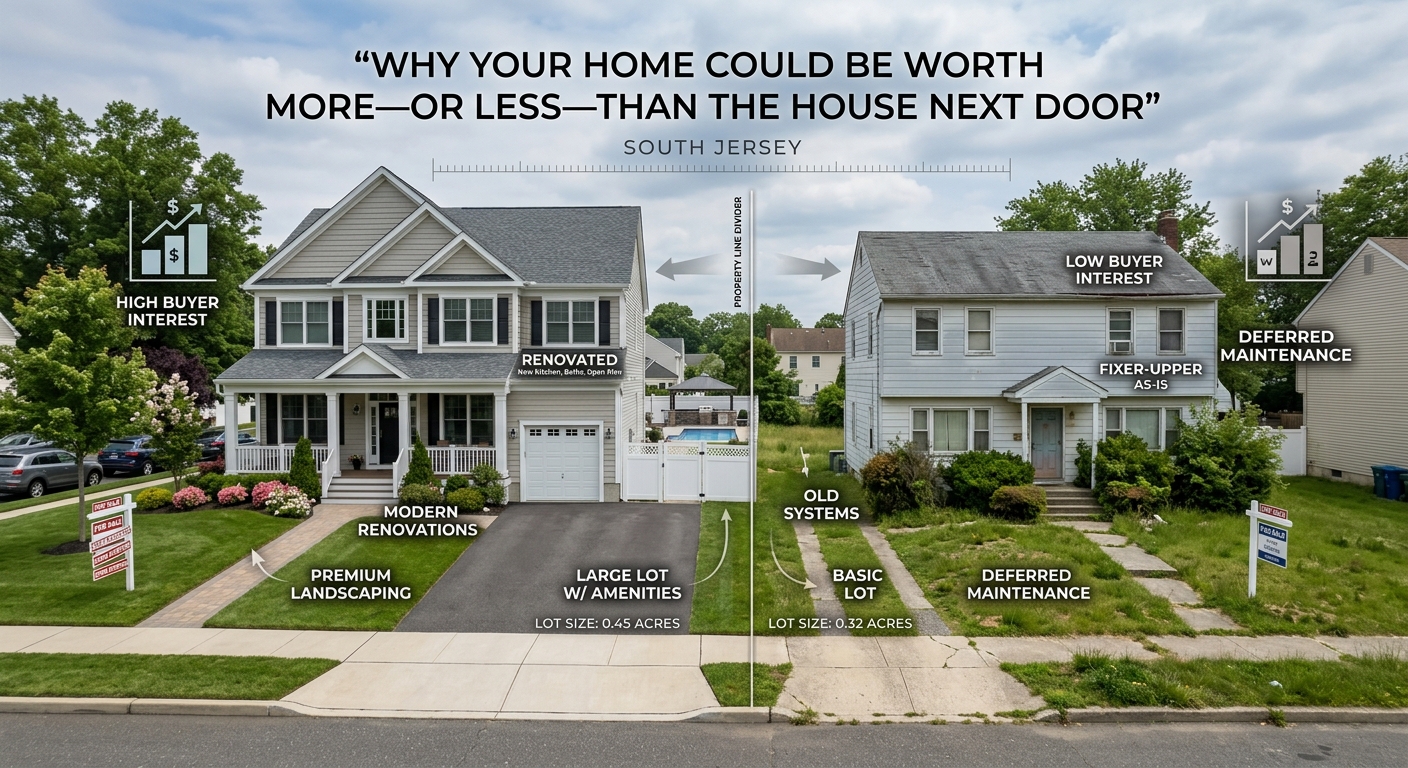
You look at the house next door and think:
“Our homes are practically identical. Why would one be worth more?”
It's a reasonable question.
Two homes can sit on the same street, have similar square footage, and even have the same number of bedrooms—and still sell for noticeably different prices.
That's because real estate value isn't determined by one number.
It's the combination of condition, layout, lot, updates, location, presentation, buyer demand, and timing.
And in South Jersey, those differences can become especially important when buyers are comparing multiple homes within the same neighborhood.
As Mary Murphy of The Murphy Group explains:
“Two homes can look similar on paper and still feel completely different to a buyer. Value comes from the details buyers notice—and sometimes the details they don't see until they look closer.”
🏡 Why “Same Street” Doesn't Mean “Same Value”
One of the biggest misconceptions homeowners have is that nearby homes should have nearly identical values.
But proximity is only one factor.
A buyer doesn't purchase a street address based solely on its location.
They're evaluating the entire property.
That includes:
- Lot size and shape
- Interior layout
- Renovations
- Natural light
- Privacy
- Outdoor space
- Parking
- Maintenance history
- Condition of major systems
- Curb appeal
- Neighborhood setting
Even small differences can influence how buyers perceive value.
💰 1. The Lot Can Change Everything
Two homes can have similar interiors but completely different lots.
One might have:
- A larger backyard
- Better privacy
- A more usable shape
- Mature landscaping
- A better position within the neighborhood
The other might have a smaller or less functional outdoor area.
For buyers who value outdoor living, pets, entertaining, gardening, or future improvements, that difference can matter significantly.
The land itself can become part of the home's competitive advantage.
🌞 2. Natural Light Changes How a Home Feels
Square footage tells buyers how much space they have.
Light influences how they experience that space.
A home with:
- Better window placement
- Southern or favorable exposure
- Fewer obstructions
- Open sightlines
- Bright living areas
may feel larger, warmer, and more inviting.
Meanwhile, a similarly sized home with darker rooms can feel less spacious.
That emotional difference can influence buyer demand even when the floor plans look similar.
🛋️ 3. The Floor Plan May Be Worth More Than the Square Footage
Two homes can have the same amount of living space but completely different functionality.
One may offer:
- Better bedroom separation
- More practical storage
- A dedicated home office
- Better kitchen flow
- A more usable family room
- Fewer awkward transition spaces
The other may technically have the same square footage but require buyers to compromise.
That's why usable space can matter more than simply having more space.
🔨 4. Renovations Can Create a Major Value Difference
Imagine two neighboring homes.
Both are 2,000 square feet.
But one has a recently renovated:
- Kitchen
- Bathrooms
- Flooring
- Lighting
- HVAC system
- Roof
while the other still has several original features.
The homes may be similar structurally, but they're offering very different experiences to today's buyers.
The renovated property may attract buyers who want convenience and fewer immediate projects.
The other may appeal to buyers willing to trade lower upfront cost for future improvements.
🏠 5. Maintenance History Matters
A home's value isn't just about what has been replaced.
It's also about how well the property has been maintained.
Buyers may feel more confident when sellers can provide information about:
- Roof maintenance
- HVAC servicing
- Plumbing repairs
- Electrical updates
- Appliance replacement
- Exterior maintenance
A well-documented maintenance history can reduce uncertainty.
And reducing uncertainty can make a home easier for buyers to feel confident about.
🚗 6. Parking Can Make One Home More Desirable
Parking isn't equally convenient on every property.
One home might have:
- A two-car garage
- A long driveway
- Easy street parking
- Additional guest parking
while the neighboring home may have limited parking options.
This can become particularly important for households with multiple vehicles, guests, or larger families.
The difference may look minor in a listing description.
To a buyer, it can be an everyday quality-of-life factor.
🌳 7. Privacy Can Create a Premium
Two houses can be only a few yards apart and still provide very different levels of privacy.
Consider:
- Mature trees
- Fencing
- Lot orientation
- Neighboring windows
- Backyard positioning
- Distance between homes
A private backyard can become one of those features buyers remember after leaving the showing.
And memorable features can influence which property receives stronger interest.
🛣️ 8. Being on the “Better” Side of the Street Can Matter
Even within the same neighborhood, exact positioning can affect buyer perception.
One property might be:
- Farther from traffic
- Away from a busy intersection
- More secluded
- Closer to a park
- Better positioned relative to surrounding homes
Another might sit directly beside a high-traffic route or near a location that creates more noise.
This is why simply saying “It's the same neighborhood” doesn't tell the whole story.
Micro-location matters.
🚦 9. Noise and Traffic Can Separate Otherwise Similar Homes
A house near a busy road may have the same number of bedrooms as the house around the corner.
But buyers may value the quieter property more.
They can notice:
- Traffic noise
- Trucks
- Nearby intersections
- Train activity
- Commercial activity
- Frequent street congestion
These factors don't necessarily make a property undesirable.
But they can affect the pool of buyers who consider it an ideal fit.
🧱 10. Condition Behind the Walls Matters Too
A home can look beautiful while still having aging infrastructure.
Buyers may eventually uncover differences in:
- Plumbing
- Electrical systems
- Insulation
- Roofing
- HVAC
- Foundation
- Drainage
That's why two homes with similar cosmetic appearances can ultimately receive very different buyer reactions during due diligence.
The better-maintained home may inspire more confidence.
📸 11. Presentation Can Change Perceived Value
Here's something homeowners often underestimate:
The way a home is presented can influence how buyers perceive its value.
Compare:
Home A
- Professional photography
- Clean, bright rooms
- Thoughtful staging
- Strong curb appeal
- Clear property story
with:
Home B
- Dark photography
- Cluttered rooms
- Limited angles
- Weak exterior presentation
Even if the homes are objectively similar, Home A may generate more interest.
More interest can create more competition.
And competition can influence the final outcome.
🧠 12. Buyers Don't Compare Homes Using a Spreadsheet Alone
Buyers absolutely consider numbers.
But they also respond emotionally.
They may walk into one home and immediately think:
“This feels like us.”
Then they walk into another and think:
“It's nice, but something is missing.”
That emotional reaction can be difficult to quantify.
But it can have a very real impact on which property receives an offer.
💎 13. Unique Features Can Create an Advantage
Sometimes the difference is one feature that buyers simply can't find everywhere else.
It could be:
- A stunning primary suite
- A finished basement
- A private backyard
- A pool
- A three-season room
- A dedicated office
- A custom kitchen
- A spectacular view
- A rare architectural feature
Unique features don't automatically guarantee a higher sale price.
But when those features align with what buyers want, they can make a home stand out from nearby alternatives.
📊 14. The Recent Comparable Sales May Tell a Different Story
Homeowners often look at what the house next door sold for and assume their home should be worth the same.
But a comparable sale is only useful if the properties are actually comparable.
Important differences include:
- Sale date
- Condition
- Renovations
- Lot
- Layout
- Location within the neighborhood
- Buyer demand at the time
- Concessions or other transaction terms
A sale from several months ago may not perfectly represent today's market.
That's why professional pricing analysis looks beyond a single nearby transaction.
⏰ 15. Timing Can Change the Outcome
Even identical homes can produce different results when sold at different times.
Market conditions can influence:
- Number of competing listings
- Buyer urgency
- Interest rates
- Inventory
- Seasonal demand
- Recent comparable sales
A home that sells during a period of strong competition may perform differently from the same home listed when buyers have significantly more options.
Timing doesn't change the property.
It changes the environment surrounding it.
🏘️ 16. Buyer Demand Isn't Identical for Every Feature
One homeowner might consider a finished basement essential.
Another might prefer a larger yard.
One buyer may prioritize a garage.
Another may care more about proximity to commuting routes.
This means value is partly determined by who is shopping for the property.
A feature becomes more valuable when it matches what a larger or more motivated group of buyers wants.
🔍 17. Online Estimates Can Miss the Details
Automated online estimates can be useful as a starting point.
But they generally cannot fully understand the nuances that make one property different from another.
They may not accurately capture:
- Recent renovations
- Interior condition
- Quality of finishes
- Functional layout
- Privacy
- Exact micro-location
- Maintenance history
- Buyer perception
That's why an online estimate shouldn't automatically be treated as the final answer to:
“What is my home worth?”
The market ultimately determines what buyers are willing to pay for that specific property.
💼 How The Murphy Group Determines What Makes a Home Different
At The Murphy Group, pricing isn't approached as simply finding the nearest house and copying its number.
The goal is to understand why properties sell for different amounts.
That means evaluating:
- Recent comparable sales
- Current competition
- Property condition
- Renovations and upgrades
- Lot characteristics
- Location-specific advantages
- Buyer demand
- Presentation strategy
- Current market momentum
“We don't want to know only what the house next door sold for,” Mary says. “We want to understand what makes your property different—and how buyers are likely to value those differences.”
📈 How Homeowners Can Find Their Property's Real Competitive Advantage
Before deciding what your home is worth, ask:
What does my home have that nearby homes don't?
Maybe it's the yard.
Maybe it's the kitchen.
Maybe it's the layout.
Maybe it's the privacy.
Maybe it's the condition.
Or maybe the advantage is something much harder to see on a property listing.
Then ask:
What could make my home less competitive?
That could include:
- Deferred maintenance
- Dated finishes
- Limited parking
- Awkward layout
- Busy location
- Smaller lot
- Higher expected maintenance costs
Understanding both sides creates a much more realistic picture of market value.
🚀 The Bottom Line
Your home's value isn't determined by the house next door.
It's influenced by everything that makes your property different.
Two homes can have:
- Similar square footage
- The same number of bedrooms
- The same school district
- The same neighborhood
and still attract very different offers.
Because buyers aren't purchasing statistics.
They're purchasing a lifestyle, a location, a condition, and a future.
And the homes that best communicate their advantages—and minimize uncertainty—often have the strongest opportunity to stand out.
📲 Wondering Why Your Home Could Be Worth More—or Less Than Your Neighbor's?
The Murphy Group helps South Jersey homeowners understand the factors that influence real market value and position their properties to compete effectively.
👉 Start here: www.mgsells.com

Mary Murphy
Team Leader | The Murphy Group | eXp Realty, LLC | PLACE
or another way