

Categories
land usability, Burlington County, Camden County, Gloucester County, home buying costs, Home Buying Tips, Home Buying Guides, New Jersey Real Estate, South Jersey Real EstatePublished October 5, 2026
Why the Shape of a South Jersey Lot Can Matter More Than Its Total Size

When buyers compare South Jersey homes, one of the first numbers they often notice is the lot size.
A quarter-acre.
Half an acre.
One acre.
It seems straightforward:
Bigger lot = more valuable property.
But real estate isn't quite that simple.
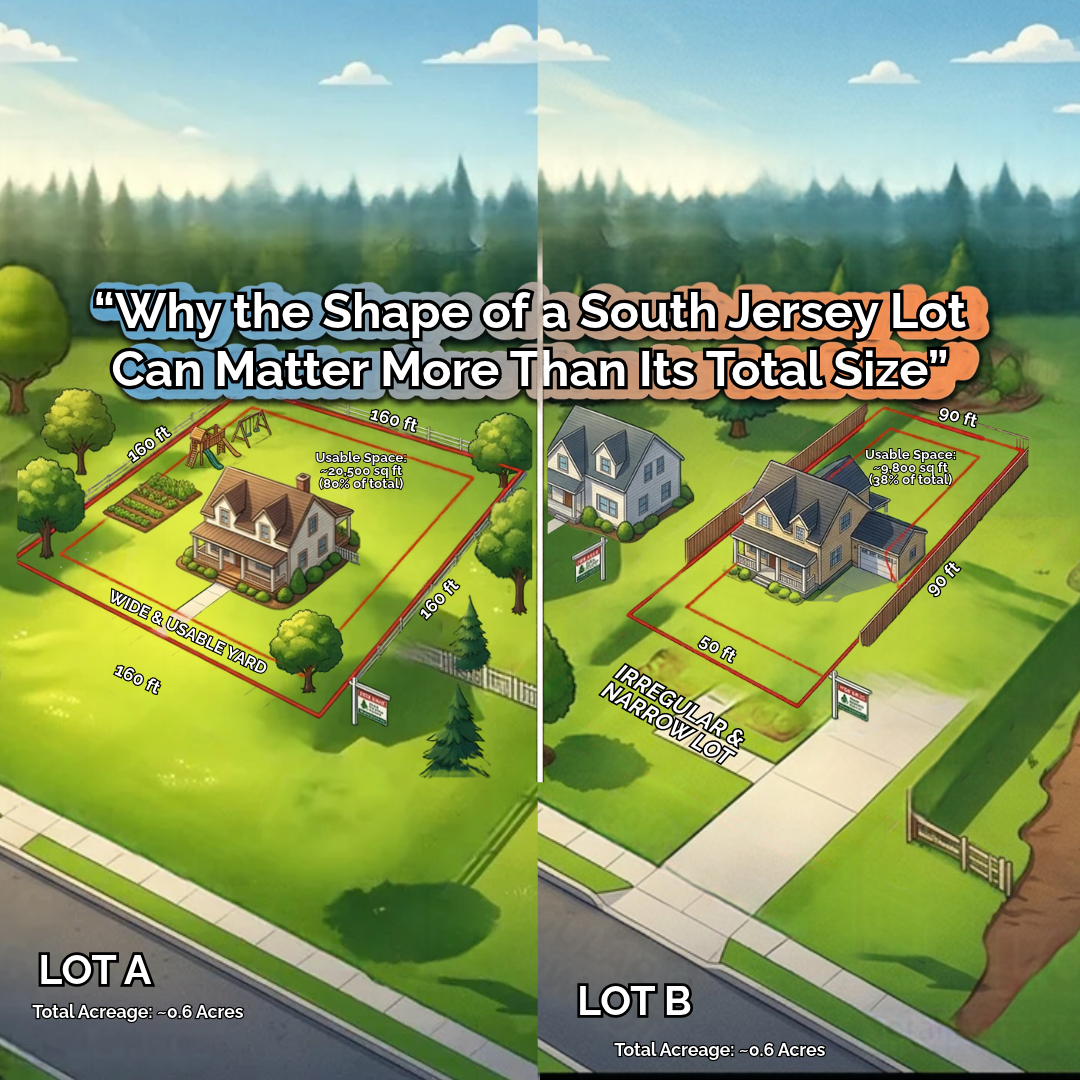
Two properties can have the same total acreage while offering completely different amounts of usable, accessible, private, and functional outdoor space.
One lot might be wide and relatively level, making it easy to use for outdoor living, parking, gardening, or future improvements.
Another might technically contain more land but have an unusual shape, narrow access, steep slopes, drainage limitations, or setbacks that make much of that land difficult to use.
That's why buyers should look beyond the number attached to the lot.
As Mary Murphy of The Murphy Group explains:
“The size of a lot tells you how much land there is. The shape tells you much more about what you may actually be able to do with it.”
📐 1. Total Square Footage Doesn't Tell the Whole Story
A property listing may advertise a large lot, but the number alone doesn't explain how that land is arranged.
Imagine two properties with identical lot sizes.
Property A
- Wide backyard
- Broad frontage
- Level terrain
- Easy driveway access
- Simple rectangular configuration
Property B
- Narrow frontage
- Long, irregular backyard
- Significant slope
- Limited side access
- Portions affected by setbacks or easements
Both may have the same acreage.
But they may provide very different experiences for the homeowner.
That's why usable land can be more important than total land.
🏡 2. Lot Shape Can Determine How the Backyard Feels
A backyard's dimensions affect how easily homeowners can arrange the space.
A relatively wide backyard may accommodate:
- Patio furniture
- Play areas
- Gardens
- Pools
- Outdoor dining
- Lawn space
A very narrow yard may have the same total area but provide fewer practical options.
The issue isn't necessarily that one shape is universally better.
It's whether the shape works for the buyer's intended use.
🚗 3. Driveway Placement Can Be Affected by Lot Configuration
Lot shape can also influence parking.
Buyers should consider:
- Where the driveway enters the property
- How wide the driveway is
- Whether multiple vehicles can fit
- Whether a garage can be conveniently accessed
- Whether vehicles need to maneuver through narrow areas
- Whether future parking improvements are practical
A large lot doesn't necessarily mean easy parking.
The configuration of the land matters.
📏 4. Frontage Can Matter More Than Buyers Expect
Frontage refers generally to the portion of a property along a road or other boundary.
Two properties with similar total acreage can have very different amounts of road frontage.
That can affect:
- Driveway placement
- Visibility
- Landscaping
- Parking access
- Home placement
- Potential future improvements
For buyers considering unusual or narrow lots, frontage deserves careful attention.
🏠 5. The House Itself Takes Up Part of the Lot
A buyer isn't purchasing an empty piece of land.
The house, garage, driveway, decks, patios, sheds, pools, septic systems, and other improvements all occupy space.
That means the practical question becomes:
How much usable land remains after everything already on the property is accounted for?
A smaller lot with an efficient home placement can sometimes feel more functional than a larger lot where the improvements consume much of the usable area.
📍 6. Setbacks Can Limit What You Can Build
One of the biggest mistakes buyers make with large lots is assuming:
“There's plenty of room, so I can build whatever I want.”
Not necessarily.
Municipal zoning requirements can affect where structures may be located.
Depending on the property and municipality, buyers may need to consider requirements involving:
- Front setbacks
- Side setbacks
- Rear setbacks
- Access
- Lot coverage
- Building placement
A large lot with an unusual shape can leave surprisingly little practical space once these requirements are considered.
Before planning an addition, garage, pool, or other structure, buyers should verify applicable municipal requirements.
🧾 7. Easements Can Change How Land Can Be Used
A property may contain an easement that grants another party certain rights to use part of the land.
Examples can involve:
- Utilities
- Access
- Drainage
- Shared driveways
- Other property-related purposes
An easement doesn't necessarily mean the land has no value.
But it can affect what a homeowner can place or construct in that area.
This is why title documents and surveys can become particularly important when buyers are considering unusual lots.
💧 8. Drainage Can Make a Large Lot Less Usable
A large backyard sounds appealing until buyers discover that part of it regularly collects water.
Lot shape and topography can influence how water moves across the property.
Look for:
- Low areas
- Standing water
- Erosion
- Poor grading
- Water flowing toward the house
- Areas that remain saturated after rain
A large lot with significant drainage challenges may provide less usable space than a smaller property with a well-functioning yard.
🌧️ 9. The Shape of the Lot Can Affect Water Flow
This becomes especially important on irregular or sloped properties.
Water naturally follows the terrain.
The configuration of neighboring properties, grading, swales, drainage systems, and structures can all influence how water moves.
Buyers shouldn't assume that a large lot automatically provides more usable outdoor space if portions of it are difficult to keep dry.
For properties with noticeable drainage concerns, professional inspection or appropriate site evaluation may be worthwhile.
🌳 10. Trees Can Take Up More Functional Space Than Buyers Realize
Mature trees can add beauty, shade, and privacy.
But their location matters.
A backyard with several large trees concentrated in the most usable portion of the property may have less flexible space for:
- Patios
- Pools
- Play areas
- Gardens
- Outbuildings
Trees aren't automatically a problem.
They're simply another part of the property's physical layout that buyers should evaluate.
☀️ 11. Lot Shape Can Influence Sunlight
The orientation and configuration of a property can affect where sunlight reaches the yard throughout the day.
This may matter to buyers who want:
- Vegetable gardens
- Outdoor dining
- A sunny patio
- Children's play areas
- Shade during summer afternoons
The shape of the lot, the position of the house, neighboring structures, and mature trees all work together.
A backyard's square footage doesn't tell you where the sunlight falls.
🏘️ 12. Neighboring Properties Can Change How a Lot Functions
A property's usable space doesn't exist in isolation.
Nearby homes can influence:
- Privacy
- Shade
- Noise
- Views
- Access
- Drainage
- Outdoor usability
A narrow lot with close neighbors may feel very different from a similarly sized lot with greater separation.
Buyers should look beyond the property lines.
🛋️ 13. Outdoor Living Requires the Right Geometry
Homeowners increasingly use yards as extensions of their living spaces.
But creating an outdoor living area requires enough practical room for the desired layout.
A buyer envisioning:
- Dining table
- Grill
- Seating area
- Fire pit
- Outdoor kitchen
needs more than a certain number of square feet.
They need a configuration where those elements can actually work together.
A wide, usable area can sometimes be more valuable for this purpose than a much larger but narrow or irregular section of land.
🏊 14. Pools Are a Good Example of Why Shape Matters
A buyer may see a large backyard and immediately imagine a pool.
But the question is whether the property can realistically accommodate one.
Potential considerations include:
- Lot dimensions
- Setbacks
- Existing structures
- Utility locations
- Easements
- Access for construction
- Grading
- Drainage
- Applicable municipal requirements
A large lot does not automatically mean a pool is feasible.
Buyers should verify the requirements before treating that possibility as part of the property's value.
🏡 15. Additions Depend on More Than Available Acreage
The same principle applies to future additions.
A homeowner may want:
- A larger family room
- Garage expansion
- Home office
- In-law space
- Covered patio
- Detached structure
The total lot size is only one factor.
The location of the existing house within the lot may be equally important.
A house positioned close to one boundary may have more usable expansion space on another side.
🧭 16. Irregular Lots Aren't Automatically Bad
It's important not to assume that an unusual lot shape is always a disadvantage.
Some irregular lots provide benefits such as:
- Greater privacy
- Longer rear yards
- Additional separation from neighbors
- Interesting landscaping opportunities
- Wider outdoor areas in specific sections
- Natural buffers
The issue is not whether the lot is perfectly rectangular.
The issue is whether its shape supports the property's intended use.
🔎 17. Flag Lots Require Extra Attention
Some properties have a configuration where the main portion of the lot sits behind another property and is connected to the roadway by a narrower access strip.
These are commonly referred to as flag lots because of their general shape.
They can offer greater privacy from the road.
But buyers should carefully investigate:
- Access rights
- Driveway maintenance
- Easements
- Shared access
- Emergency access
- Utility access
- Snow removal
- Future resale considerations
A flag-shaped property isn't automatically a problem—but its access arrangement deserves careful review.
📜 18. Surveys Can Reveal What a Listing Can't
A listing description may provide the lot dimensions or acreage.
A survey can provide a much more detailed picture of the property's physical configuration.
Depending on the survey, buyers may be able to better understand:
- Property boundaries
- Structures
- Easements
- Setbacks
- Encroachments
- Driveways
- Other site characteristics
When a lot is unusual, a survey can be particularly useful during due diligence.
🗺️ 19. Don't Rely Entirely on the Listing's Lot Description
Online listings are designed to provide a quick overview.
But buyers considering a property should verify important information through appropriate sources.
Useful documents and resources may include:
- Property survey
- Municipal property records
- Tax records
- Zoning information
- Title documents
- Applicable municipal ordinances
- Flood or environmental mapping where relevant
The more unusual the lot, the more important verification becomes.
💰 20. Lot Shape Can Influence Resale Appeal
When you eventually sell, future buyers may evaluate the same characteristics you noticed.
Some buyers prioritize:
- Large lawns
- Privacy
- Pools
- Gardens
- Outdoor entertaining
- Expansion possibilities
Others may prefer:
- Low-maintenance yards
- Smaller lots
- Easy landscaping
- Minimal exterior upkeep
This means lot configuration can influence the pool of potential buyers.
It's one more reason to consider usability rather than relying solely on acreage.
📊 21. Bigger Isn't Always Better—But Bigger Can Still Matter
This isn't an argument that lot size doesn't matter.
It does.
A larger usable lot can provide meaningful benefits.
The point is that size and usability should be evaluated together.
A buyer should ask:
“How much land is there?”
But also:
“How much of that land can I realistically use?”
That second question can reveal much more about the property's practical value.
🧠 22. Think About the Lot Based on Your Lifestyle
Different buyers will value different configurations.
If you have children:
You may prioritize flat, open lawn space.
If you have pets:
You may care about fencing and secure access.
If you love gardening:
Sunlight and usable planting areas may matter most.
If you entertain:
You may prioritize patio placement and outdoor flow.
If you want a pool:
Setbacks, dimensions, access, and site conditions become particularly important.
If you want privacy:
Lot orientation and neighboring properties may matter more than total acreage.
There is no single definition of a “perfect” lot.
📋 South Jersey Lot-Shape Checklist for Buyers
Before deciding that a large lot is a major advantage, consider:
Shape
- Is the lot rectangular, irregular, narrow, or unusually configured?
- Where are the widest usable areas?
Access
- Is driveway access convenient?
- Are there shared-access arrangements?
Usability
- How much of the lot is actually usable?
- Is the terrain level?
Restrictions
- Are there setbacks?
- Are there easements?
- Are there zoning limitations?
Drainage
- Where does water go?
- Are there low areas or standing-water concerns?
Outdoor Plans
- Could the property accommodate the improvements you envision?
- Have those possibilities been verified?
Privacy
- How close are neighboring homes?
- What areas of the yard are visible?
Resale
- Would the lot's configuration appeal to the types of buyers likely to shop in the area?
💼 How The Murphy Group Helps Buyers Look Beyond Lot Size
At The Murphy Group, evaluating a property means looking beyond the headline numbers.
The team can help buyers consider how factors such as:
- Lot configuration
- Outdoor usability
- Property access
- Location
- Comparable homes
- Potential improvements
- Resale considerations
fit together.
“A lot can look impressive on paper,” Mary says. “But buyers should understand how the land actually functions before deciding how much value it adds to the home.”
📊 The Bottom Line
A South Jersey lot's value isn't determined by acreage alone.
Its shape can influence:
- How much yard is actually usable
- Where you can place outdoor features
- Driveway and parking options
- Privacy
- Drainage
- Sunlight
- Future improvements
- Resale appeal
A large, awkwardly configured lot may offer less practical value than a smaller lot that is level, accessible, private, and highly usable.
For buyers, the smartest approach is to evaluate the land as a three-dimensional space—not just as a number on a listing.
Because when it comes to real estate, usable space often matters more than impressive measurements.
📲 Thinking About Buying or Selling in South Jersey?
The Murphy Group helps buyers and sellers look beyond square footage and listing statistics to understand the characteristics that can influence a property's practical appeal and long-term value.
👉 Start here: www.mgsells.com

Mary Murphy
Team Leader | The Murphy Group | eXp Realty, LLC | PLACE
or another way