

Categories
South Jersey home prices, South Jersey Real Estate, Burlington County, Camden County, Gloucester County, Home Selling Tips, Home Buying Tips, NJ Housing, Real Estate Market InsightsPublished September 14, 2026
Why Some South Jersey Homes Hold Their Value Better During Market Changes

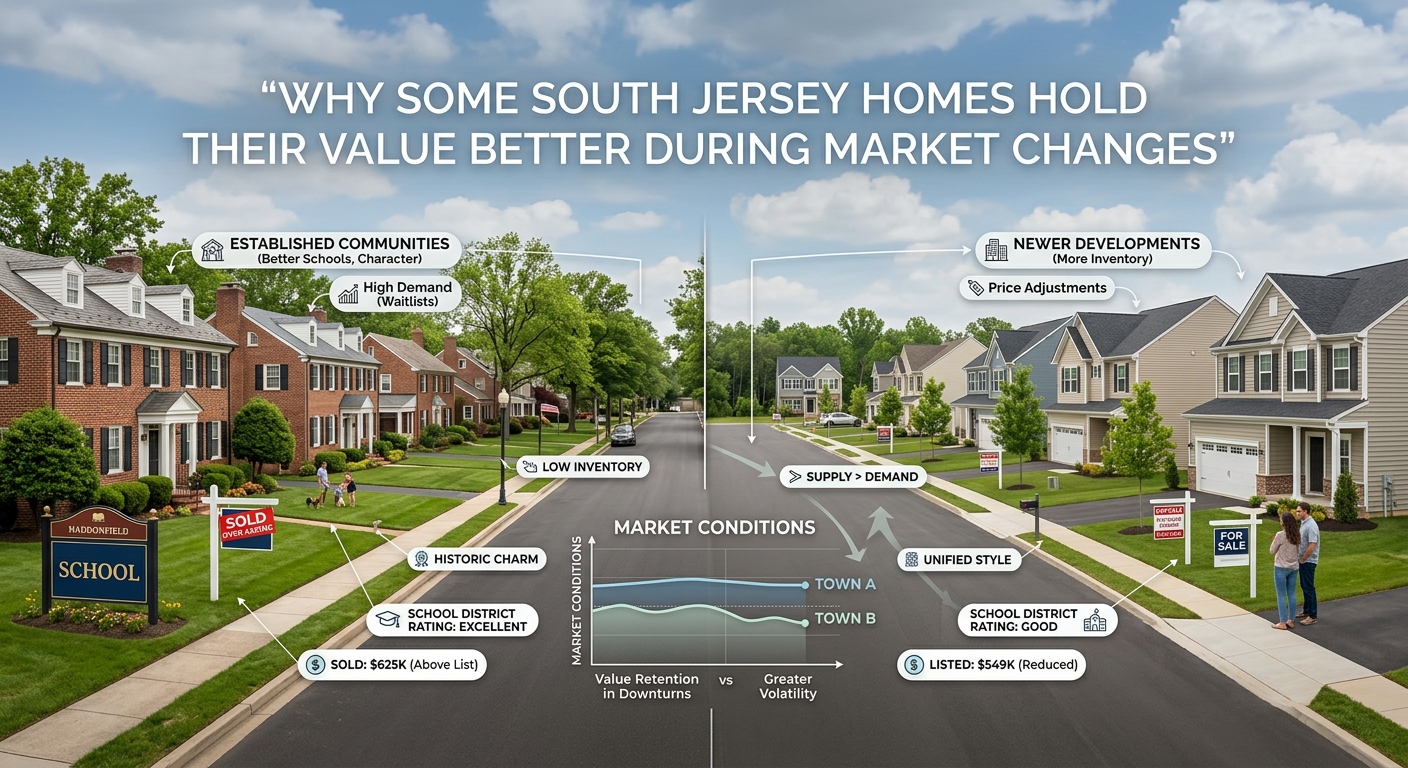
Real estate markets change.
Interest rates move.
Inventory rises and falls.
Buyer preferences evolve.
Economic conditions shift.
And when the market changes, homeowners often ask one important question:
“Will my home hold its value?”
The answer isn't determined by one feature.
Some South Jersey homes may prove more resilient because they combine characteristics that continue to attract buyers across different market conditions.
That doesn't mean their values never decline.
It means that when buyers become more selective, certain properties may continue to have advantages over competing homes.
As Mary Murphy of The Murphy Group explains:
“Market conditions can change quickly, but buyer demand doesn't disappear equally for every property. Homes that continue to solve what buyers want tend to remain competitive.”
🏡 1. Location Is Difficult to Replace
You can renovate a kitchen.
You can replace flooring.
You can repaint the entire house.
But you can't move the property.
That makes location one of the most important long-term considerations.
Homes that offer a combination of:
- Convenient transportation
- Desirable surroundings
- Access to everyday services
- Established neighborhoods
- Parks and recreation
- Reasonable commuting options
may appeal to a broader range of buyers.
When buyers have fewer options or become more price-sensitive, properties with strong location advantages can still stand out.
🚗 2. Convenient Transportation Creates Lasting Appeal
South Jersey buyers often consider access to major transportation routes when choosing where to live.
Convenient access can make it easier to reach:
- Philadelphia
- Major employment centers
- Shopping
- Airports
- Regional destinations
- Neighboring communities
But proximity to transportation isn't automatically positive.
A home directly exposed to significant traffic or noise may have a different buyer appeal than one that offers convenient access without being immediately adjacent to the busiest roadway.
The sweet spot is often accessibility without sacrificing livability.
🏘️ 3. Established Neighborhoods Can Provide Stability
Established neighborhoods often offer something buyers can't create overnight:
A sense of place.
They may have:
- Mature trees
- Established landscaping
- Long-term residents
- Consistent streetscapes
- Nearby services
- Existing community infrastructure
That doesn't mean newer communities lack value.
But established neighborhoods can appeal to buyers who want a more developed environment rather than waiting for surrounding amenities and infrastructure to mature.
🛋️ 4. Functional Floor Plans Age Better Than Trendy Features
Design trends come and go.
But functionality tends to remain important.
A home may be more broadly appealing when it offers:
- Comfortable bedroom separation
- Practical storage
- Useful living areas
- Flexible rooms
- A functional kitchen
- Space for working from home
- Easy everyday flow
A dramatic design feature may attract attention.
A practical layout can keep attracting buyers years later.
💡 5. Homes That Feel Move-In Ready Can Have an Advantage
When market conditions become uncertain, buyers often become more selective about where their money goes.
A home requiring extensive immediate work can become harder to justify.
Properties that are:
- Well maintained
- Clean
- Updated where necessary
- Mechanically sound
- Professionally presented
may feel less risky to buyers.
This doesn't mean every buyer wants a completely renovated home.
It means buyers may place greater value on predictability and manageable ownership costs.
🔧 6. Well-Maintained Major Systems Matter
A beautiful kitchen won't compensate for a roof nearing the end of its useful life.
Buyers increasingly look at the larger maintenance picture.
Important systems can include:
- Roof
- HVAC
- Water heater
- Plumbing
- Electrical
- Windows
- Drainage
When these systems have been properly maintained or recently updated, buyers may feel more confident about the property.
That confidence can matter even more when buyers are worried about unexpected expenses.
🌳 7. Usable Outdoor Space Can Broaden Buyer Appeal
Outdoor space became an even more important consideration for many buyers in recent years.
But the key isn't simply having a large yard.
It's having usable outdoor space.
That could mean:
- A private backyard
- A level lawn
- A usable patio
- A deck
- Mature landscaping
- Space for entertaining
- Room for pets or recreation
The most valuable outdoor feature depends on the buyer.
But functional outdoor space can create another reason for buyers to choose one property over another.
🏠 8. Flexible Homes Can Adapt to Changing Buyer Needs
The way people use their homes continues to evolve.
One buyer may need:
- A home office
Another may need:
- A guest room
Another may want:
- A workout area
Another may need:
- Space for multigenerational living
Homes with flexible spaces can appeal to different buyers over time.
That's important because broader buyer appeal can provide more opportunities when the market becomes more selective.
💰 9. Total Ownership Costs Can Influence Demand
The purchase price is only one part of owning a home.
Buyers may also consider:
- Property taxes
- Insurance
- Utilities
- Maintenance
- HOA costs
- Commuting expenses
When monthly budgets become tighter, buyers may become increasingly focused on the total cost of ownership.
A home that appears affordable at the listing price may feel less attractive once all recurring expenses are considered.
Properties with predictable and manageable ownership costs can therefore have an advantage.
📍 10. Micro-Location Can Matter More Than the ZIP Code
Two homes can share the same ZIP code and still offer very different experiences.
One might be:
- On a quiet interior street
- Near a park
- Set farther from traffic
- More private
Another might be:
- Near a busy intersection
- Adjacent to commercial activity
- More exposed to traffic noise
Buyers often notice these differences.
That's why evaluating a property solely by ZIP code or municipality can miss important details.
The exact location matters.
📸 11. Presentation Helps Protect a Home's Competitive Position
Market resilience isn't only about physical characteristics.
It's also about how clearly those characteristics are presented.
A well-maintained home with strong:
- Photography
- Staging
- Curb appeal
- Listing copy
- Floor-plan presentation
- Digital marketing
can make its advantages easier for buyers to understand.
When buyers have many choices, unclear presentation can cause a strong property to be overlooked.
🧠 12. Broad Buyer Appeal Can Be a Powerful Advantage
Some properties are designed around a very specific buyer.
Others appeal to many different types of households.
Broadly appealing homes may offer:
- Practical layouts
- Multiple bedrooms
- Convenient locations
- Flexible spaces
- Manageable maintenance
- Functional outdoor areas
The larger the potential buyer pool, the more opportunities a property may have when market conditions change.
🏫 13. Access to Desirable Community Resources Can Matter
Buyers don't just evaluate the house.
They evaluate the surrounding lifestyle.
That can include access to:
- Schools
- Parks
- Libraries
- Shopping
- Healthcare
- Restaurants
- Recreation
- Community services
The specific priorities vary from buyer to buyer.
But convenient access to everyday resources can help make a location more attractive to a broader market.
🏗️ 14. Neighborhood Stability Can Influence Buyer Confidence
Buyers often pay attention to the condition and consistency of the surrounding neighborhood.
Questions they may consider include:
- Are nearby homes maintained?
- Is the area changing rapidly?
- Are businesses and services accessible?
- Is new development coming?
- Is infrastructure keeping pace?
- Does the neighborhood feel established?
Neighborhood stability doesn't mean nothing should ever change.
Healthy development can be positive.
The important consideration is whether the direction of change aligns with buyer demand.
🔄 15. Homes That Can Compete at Multiple Price Points May Have an Advantage
When buyers become more budget-conscious, competition shifts.
A home positioned far above the typical neighborhood price may have a smaller pool of potential buyers.
A property that offers strong value relative to nearby alternatives may attract more attention.
This is why pricing strategy becomes especially important when the market changes.
A home's features matter.
But how those features compare with competing properties matters too.
📊 16. Scarcity Can Help Desirable Properties Stand Out
Some homes offer combinations that are difficult to replicate.
Maybe it's:
- A larger lot
- A rare floor plan
- A particular location
- A private setting
- A desirable combination of bedrooms and amenities
- A renovated property in an otherwise older neighborhood
When buyers have difficulty finding comparable alternatives, a distinctive property may attract stronger attention.
Scarcity doesn't guarantee a premium.
But it can make a home harder to replace.
🧠 17. Buyer Psychology Changes With the Market
When the market is highly competitive, buyers may overlook imperfections simply to secure a home.
When the market becomes more balanced, they tend to become more selective.
They start asking:
“What am I getting for my money?”
“What will this cost me after closing?”
“How much work will this require?”
“What alternatives do I have?”
That shift can expose the difference between homes that simply attracted attention during a hot market and homes that provide enduring value.
⚠️ Holding Value Doesn't Mean Being Immune to Market Changes
This distinction is important.
No property is completely protected from market conditions.
Prices can be influenced by:
- Interest rates
- Economic conditions
- Local inventory
- Buyer demand
- Employment trends
- Property-specific issues
- Broader housing conditions
A home that tends to be more resilient can still experience price changes.
The goal isn't to predict that a property will never decline.
It's to understand the characteristics that can help it remain competitive.
💼 How The Murphy Group Helps Homeowners Think Long-Term
At The Murphy Group, the conversation isn't simply about today's listing price.
It's about understanding what makes a property competitive now—and what may continue to matter to buyers later.
That means evaluating:
- Location
- Condition
- Layout
- Buyer demand
- Competing inventory
- Ownership costs
- Property-specific strengths
- Long-term marketability
“We can't control what the market does next,” Mary says. “But we can help homeowners understand what makes their property attractive when buyers have choices.”
🏡 What Homeowners Can Do to Strengthen Long-Term Appeal
If you're thinking about protecting your home's competitiveness, focus on improvements that buyers can actually feel and use.
Consider:
✔ Maintain the major systems
Don't wait until a major system fails before addressing it.
✔ Keep the layout functional
Avoid changes that make everyday living less practical.
✔ Protect curb appeal
First impressions matter.
✔ Address deferred maintenance
Small problems can become larger buyer concerns.
✔ Make thoughtful upgrades
Focus on improvements that fit the neighborhood and buyer expectations.
✔ Keep documentation
Records of repairs and improvements can reduce uncertainty.
✔ Understand your local competition
Know what buyers can purchase instead of your home.
📈 The Bottom Line
Some South Jersey homes may hold their value better during market changes because they offer something buyers continue to prioritize:
A strong overall combination of location, functionality, condition, lifestyle, and value.
That doesn't make them immune to market shifts.
But when buyers become more selective, these properties may have more reasons for buyers to keep them on the shortlist.
The strongest long-term advantage isn't always the newest kitchen or the most expensive finish.
Sometimes it's much simpler:
A home that works well, in a location people want, at a price that makes sense.
📲 Want to Understand What Makes Your South Jersey Home Competitive?
The Murphy Group helps South Jersey homeowners evaluate what buyers value, understand local competition, and position their properties strategically as market conditions change.
👉 Start here: www.mgsells.com

Mary Murphy
Team Leader | The Murphy Group | eXp Realty, LLC | PLACE
or another way