

Categories
real estate due diligence, property surveys, boundary disputes, Burlington County, Camden County, Gloucester CountyPublished October 12, 2026
What Happens When a South Jersey Property Line Doesn’t Match the Fence?

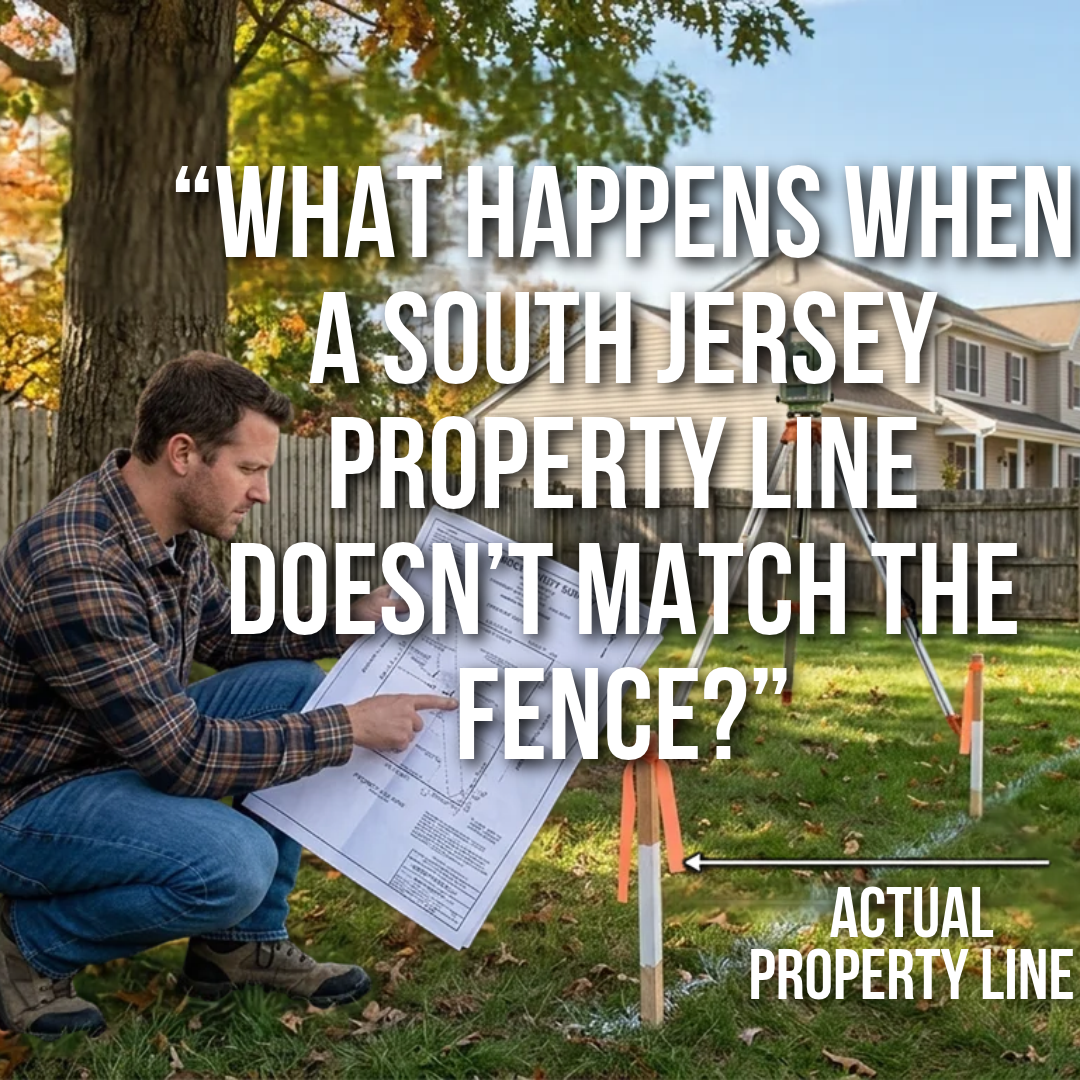
A backyard fence can make a property feel private, secure, and clearly defined.
It separates outdoor living spaces, keeps pets contained, and creates the impression that everyone knows where one property ends and the next begins.
But what happens when the fence doesn't actually follow the legal property line?
For South Jersey homebuyers, this is a detail that can be easy to overlook during a showing. A fence may have been in place for decades, the landscaping may follow its boundaries, and the neighbors may appear comfortable with the arrangement.
Yet the fence's physical location does not, by itself, establish the legal boundary between two properties.
A survey might reveal that the fence sits several inches—or several feet—inside the neighboring property, crosses a recorded easement, or occupies land that belongs to someone else.
In other cases, the fence may be correctly placed while a buyer's assumptions about the property dimensions are mistaken.
As Mary Murphy of The Murphy Group explains:
“When buying a home, it's important to understand not just what the property looks like, but what you're actually purchasing. A fence can help define a yard visually, but buyers should verify property boundaries before making assumptions about ownership.”
A discrepancy doesn't automatically mean a property has a serious problem. It does, however, deserve attention before closing because it can affect privacy, usable yard space, future improvements, neighbor relationships, and potentially resale.
Here's what South Jersey buyers should understand when the fence and property line don't appear to match.
🏡 1. Understand Why a Fence May Not Follow the Property Line
There are several reasons a fence may be located somewhere other than the actual boundary.
For example:
- A previous owner installed it without obtaining a survey.
- The fence followed an older fence that was already misplaced.
- A contractor relied on assumptions rather than verified boundary markers.
- The property's boundaries were misunderstood.
- A fence was installed to avoid trees, landscaping, or uneven terrain.
- A previous owner and neighbor informally agreed on a fence location.
- The property was subdivided or its boundaries were otherwise documented differently than the current fence suggests.
Sometimes, the discrepancy is minor and relatively straightforward to address.
Other times, the fence's location has been accepted for years, and questions about ownership, maintenance, access, or historical use make the situation more complicated.
The first step is to establish where the legal boundary actually lies.
Don't assume that the oldest fence, the most recently installed fence, or the line where the grass changes color is necessarily correct.
📏 2. A Fence Is Not the Same as a Property Survey
One of the most important distinctions buyers should understand is the difference between a physical boundary marker and a professionally prepared survey.
A fence shows where someone chose to place a barrier.
A property survey uses surveying methods, measurements, and relevant property records to depict the property's boundaries and other features within the survey's scope.
A survey may identify:
- Property lines
- Boundary dimensions
- Existing fences
- Buildings and other structures
- Driveways
- Easements
- Encroachments
- Certain visible improvements
The exact information shown depends on the survey type and its purpose.
If the fence appears inconsistent with the boundary shown on a survey, ask a licensed professional land surveyor to clarify the discrepancy.
Don't rely solely on a listing photograph, a seller's recollection, an online parcel map, or a fence contractor's estimate of where the boundary should be.
These sources may provide useful context, but they are not interchangeable with a professional boundary determination.
🔍 3. Review the Existing Survey Before Assuming There Is a Problem
If a fence looks suspiciously close to a neighboring property, ask whether the seller has an existing survey.
A survey prepared during a previous purchase may provide valuable information about the property and its improvements.
Look for whether the drawing identifies:
- The fence's location
- Boundary measurements
- Survey monuments or markers
- Neighboring structures
- Driveways and walkways
- Easements or rights-of-way
- Notes about encroachments or limitations
Pay particular attention to whether the fence is drawn directly on the property line or offset to one side.
However, don't assume that an older survey necessarily reflects every change made since it was prepared.
A fence may have been replaced, moved, or extended after the survey was completed.
If the existing documents are unclear, incomplete, or inconsistent with current conditions, ask a licensed surveyor whether an updated survey or additional fieldwork is appropriate.
🧭 4. Find Out Which Property the Fence Actually Occupies
A fence can be positioned in several ways relative to a property boundary.
It might sit entirely within the seller's property, entirely within the neighboring property, directly along the boundary, or partly on each side.
These distinctions can affect who owns the land beneath or beyond the fence and what action may be appropriate.
Consider three common scenarios.
Scenario A: The fence sits inside the seller's property.
The seller may own a strip of land beyond the fence that is not currently being used as part of the fenced yard. That area may be accessible, subject to easements and other restrictions.
Scenario B: The fence sits inside the neighboring property.
The seller's yard may appear larger or more private than the property boundaries actually support. The neighboring owner may have a claim concerning the encroachment, depending on the circumstances.
Scenario C: The fence crosses the boundary.
Part of the fence may occupy land on each side of the legal line. This can raise questions about ownership, removal, relocation, maintenance, and any historical agreements or claims.
The actual implications depend on the evidence, the property's legal history, and applicable law.
Before deciding who should move a fence or pay for the work, establish the boundary and understand the circumstances.
⚠️ 5. Understand What an Encroachment Means
In real estate, an encroachment generally occurs when a structure or improvement extends onto land beyond the boundary where it is authorized to be located.
A fence is one possible example.
Other examples include:
- A driveway extending onto a neighboring lot
- A shed positioned across a property line
- A retaining wall occupying adjoining land
- Landscaping structures crossing a boundary
- A building addition extending beyond the property line
An encroachment doesn't automatically mean that a property cannot be sold.
However, it may create practical or legal issues that should be understood before ownership changes.
Depending on the circumstances, possible solutions may include relocating the structure, documenting an agreement, obtaining legal advice about property rights, or pursuing another appropriate resolution.
Buyers should avoid treating every encroachment as either harmless or automatically deal-breaking.
The important question is what land is affected, what rights exist, and how the issue could affect the buyer's intended use of the property.
🌳 6. Determine Whether the Discrepancy Affects Usable Yard Space
A property line discrepancy can affect more than a few inches of fence.
It may change how much of the yard the buyer can confidently treat as part of the property.
For example, a buyer might assume that the entire fenced area belongs to the home because it has been landscaped, maintained, and used as one continuous backyard.
If a survey reveals that part of the enclosed area belongs to a neighbor, the buyer may discover that the usable space is smaller than expected.
That could affect plans for:
- A patio
- A swimming pool
- A garden
- A play area
- A shed
- Additional fencing
- Landscaping
- Outdoor entertaining
It can also affect how the property feels and functions.
If the backyard is a major reason for purchasing the home, resolve the discrepancy before relying on the entire fenced area as part of the property's usable space.
🤝 7. Ask Whether the Neighbor Agreed to the Fence Location
A seller may explain that the fence has been in its current location for years and that the neighbor has never objected.
That information may be useful, but it does not automatically resolve a boundary question.
Ask whether there is any written documentation concerning the fence, such as:
- A boundary agreement
- A fence maintenance agreement
- An easement
- A license or permission to use land
- Correspondence between property owners
- Records of a previous dispute or resolution
An informal understanding between neighbors may explain why the fence was placed where it is.
However, buyers should not assume that an informal arrangement creates a permanent property right or will automatically bind future owners.
If the fence crosses a boundary, ask a New Jersey real estate attorney to review any agreement and explain its legal effect.
Clear documentation can help prevent misunderstandings after closing.
📜 8. Don't Assume Long-Term Use Automatically Settles Ownership
One of the more complicated situations occurs when a fence has been in place for many years.
A seller might say:
- “That fence has always been there.”
- “The neighbors have never complained.”
- “We've maintained that entire section of the yard.”
- “The previous owners treated the area as part of this property.”
These statements may provide useful historical context, but they do not independently establish legal ownership.
In some circumstances, long-term possession or use may become relevant to a legal claim, including an adverse-possession claim. Whether such a claim is available depends on the specific facts and applicable legal requirements.
The location of the fence, the nature and duration of the use, the evidence of possession, and other legal considerations may matter.
New Jersey courts have considered disputes involving fences, surveys, deeds, historical use, and competing claims to land. The outcome depends on the evidence and the applicable law.
For buyers, the practical lesson is straightforward:
Don't assume that the fence determines ownership simply because it has been there for a long time.
If the discrepancy involves a meaningful amount of land or an unresolved ownership claim, obtain legal advice before proceeding.
🗺️ 9. Check the Deed, Survey, and Relevant Property Records Together
A property boundary question should not be resolved by looking at only one document.
Relevant records may include:
- The current deed
- Existing property surveys
- Recorded subdivision or boundary maps
- Easement documents
- Recorded agreements affecting the property
- Relevant title records
These documents can help establish the property's legal description and provide context for interpreting its boundaries.
Tax maps and online parcel maps can also be useful for preliminary reference, but their lines should not be treated as definitive survey-grade boundary determinations.
If the documents conflict or leave the boundary uncertain, a licensed surveyor and, where necessary, a real estate attorney can help determine the appropriate next step.
In a dispute, the evidence may extend beyond a single survey. New Jersey boundary cases can involve deeds, prior surveys, historical records, physical markers, and other relevant evidence.
🏠 10. Consider How the Fence Discrepancy Could Affect Resale
Even if the current seller and neighbor get along, the issue may arise again when the property is sold.
A future buyer may ask:
- Does the fence match the survey?
- Is any portion of the yard on neighboring land?
- Is there an agreement covering the arrangement?
- Could the fence need to be moved?
- Does the discrepancy affect a planned improvement?
- Is the property boundary clearly documented?
An unresolved discrepancy can introduce uncertainty during a future sale.
It may also affect a buyer's plans for the yard or the property's perceived value.
That doesn't mean every fence discrepancy reduces market value. The impact depends on the amount of land involved, the location, the property's features, the legal circumstances, and the options for resolving the issue.
But a documented, understood boundary is generally easier to explain than an unresolved disagreement.
🏗️ 11. Check Before Planning a New Fence, Pool, or Addition
If you plan to make improvements after closing, the exact boundary matters even more.
A fence that appears to mark the property line may not be a reliable guide for future construction.
Before planning an improvement, verify the boundary and investigate any applicable restrictions.
Depending on the project, these may include:
- Municipal zoning requirements
- Fence placement and height rules
- Building permit requirements
- Easements
- Setbacks
- Drainage requirements
- Homeowners association rules, if applicable
For example, a proposed pool or shed may require specific clearances from property lines or other structures. A new fence may also be subject to local requirements.
Check with the relevant municipality and qualified professionals before beginning work.
Moving a fence to match a surveyed line may not, by itself, resolve every zoning, access, or easement issue.
💰 12. Understand Who May Be Responsible for Moving the Fence
If a survey confirms that the fence crosses the property line, buyers should determine what options exist for resolving the issue.
Possible approaches may include:
- Relocating the fence
- Repairing or removing an encroaching section
- Reaching a documented agreement with the neighbor
- Obtaining legal advice about an existing right or claim
- Negotiating a resolution as part of the purchase
Responsibility for the cost is not always automatic.
It may depend on who owns the fence, how it was installed, any agreements, the circumstances of the encroachment, local requirements, and the parties' legal rights.
Buyers should not assume that the seller must always move the fence—or that the buyer must accept it as it stands.
If the issue is discovered before closing, discuss the available options with your real estate agent and attorney. Put any negotiated resolution in writing.
📋 13. Questions to Ask Before Making an Offer
If a property has a fence near a boundary, ask these questions early in the process.
About the survey
- Is there an existing survey?
- Does it show the current fence?
- Have any improvements been made since the survey?
- Are the boundary markers identifiable?
About the fence
- Who installed it?
- When was it installed?
- Has it been moved or replaced?
- Has anyone raised concerns about its location?
About the neighbor
- Is there a written agreement concerning the fence?
- Has there been a boundary dispute?
- Does either property rely on the fence for access, privacy, or another purpose?
About ownership and future use
- Does the fence appear to cross the property line?
- Is any portion of the yard affected?
- Could the discrepancy interfere with planned improvements?
- Are there easements or recorded agreements to review?
About resolution
- Has a licensed surveyor evaluated the discrepancy?
- Has an attorney reviewed any relevant agreement?
- Would the fence need to be relocated?
- What would the potential cost be?
- Can the issue be resolved before closing?
Not every question will apply to every property. The purpose is to identify the facts that matter before committing to the purchase.
🚩 14. Warning Signs That Deserve Further Investigation
A fence discrepancy deserves closer attention when it involves more than an uncertain measurement.
Consider seeking professional advice if:
- The fence clearly crosses a surveyed boundary.
- A neighboring driveway, shed, or other structure also encroaches.
- The seller and neighbor disagree about ownership.
- The seller cannot explain a known discrepancy.
- A written agreement appears inconsistent with the survey.
- The discrepancy affects a substantial portion of the yard.
- The fence prevents access or interferes with a proposed improvement.
- The title or survey review identifies unresolved concerns.
These circumstances do not automatically make the home a bad purchase.
They indicate that the buyer should understand the facts and available options before moving forward.
🔍 15. What Should You Do If the Survey Confirms a Mismatch?
If a professional survey confirms that the fence and legal boundary differ, follow a structured process.
Step 1: Confirm the finding.
Ask the surveyor to explain the discrepancy, its extent, and any relevant limitations of the survey.
Step 2: Review the legal documents.
Examine the deed, survey, title records, easements, and any written agreements that may affect the land.
Step 3: Understand the practical impact.
Determine whether the issue affects usable yard space, access, privacy, planned improvements, or neighboring structures.
Step 4: Discuss resolution options.
Depending on the facts, the parties may consider relocating the fence, documenting an agreement, or pursuing another legally appropriate solution.
Step 5: Address the issue before contractual deadlines.
If you're buying the property, discuss the discrepancy with your real estate agent and attorney while any inspection, review, or negotiation periods remain open.
Step 6: Keep the resolution documented.
If the parties reach an agreement, have the appropriate professional prepare or review the documentation. Where necessary, ensure that any required recording or municipal steps are completed.
The goal is not simply to make the fence look right. It is to understand and appropriately address the property's legal and practical boundaries.
💼 How The Murphy Group Helps Buyers Look Beyond the Fence
At The Murphy Group, helping buyers evaluate a property means considering more than its appearance and immediate functionality.
A fence may seem like a minor landscaping feature, but its location can raise questions about property boundaries, usable space, future improvements, and neighboring relationships.
When a discrepancy is suspected, buyers benefit from identifying the concern early, reviewing available records, and consulting the appropriate professionals before making assumptions about ownership.
Mary Murphy explains:
“A home should be evaluated with both today's lifestyle and tomorrow's plans in mind. Understanding the property boundaries helps buyers make more informed decisions about how they can use and enjoy their investment.”
The Murphy Group helps buyers navigate property questions as part of the broader purchasing process, so they can make decisions with a clearer understanding of what they're buying.
📊 The Bottom Line
When a South Jersey property line doesn't match the fence, the most important step is to establish the actual boundary before deciding what the discrepancy means.
Remember:
- A fence does not automatically establish ownership.
- An existing survey can provide valuable information, but its scope and date matter.
- Long-term use does not automatically settle a boundary dispute.
- Encroachments can affect usable space, improvements, and resale.
- Written agreements and easements may influence the available options.
- Surveyors and real estate attorneys can help clarify technical and legal questions.
A fence that doesn't match the property line isn't necessarily a dealbreaker.
But it is a reason to slow down, gather the right information, and resolve uncertainty before closing whenever possible.
Before you buy the yard you see, make sure you understand the property you are actually purchasing.
📲 Thinking About Buying or Selling in South Jersey?
The Murphy Group helps buyers and sellers navigate property questions, evaluate homes carefully, and make informed real estate decisions.
👉 Start here: www.mgsells.com

Mary Murphy
Team Leader | The Murphy Group | eXp Realty, LLC | PLACE
or another way