

Categories
Housing Guide, Burlington County, Camden County, Gloucester CountyPublished June 8, 2026
The invisible checklist buyers use without realizing it

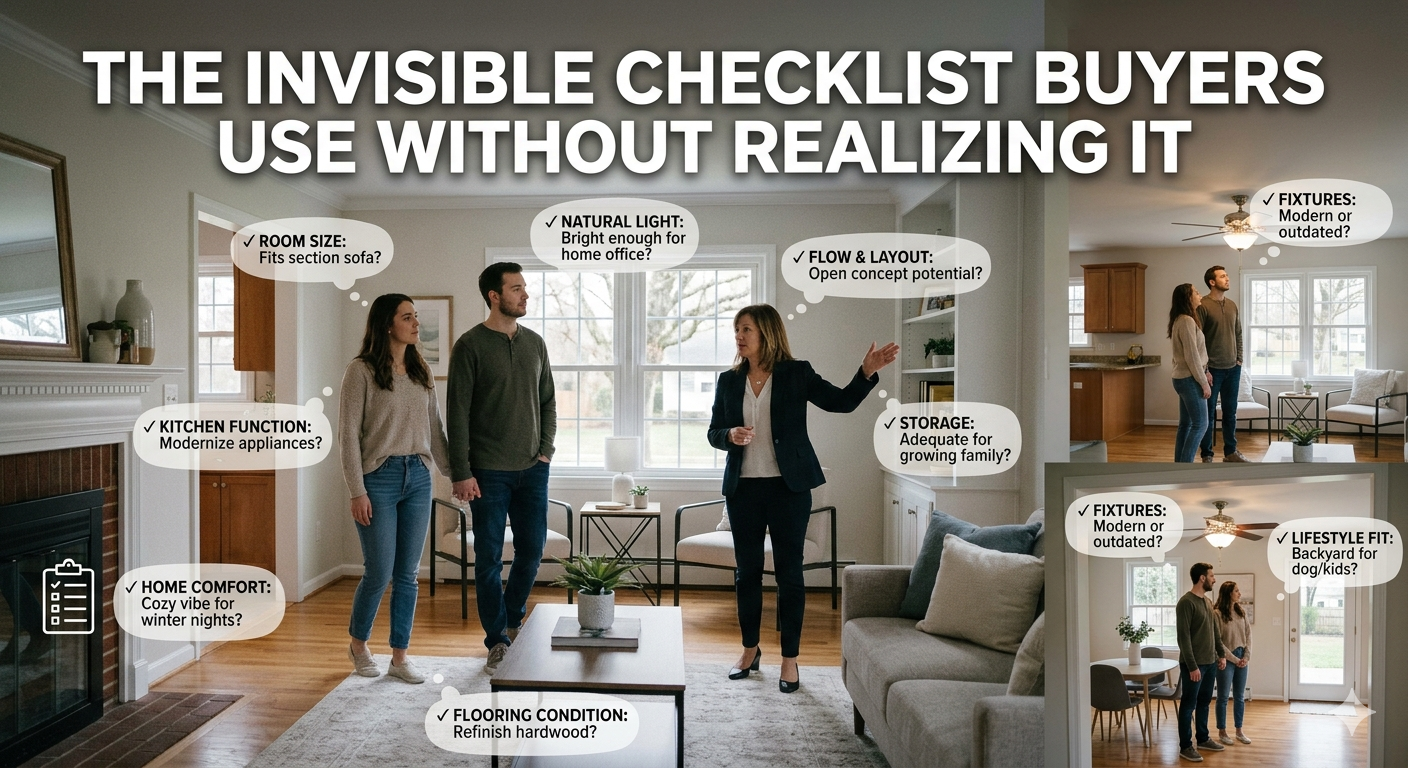
Buyers rarely walk into a showing thinking in a structured, organized way.
They don’t say:
“Now I will evaluate lighting, layout, and resale potential.”
Instead, they experience the home—and their brain quietly runs a series of automatic checks in the background.
This is the invisible checklist.
It’s fast, emotional, and often subconscious.
And in South Jersey’s 2026 market, it plays a major role in which homes get offers—and which get quietly passed over.
As Mary Murphy of The Murphy Group explains:
“Buyers think they’re touring homes. In reality, they’re constantly checking whether a home passes their internal comfort test.”
🧠 The Checklist Is Emotional Before It Is Logical
Most buyers assume they are evaluating facts:
- Price
- Bedrooms
- Condition
- Location
But the first pass is almost always emotional:
👉 “Does this feel right?”
Only after that does logic step in to justify or question the feeling.
🏡 1. “Can I See My Life Here?”
This is the first and most important invisible question.
Buyers quickly imagine:
- Morning routines
- Cooking and family time
- Work-from-home spaces
- Weekend relaxation
If they cannot easily picture life unfolding in the space, interest drops immediately.
🌞 2. “Does This Feel Bright, Clean, and Comfortable?”
Without realizing it, buyers assess:
- Natural light
- Airiness
- Cleanliness
- Overall comfort
Even small issues—dim rooms or clutter—can create subconscious hesitation.
🧭 3. “Does the Layout Make Sense Instantly?”
Buyers don’t want to solve a puzzle.
They instinctively check:
- Is the flow intuitive?
- Do rooms connect naturally?
- Does anything feel awkward or forced?
If the layout requires explanation, the emotional score drops.
🛋️ 4. “What Would I Have to Change?”
Even in a great home, buyers mentally list adjustments:
- Paint colors
- Furniture placement
- Minor renovations
- Cosmetic updates
The shorter that list feels, the stronger the emotional approval.
📍 5. “Does the Neighborhood Feel Right?”
This evaluation happens almost immediately upon arrival:
- Street condition
- Nearby homes
- Privacy and spacing
- General atmosphere
Buyers often decide how they feel about the neighborhood before fully entering the home.
💰 6. “Does This Feel Worth the Price?”
This is not a spreadsheet calculation.
It’s a gut reaction.
Buyers subconsciously compare:
- What they expected
- What they are seeing
- What else is available
Value perception is formed in seconds—not spreadsheets.
🧠 7. “What Could Go Wrong?”
Even excited buyers run quiet risk checks:
- Maintenance concerns
- Structural uncertainty
- Future resale worries
- Hidden costs
If too many unknowns appear, confidence weakens.
🚪 8. “Did I Feel Anything Strong Enough to Remember It?”
This is the final invisible step.
Buyers ask themselves—often later:
- Do I remember this home clearly?
- Did anything stand out?
- Would I recognize it instantly again?
Memorability often determines whether a home gets a second showing.
⚠️ Why Buyers Don’t Realize They’re Doing This
The checklist is automatic.
It runs:
- Quickly
- Emotionally
- Without structured thought
Buyers rarely articulate it—but it shapes every decision.
They just feel:
- “I liked it.”
- “I didn’t feel it.”
- “It wasn’t quite right.”
Those feelings come from this hidden process.
🧠 Why This Matters in Today’s Market
In South Jersey’s fast-moving 2026 environment:
- Buyers see more listings in less time
- Decisions happen earlier in the process
- Emotional filtering replaces deep analysis
- First impressions carry more weight than ever
That means the invisible checklist is now a major driver of outcomes.
💼 How The Murphy Group Helps Sellers Pass the Checklist
At The Murphy Group, marketing is designed around how buyers actually think—not how listings are written.
Their approach includes:
- Optimizing first impressions for emotional clarity
- Ensuring layout flow reads instantly online and in person
- Highlighting lifestyle, not just features
- Reducing uncertainty triggers during showings
- Aligning presentation with buyer psychology
“We don’t just market homes,” Mary says. “We make sure they pass the buyer’s silent test.”
📊 The Bottom Line
Buyers use an invisible checklist because:
- Emotion leads decision-making
- Logic follows feelings
- Comfort drives confidence
- Clarity reduces hesitation
- Memory influences final choice
And in today’s market:
👉 Homes don’t just compete on features—they compete on how easily they pass the buyer’s subconscious test.
📲 Thinking About Selling or Buying in South Jersey?
The Murphy Group helps clients understand the hidden psychology behind buyer decisions so homes are positioned to connect faster and convert stronger.
👉 Start here: www.mgsells.com

Mary Murphy
Team Leader | The Murphy Group | eXp Realty, LLC | PLACE
or another way