

Categories
South Jersey Real Estate, Real Estate Guides, Housing Guide, Home Buying Guides, Camden County, Burlington County, Gloucester County, Home Buying TipsPublished September 14, 2026
The Hidden Warning Signs Buyers Should Never Ignore Before Buying a South Jersey Home

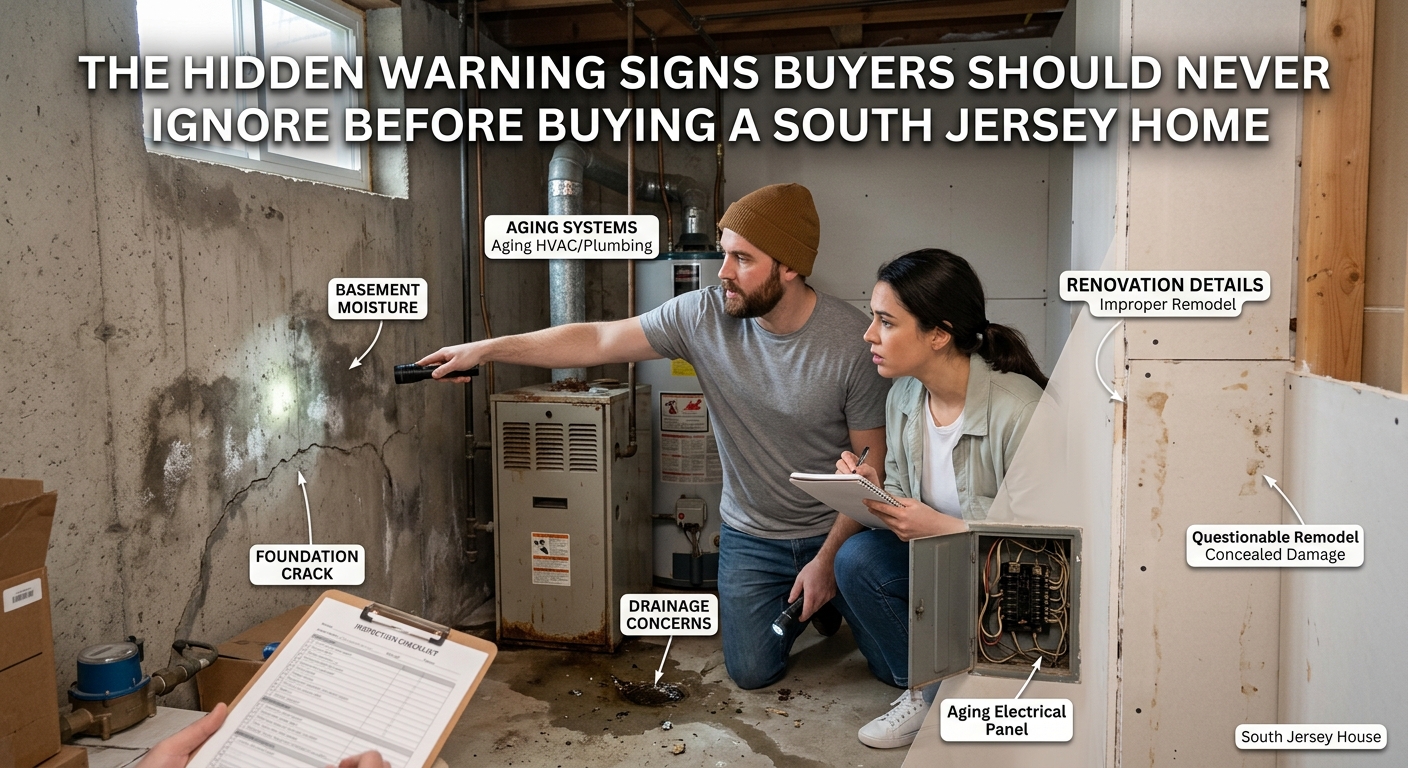
Buying a home is exciting.
You walk through the front door and start imagining where your furniture will go, where you'll have your morning coffee, and what life could look like in the space.
But beneath the fresh paint, updated kitchen, and attractive listing photos, there may be details worth investigating.
Some warning signs are obvious.
Others are surprisingly easy to overlook.
And in South Jersey, where buyers encounter everything from older established homes to newer construction, waterfront properties, wooded lots, finished basements, and homes near major transportation corridors, knowing what to look for can make a major difference.
The goal isn't to assume something is wrong.
It's to know when something deserves a closer look.
As Mary Murphy of The Murphy Group explains:
“A beautiful home can still deserve careful questions. The goal isn't to scare buyers away—it's to help them understand what they're actually buying.”
🚩 1. Fresh Paint in Just One Problem Area
Fresh paint is usually a positive.
But when only one portion of a basement, ceiling, wall, or room appears recently painted, buyers may want to ask why.
It could be completely innocent.
The homeowner may simply have completed a cosmetic update.
But fresh paint can also cover:
- Previous water staining
- Cracks
- Repairs
- Peeling
- Previous moisture problems
Don't assume the worst.
Instead, ask:
“What was repaired or updated here, and when?”
Documentation and a clear explanation can provide much more confidence than appearances alone.
💧 2. Musty Smells or Excessive Moisture
A musty basement should never automatically disqualify a home—but it shouldn't be ignored either.
Pay attention to:
- Musty odors
- Damp walls
- Condensation
- Water stains
- Peeling paint
- Efflorescence on masonry
- Dehumidifiers running continuously
These signs may point to moisture management issues.
South Jersey homes with basements or lower-level living spaces deserve particular attention because water intrusion can affect both usability and long-term maintenance.
A professional inspection can help determine whether you're looking at a minor issue or something requiring significant attention.
🏠 3. Cracks That Deserve a Second Look
Not every crack means structural trouble.
Homes naturally settle, and small cosmetic cracks can occur.
But buyers should pay attention to cracks that appear:
- Large or widening
- Around doors and windows
- Along foundation walls
- Horizontally across masonry
- In combination with sticking doors or uneven floors
The important question isn't simply:
“Is there a crack?”
It's:
“What is causing it?”
When something looks unusual, getting a qualified professional's opinion can be far more valuable than trying to diagnose it during a showing.
🌧️ 4. Poor Drainage Around the Property
Sometimes the warning sign isn't inside the house.
Walk around the exterior and look at how water appears to move around the property.
Potential concerns include:
- Soil sloping toward the foundation
- Downspouts discharging directly beside the house
- Standing water
- Erosion
- Saturated areas near the foundation
- Gutters that appear poorly maintained
Water management matters because repeated moisture exposure can contribute to basement problems, foundation concerns, landscaping damage, and maintenance costs.
A property doesn't need perfect drainage to be a good purchase.
But buyers should understand how water is managed before making a decision.
⚡ 5. Outdated Electrical Components
Electrical systems are another area where appearances can be misleading.
A home may have a beautiful renovated kitchen while still containing older electrical components elsewhere.
During a showing, buyers may notice:
- Older electrical panels
- Limited outlets
- Extension cords being used extensively
- Flickering lights
- Improvised wiring
- Unusual switches or fixtures
These aren't necessarily proof of a serious problem.
But they are reasons to ask questions and have the system evaluated appropriately.
For older South Jersey homes, understanding when major systems were updated can be especially important.
🔥 6. Aging HVAC, Plumbing, or Water Heater
A home can look completely move-in ready while several major systems are approaching the end of their useful lives.
Ask about the age and maintenance history of:
- Heating equipment
- Air conditioning
- Water heater
- Plumbing
- Roof
- Electrical systems
This is where buyers need to think beyond the purchase price.
A lower-priced home may require substantially more near-term maintenance than a similarly priced property with recently updated systems.
Knowing the difference can change how you evaluate the overall value.
🧱 7. A Finished Basement With Unclear History
Finished basements can add valuable living and recreational space.
But buyers should ask important questions before assuming every finished square foot is equivalent to above-grade living space.
Questions may include:
- When was the basement finished?
- Were permits obtained where required?
- Was electrical or plumbing work performed?
- Is there proper egress where applicable?
- Has the space ever experienced water intrusion?
- Is the area represented correctly in the listing and property records?
A finished basement can be a fantastic feature.
It simply deserves the same level of due diligence as the rest of the home.
📋 8. Renovations With Little or No Documentation
A seller may tell you:
“The entire house was renovated.”
That's great—but buyers should ask what that actually means.
Find out:
- What was renovated?
- When was the work completed?
- Who performed it?
- Were permits required?
- Are receipts or warranties available?
- Were major systems replaced or simply cosmetically updated?
A renovated kitchen and fresh flooring don't necessarily mean the home's underlying systems were updated.
Documentation can help separate cosmetic improvements from substantial upgrades.
🚪 9. Doors and Windows That Don't Operate Properly
This is one of the easiest warning signs to miss during an enthusiastic showing.
Pay attention to whether:
- Doors stick
- Windows are difficult to open
- Locks don't work smoothly
- Floors feel noticeably uneven
- Cabinets don't close properly
One problematic door isn't necessarily meaningful.
But several operating issues throughout the home can justify additional questions.
Small details can sometimes provide clues about maintenance, settlement, moisture, or simply years of normal wear.
🏘️ 10. The Neighborhood Doesn't Match the Listing Impression
Buyers aren't purchasing only four walls.
They're buying a location.
Before making an offer, look beyond the property itself.
Consider:
- Traffic
- Street noise
- Parking
- Nearby commercial properties
- Major roads
- Railroad proximity
- Surrounding property conditions
- Access to everyday services
- Future development
A home can be beautiful while still being located somewhere that doesn't fit a buyer's lifestyle.
That's why visiting the neighborhood at different times can be useful.
The block may feel completely different during a weekday commute than it does on a quiet Saturday afternoon.
🚗 11. Noise That Isn't Obvious During the Showing
A quick daytime showing doesn't always reveal the full sound environment.
Listen for:
- Highway traffic
- Trucks
- Train activity
- Aircraft
- Busy intersections
- Nearby commercial activity
South Jersey's extensive road network makes transportation access a major advantage for many homeowners—but proximity to major routes can also introduce traffic and noise considerations.
Buyers should decide where their personal comfort level falls.
Convenience and quiet aren't always found in the same location.
🌳 12. Large Trees Too Close to the Home
Mature trees can be one of a property's most attractive features.
They provide shade, privacy, and character.
But large trees also require maintenance.
Look for:
- Large branches over the roof
- Trees growing extremely close to the foundation
- Visible dead limbs
- Root intrusion
- Trees leaning significantly
- Signs of disease or damage
Don't automatically view mature trees as a negative.
Instead, understand the maintenance responsibilities associated with them.
💰 13. The Home Needs More Work Than the Price Suggests
This is one of the biggest buyer mistakes.
A property may appear inexpensive compared with nearby homes.
But once buyers start adding:
- Roof work
- HVAC replacement
- Painting
- Flooring
- Landscaping
- Electrical updates
- Plumbing repairs
- Bathroom renovations
the price advantage can disappear quickly.
The better question is:
“What will this home actually cost me after I buy it?”
That's a much more useful way to evaluate value.
📑 14. Property Records Don't Seem to Match the Home
Buyers should pay attention when the physical property appears significantly different from available records or the listing description.
Examples might include:
- An addition that isn't clearly documented
- Finished space that is described inconsistently
- A converted garage
- Significant structural changes
- An extra bathroom or room configuration
This doesn't automatically mean there's a problem.
It means the buyer should ask questions.
When improvements have been made, understanding whether required approvals or permits were obtained can help avoid unpleasant surprises later.
🧠 15. The Seller's Answers Are Vague
Sometimes the biggest warning sign isn't something you see.
It's something you can't get a clear answer about.
If questions about:
- Roof age
- Water intrusion
- Renovations
- Permits
- HVAC
- Property boundaries
- Previous repairs
are consistently met with vague responses, buyers should slow down and investigate.
Transparency doesn't mean a home has to be perfect.
It means buyers should be able to understand its history and condition well enough to make an informed decision.
🔍 16. The Inspection Reveals a Pattern—Not Just One Issue
Every home has imperfections.
The purpose of an inspection isn't necessarily to find a perfect house.
It's to understand the property's condition.
One minor repair may be completely manageable.
But several issues pointing toward the same underlying problem deserve closer attention.
For example, moisture staining combined with drainage concerns and a musty basement may warrant more investigation than any one issue by itself.
Look for patterns.
That's where professional guidance becomes especially valuable.
⚠️ Don't Confuse a Warning Sign With a Dealbreaker
This distinction is important.
A warning sign isn't automatically a reason to walk away.
Instead, it should trigger a question:
“Do I understand this issue well enough to make an informed decision?”
Some concerns can be:
- Easily repaired
- Negotiated
- Budgeted for
- Covered by warranties
- Explained by documentation
Others may be more significant.
The key is knowing the difference before you're fully committed.
🏡 How Buyers Can Protect Themselves
Before purchasing a South Jersey home, buyers can take a few practical steps:
✔ Look beyond the staging
Beautiful furniture and décor shouldn't distract from the property's underlying condition.
✔ Ask about major systems
Know the age, maintenance history, and replacement timeline.
✔ Review available documentation
Permits, receipts, warranties, and repair records can provide valuable context.
✔ Visit more than once
A second visit can reveal things you didn't notice during the first walkthrough.
✔ Explore the neighborhood
Drive the surrounding streets and consider traffic, noise, parking, and nearby development.
✔ Get a professional inspection
An inspection is an important part of understanding the condition of the property.
✔ Think about total ownership costs
Purchase price is only one part of the financial picture.
💼 How The Murphy Group Helps South Jersey Buyers Look Beyond the Surface
At The Murphy Group, helping buyers isn't just about finding a home they love.
It's about helping them understand what they're buying.
That means encouraging buyers to:
- Ask better questions
- Look beyond cosmetic upgrades
- Evaluate location and surroundings
- Understand maintenance considerations
- Review available property information
- Think about long-term ownership
- Move forward with greater confidence
“Our job isn't to tell buyers what they should buy,” Mary says. “It's to help them see the whole picture so they can make a decision they feel confident about.”
📊 The Bottom Line
The most important warning signs aren't always dramatic.
Sometimes they're subtle:
- A strange smell
- A fresh patch of paint
- Poor drainage
- An aging system
- An undocumented renovation
- A difficult-to-answer question
- A neighborhood that feels different at another time of day
None of these automatically means you shouldn't buy the home.
But each can be a reason to pause, investigate, and understand more.
Because the best home purchase isn't simply the property that looks great during a showing.
It's the property whose condition, location, costs, and long-term potential make sense for you.
📲 Thinking About Buying a South Jersey Home?
The Murphy Group helps buyers navigate the South Jersey market with local insight, thoughtful questions, and a strategy focused on finding the right fit—not simply the next available property.
👉 Start here: www.mgsells.com

Mary Murphy
Team Leader | The Murphy Group | eXp Realty, LLC | PLACE
or another way