

Categories
property access easements, due diligence, road maintenance, Home Buying Guides, Home Buying TipsPublished October 12, 2026
Should You Buy a South Jersey Home With a Private Road?

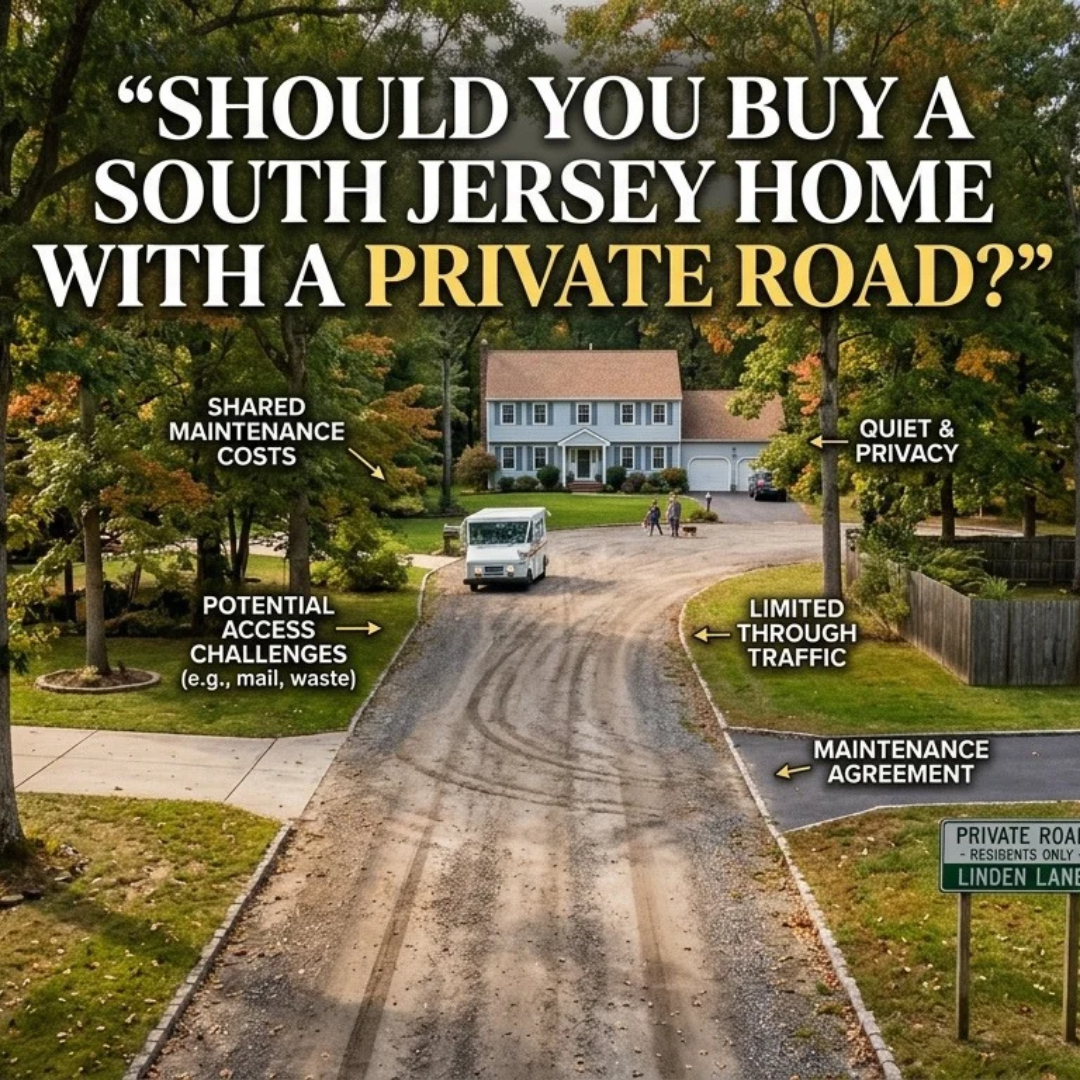
Imagine finding a South Jersey home that checks nearly every box: the right price, a spacious yard, a quiet setting, and a little more privacy than you would find on a typical suburban street.
Then you discover that the road leading to the property is privately maintained.
Should that change your decision?
Not necessarily—but it should prompt a closer look before you commit.
A home on a private road can offer privacy, reduced through traffic, and a more secluded setting. However, it can also come with responsibilities that buyers may not encounter when purchasing a home on a publicly maintained street.
Depending on the property, those responsibilities could include shared road repairs, snow removal, drainage maintenance, access easements, and agreements with neighboring property owners.
As Mary Murphy of The Murphy Group explains:
“A property's appeal goes beyond the house itself. Buyers need to understand how they'll access the home, what responsibilities come with the property, and whether those arrangements will work for them long after closing.”
Before deciding whether a private-road property is right for you, it helps to understand what private-road ownership really means.
🛣️ What Does It Mean When a Home Is on a Private Road?
A private road is generally a road that is not maintained as an ordinary public street by a government road authority. Depending on the arrangement, it may be owned by an individual, several property owners, a homeowners association, or another private entity.
In South Jersey, a private road might serve:
- A small group of homes on a shared lane
- A rural property set back from a public street
- A private residential development
- A group of neighboring properties with a common access route
- A home reached through another property's land under an easement
The important distinction is that having physical access to a house does not automatically establish every legal right or maintenance responsibility associated with the road.
The property may have a recorded access easement, a road maintenance agreement, both documents, or an arrangement that requires further investigation.
Those details matter because the rights and obligations can differ significantly from one property to another.
🏡 1. Understand the Potential Benefits of a Private Road
Before focusing on possible complications, consider why some buyers actively prefer private-road properties.
More privacy and less through traffic
A private road serving only a handful of homes may experience less unrelated traffic than a busy public street. This can make the setting feel quieter or more secluded, although actual traffic and noise levels depend on the road's location and who is permitted to use it.
A more rural or tucked-away setting
Some South Jersey properties are set back from the main road or surrounded by trees and open land. A private access road may contribute to the sense of separation that attracts buyers to these homes.
A smaller group of neighboring properties
If a road serves only a few households, owners may have more direct communication about maintenance decisions than residents in a large development.
However, a smaller group can also mean fewer people sharing the cost of major repairs.
A property that fits a specific lifestyle
For buyers who value privacy, outdoor space, or a less conventional setting, a private-road home may offer features that are difficult to find elsewhere.
The goal is to determine whether the benefits outweigh the responsibilities for your particular needs and budget.
⚠️ 2. Confirm That You Have Legal Access to the Property
This is one of the most important questions to resolve before buying.
A driveway or road that has been used for years may appear to provide straightforward access. But buyers should verify the legal basis for using the route, especially when the road crosses land owned by someone else.
Ask your real estate attorney and title professional to review:
- The property's deed and relevant recorded documents
- Any access easement or right-of-way
- The location and scope of the access route
- Which properties benefit from the easement
- Whether the route shown in the records matches the road on the ground
- Any restrictions on the type or extent of permitted use
An easement generally grants certain rights to use another person's land without transferring ownership of that land.
The wording matters. A document might address ordinary access but leave questions about maintenance, widening, utility work, or other uses unresolved.
Do not assume that a road's existence or long-standing use is enough to establish that your intended access is legally protected. Have the relevant documents reviewed before your contractual deadlines expire.
📄 3. Find Out Who Owns the Road
The next question is deceptively simple: Who actually owns the road?
Possible arrangements include:
- A neighboring landowner owns the road.
- Several owners share ownership of the road or adjoining land.
- A homeowners association or other entity owns or manages it.
- The road lies within a recorded right-of-way over privately owned property.
Ownership can influence who controls improvements, who can authorize certain work, and which agreements apply.
Ask the seller for any available road deeds, recorded easements, maintenance agreements, subdivision plans, and association documents.
Your attorney and title professional can help determine what those records mean for the property you intend to purchase.
Do not rely solely on a seller's verbal explanation or a neighbor's understanding of the arrangement.
🔧 4. Determine Who Pays for Road Maintenance
A private road still needs upkeep—even when traffic is light.
Depending on its construction and condition, maintenance may involve:
- Pothole repairs
- Gravel replacement or grading
- Asphalt resurfacing
- Drainage improvements
- Culvert repairs
- Tree trimming and vegetation control
- Shoulder stabilization
- Snow and ice removal
- Repairs after storms or heavy vehicle use
The critical question is how these costs are allocated.
For example, a road serving four homes might have a written agreement requiring each owner to contribute a defined share. Another arrangement might assign responsibility by road segment. A third might leave the details unclear.
These differences can have a significant effect on your future expenses.
Ask for the written agreement, if one exists, and determine whether contributions are fixed, shared equally, based on usage, or calculated through another method.
Also ask whether owners can be required to contribute toward major repairs—not just routine maintenance.
💰 5. Budget for Unexpected Road Expenses
A private-road property may have costs that are not obvious from the listing price.
Routine maintenance is only one part of the picture. A deteriorating road, failed culvert, drainage problem, or damaged bridge could require a much larger expenditure.
Before closing, ask:
- What maintenance has been performed in recent years?
- Are any repairs currently recommended?
- Has the road been professionally evaluated?
- Are there outstanding bills or planned projects?
- Is there a reserve fund for major work?
- How are emergency expenses divided among owners?
- What happens if one owner refuses or cannot afford to contribute?
If a homeowners association manages the road, request available budgets, financial statements, meeting minutes, and information about pending assessments.
If the road is shared informally, ask your attorney to assess whether the existing arrangement provides sufficient clarity and enforceability.
A property that initially appears affordable may carry additional ownership costs. Those costs should be considered alongside the mortgage, property taxes, insurance, and ordinary home maintenance.
❄️ 6. Ask Who Handles Snow and Ice Removal
Winter road maintenance deserves special attention in South Jersey.
A private road may not receive the same plowing or salting service as a nearby public road. The actual arrangement depends on the road's ownership, any applicable agreement, and the services contracted by the responsible parties.
Find out:
- Who arranges snowplowing?
- Who pays for salting or ice treatment?
- Is there a regular contractor?
- How quickly is service typically provided?
- Are private driveways included or excluded?
- Who handles fallen trees or storm debris?
- Is there a backup plan if the usual contractor is unavailable?
Consider your own circumstances, too. A steep driveway, shaded road, or long access route may require more attention during winter weather.
If you need reliable access for work, school, medical appointments, or other daily responsibilities, understand how winter maintenance works before you buy.
🌧️ 7. Inspect Drainage, Culverts, and Road Conditions
The surface of a private road is only part of the inspection.
Water can damage roadbeds, wash away gravel, undermine pavement, and create recurring repair costs. Poorly maintained drainage systems can also affect neighboring land or the property itself.
During your due diligence, look for:
- Potholes or uneven pavement
- Deep ruts or soft road shoulders
- Standing water after rain
- Erosion along the road
- Damaged or obstructed culverts
- Cracked pavement around drainage structures
- Steep sections that may be difficult to navigate
- Signs of recurring flooding or runoff
A standard home inspection may not include a comprehensive evaluation of the entire private road or its drainage infrastructure.
If the road appears deteriorated or drainage concerns are visible, ask whether a qualified contractor or other appropriate professional should evaluate it.
The cost and responsibility for correcting any problems should be clarified before closing.
🚑 8. Verify Emergency Vehicle Access
A home can be beautiful and secluded while still presenting practical access challenges.
Consider whether the road can accommodate emergency vehicles and whether its condition, width, turning areas, gates, or overhead obstructions could interfere with access.
Questions to investigate include:
- Is the road wide enough for the vehicles expected to use it?
- Are there adequate turning or turnaround areas?
- Could parked cars block the route?
- Are bridges or culverts subject to weight restrictions?
- Is a locked gate or other barrier present?
- Are there local requirements that apply to the property's access route?
Do not assume that emergency services will have unrestricted or uncomplicated access simply because residents use the road every day.
Where the road's configuration raises concerns, contact the appropriate local authority or fire official for guidance.
🚗 9. Consider Everyday Convenience and Accessibility
The road may work perfectly well under ordinary conditions but become inconvenient in certain circumstances.
Think about how you and your household will use it throughout the year.
Consider:
- Daily commuting
- School transportation
- Package and grocery deliveries
- Garbage and recycling collection
- Guests and service providers
- Construction or moving trucks
- Winter driving conditions
- Access for people with mobility needs
A narrow road with limited passing space may be manageable for two neighboring households but more complicated when several vehicles arrive simultaneously.
If the road is long or has limited visibility, consider driving it at different times of day and under different weather conditions when possible.
The key is to assess the actual route rather than judging the property solely by the house and yard.
🏦 10. Check Mortgage Lender Requirements Early
Financing should be addressed before you are close to closing.
A lender may require evidence that a property has acceptable legal access and that the private-road arrangement meets its underwriting standards. Depending on the loan program and property, the lender may request recorded documents or an enforceable maintenance agreement.
Do not assume every lender applies identical requirements.
Before making major financial commitments, tell your lender that the home is accessed by a private road and ask what documentation will be needed.
You should also confirm:
- Whether the access arrangement is acceptable for the specific loan
- Whether a road maintenance agreement is required
- Whether the agreement must be recorded
- Whether any road condition or access issue could affect approval
- Whether additional documentation is needed before closing
If a required document does not exist, find out whether it can be prepared and properly executed within your transaction timeline. Do not assume the seller or neighbors can resolve it at the last minute.
🛡️ 11. Review Insurance and Liability Questions
Insurance considerations can vary based on the property's location, road ownership, and the policy being purchased.
Ask your insurance agent whether the private-road arrangement creates any specific underwriting questions or coverage considerations.
It may also be important to understand who is responsible for injuries, property damage, or claims involving the road itself.
Review any agreement for provisions addressing insurance, liability, damage caused by contractors, and responsibility for maintaining the road in a reasonably safe condition.
Do not assume that a neighbor's insurance automatically protects you, or that your homeowners policy covers every road-related loss.
Ask your insurance professional to explain what is covered, what is excluded, and whether additional coverage or documentation is appropriate.
📝 12. Read the Road Maintenance Agreement Carefully
A road maintenance agreement can help establish expectations, but its value depends on its actual terms and enforceability.
If one exists, have your attorney review it before closing.
Look for provisions addressing:
- Routine maintenance and repair
- How costs are divided
- Major reconstruction expenses
- Snow and ice removal
- Drainage and culvert upkeep
- Contractor selection and approval
- Payment deadlines and collection procedures
- Decision-making and voting rights
- Dispute resolution
- Responsibility for damage caused by heavy vehicles
- Whether obligations apply to future owners
An informal understanding between neighbors may not provide the same certainty as a properly drafted, enforceable agreement.
If there is no agreement, that does not automatically mean the purchase is impossible. It does mean you should understand the consequences and determine whether a suitable arrangement is needed for your circumstances, including any lender requirements.
🤝 13. Understand Your Relationship With the Other Road Users
When several property owners share a road, cooperation can make everyday maintenance easier.
However, neighbors may disagree about how much to spend, which contractor to hire, or whether a repair is necessary.
Before buying, ask how decisions have been handled in the past.
Consider:
- Are maintenance costs paid on time?
- Is there a history of disputes?
- Are owners able to agree on repairs?
- Who makes decisions when immediate work is needed?
- Is there a process for resolving disagreements?
- Can one owner block necessary work or access?
Where possible, review relevant records rather than relying only on informal assurances.
You do not need to become best friends with every neighboring owner. You do need a clear understanding of the arrangements that could affect your access, expenses, and ability to maintain the road.
📍 14. Check Local Requirements and Property Records
Private-road arrangements can intersect with local land-use, subdivision, drainage, and access requirements.
Depending on the property, relevant information may be available through the municipality, county records, recorded plats, or other public documents.
Ask your attorney or other appropriate professional to determine whether you should review:
- Recorded subdivision or site plans
- Road dedication or acceptance records
- Applicable easements and restrictions
- Municipal requirements relating to access
- Relevant permits or approvals for road improvements
- Drainage or stormwater obligations
- Any known notices involving the road
Do not assume that a road is publicly maintained just because it appears on a map or has a street name. Confirm its status with the appropriate road authority.
Likewise, do not assume that a private road will eventually become public or that the municipality will pay for future improvements.
📉 15. Think About Future Resale Value
Buying a private-road home also means considering how a future buyer might evaluate the same arrangement.
A well-maintained road with clearly documented access and predictable shared expenses may be easier to explain during a future sale than a road with unclear ownership, disputed responsibilities, or recurring repair problems.
Potential buyers may ask:
- Is legal access documented?
- Who maintains the road?
- Are costs predictable?
- Are there outstanding disputes or assessments?
- Will the next buyer's lender accept the arrangement?
- Are there unresolved road or drainage issues?
A private road is not automatically a disadvantage when reselling. Its effect depends on the property, the road's condition, the surrounding market, and the quality of the legal and maintenance arrangements.
Keeping copies of agreements, invoices, repair records, and relevant correspondence can help you answer future buyer questions with confidence.
🚩 16. Warning Signs That Deserve More Investigation
Some issues do not automatically mean you should walk away, but they should be resolved before you proceed.
Pay close attention if:
- No one can clearly explain who owns the road.
- The seller cannot provide documentation supporting access.
- The road crosses another owner's property without a clearly established right of access.
- Neighbors disagree about who must pay for repairs.
- Major maintenance work is overdue.
- Drainage or erosion problems are visible.
- The road maintenance arrangement is based entirely on verbal promises.
- The lender requests documentation that is not available.
- Emergency access appears restricted.
- There are unresolved disputes involving the road.
The appropriate response is to investigate the issue, understand the possible cost or legal impact, and decide with qualified professional guidance whether the risk is acceptable.
✅ 17. Questions to Ask Before Making an Offer
Use this checklist when evaluating a South Jersey home on a private road.
-
Is legal access to a public road documented?
-
Who owns the road and the land beneath it?
-
Is there a recorded access easement?
-
Is there a written road maintenance agreement?
-
Who pays for routine upkeep and major repairs?
-
How are snow and ice removal handled?
-
Are drainage systems, culverts, and road surfaces in good condition?
-
Are there outstanding repair bills or planned assessments?
-
Can emergency vehicles and delivery trucks reach the property?
-
Has my lender confirmed that the arrangement is acceptable?
-
Has my insurance agent reviewed any relevant concerns?
-
Have my attorney and title professional reviewed the recorded documents?
-
Have I budgeted for both regular upkeep and unexpected repairs?
You may not need every answer before submitting an offer, but you should establish appropriate due-diligence protections and resolve material questions before your relevant contractual deadlines expire.
💼 How The Murphy Group Helps Buyers Evaluate the Whole Property
At The Murphy Group, buying a home means looking beyond the listing photos and asking practical questions about how the property will function over time.
When a home is located on a private road, understanding the access arrangement and maintenance responsibilities is an important part of evaluating the overall ownership picture.
The process can include helping buyers identify questions to raise with their real estate attorney, lender, title professional, inspector, and insurance agent.
That may involve reviewing the available property information, understanding the road's condition, identifying potential recurring costs, and considering how the arrangement fits the buyer's budget and long-term plans.
“The goal is not to rule out a property because it has a private road,” Mary says. “It's to make sure buyers understand what they're purchasing so they can move forward with confidence.”
📊 The Bottom Line
Should you buy a South Jersey home with a private road?
It can be a worthwhile choice when the property offers the setting and features you want, and the legal access, maintenance responsibilities, and costs are clearly understood.
Before moving forward, make sure you have investigated:
- Legal access and recorded easements
- Road ownership and maintenance responsibilities
- Routine and unexpected expenses
- Snow removal, drainage, and physical condition
- Emergency access and everyday convenience
- Lender and insurance requirements
- Future resale considerations
A private road is not automatically a red flag. But unclear access rights, uncertain cost-sharing arrangements, and neglected maintenance can create avoidable complications.
The best decision comes from understanding both the home's appeal and the responsibilities that come with reaching it.
📲 Thinking About Buying a Home in South Jersey?
The Murphy Group can help you evaluate properties, identify important questions, and navigate the homebuying process with a clearer understanding of the factors that affect ownership.
👉 Start here: www.mgsells.com

Mary Murphy
Team Leader | The Murphy Group | eXp Realty, LLC | PLACE
or another way