

Categories
South Jersey Real Estate, Burlington County, Camden County, Gloucester County, Home Buying Guides, Home Buying Tips, buyer tips, garage parking, resale valuePublished October 19, 2026
Does a Home’s Parking Capacity Affect Its Appeal to South Jersey Buyers?

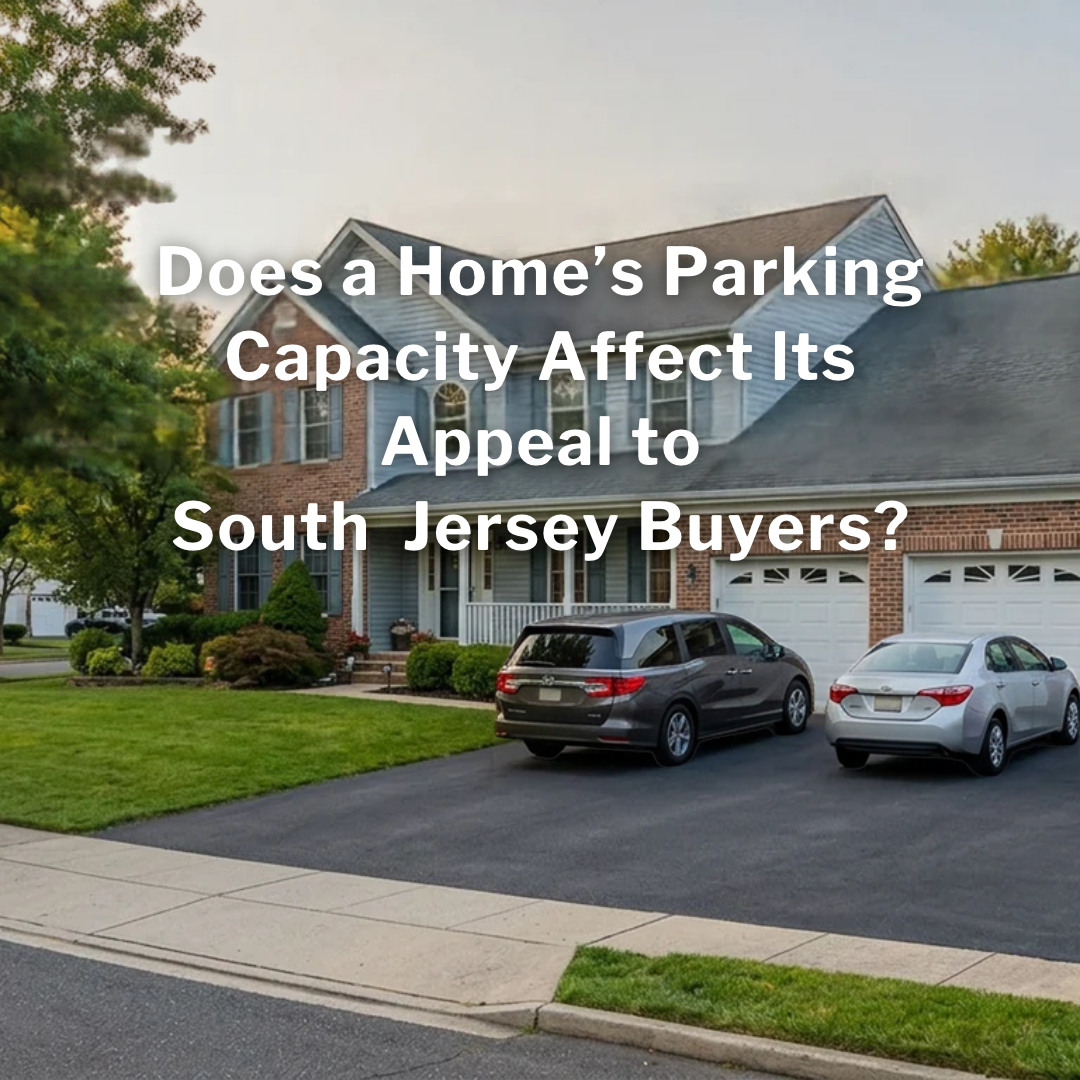
When buyers evaluate a South Jersey home, they usually focus on the big-ticket features: price, bedrooms, bathrooms, kitchen condition, and location.
But there's another practical detail that can influence whether a property feels like the right fit: how many vehicles it can comfortably accommodate.
A home may have beautiful interiors, a spacious backyard, and an updated kitchen, but if the driveway only fits one car and the household owns three vehicles, everyday parking could become a source of frustration.
a
For other buyers, a single-car driveway may be perfectly adequate, particularly in a neighborhood where street parking is readily available or public transportation is convenient.
The difference comes down to how well the property's parking arrangement matches the needs of the people who might live there.
As Mary Murphy of The Murphy Group explains:
“Parking isn't always the first feature buyers ask about, but it can become a deciding factor when they picture their everyday routine. A home needs to work for the household—not just look good in listing photos.”
For South Jersey homeowners preparing to sell, understanding parking capacity can help reveal an overlooked selling point. For buyers, it can prevent an inconvenient surprise after moving day.
🚗 1. Parking Capacity Is About More Than the Number of Spaces
A listing might advertise a two-car garage or a large driveway, but the number of spaces alone doesn't tell the whole story.
Buyers should consider whether the parking arrangement is genuinely practical.
For example, a property might have:
- A two-car garage and a two-car driveway
- A one-car garage with room for several vehicles outside
- A long driveway that accommodates multiple cars in a line
- A narrow driveway where vehicles must be moved to let others out
- A garage that is primarily used for storage rather than parking
Each arrangement offers a different level of convenience.
A driveway that technically accommodates four vehicles may be less useful to a household whose members leave for work at different times if the cars are parked one behind another.
Usable parking capacity matters more than the maximum number of vehicles that can physically fit on the property.
🏡 2. Multiple-Car Households May Need More Space
Many households have different transportation needs. Two adults may each have a vehicle, an older child may drive, or a family may keep a second car for commuting and errands.
For these households, parking can become a daily logistical issue.
Buyers may ask themselves:
- Can everyone park without blocking someone else?
- Is there enough room for visitors?
- Will vehicles need to be moved frequently?
- Is there space for a work van or another larger vehicle?
- Can the garage still be used for its intended purpose?
A property with ample, independent parking spaces may offer greater flexibility to a household with several drivers.
However, not every buyer needs the same amount of space. A couple with one vehicle may prefer a smaller driveway that requires less maintenance, while a larger household may prioritize additional off-street parking.
🛣️ 3. A Large Driveway Can Be More Useful Than a Bigger Garage
Garage size often receives attention in real estate listings, but driveway capacity can be just as important.
A garage may be too narrow for modern vehicles, occupied by storage, or inconvenient to enter and exit. In those situations, a generous driveway may provide more practical day-to-day value.
Buyers should look at:
- The number of vehicles that fit without blocking sidewalks or access points
- Whether cars can enter and exit safely
- Whether parking spaces are independent or stacked
- The driveway's width and turning space
- Whether the surface is cracked, uneven, or deteriorating
- Whether the driveway drains properly after heavy rain
A long driveway can be especially useful when several household members own vehicles. But its layout matters: a single-lane driveway with tandem parking may require coordination that a wider driveway does not.
The best setup depends on the household's needs and the property's physical limitations.
🏘️ 4. Neighborhood Parking Conditions Change What Buyers Expect
South Jersey includes a wide variety of residential settings, from established neighborhoods with compact lots to suburban communities with garages and larger driveways.
In a neighborhood where off-street parking is limited, a home with a dedicated driveway may stand out.
In an area where most homes already have two-car garages and generous driveways, buyers may see those features as standard rather than exceptional.
Street parking also changes the equation. A property with limited driveway space may still be convenient if nearby parking is consistently available and legally permitted.
Buyers should visit the neighborhood at different times, if possible, to observe:
- How crowded the street becomes in the evening
- Whether residents regularly park along both sides of the road
- Whether parking restrictions apply
- Whether guests can usually find spaces nearby
- Whether snow, local events, or seasonal activity affect availability
Parking expectations should be assessed in the context of the specific street and community—not based on a general assumption about South Jersey.
🚘 5. Tandem Parking Can Be a Hidden Trade-Off
Tandem parking occurs when one vehicle must be parked behind another, meaning the front vehicle may need to move before the rear vehicle can leave.
This setup can increase the number of cars a driveway accommodates, but it does not necessarily provide the same convenience as separate parking spaces.
It may work well when:
- Household members follow similar schedules
- One vehicle is used infrequently
- The driveway is long enough to accommodate the vehicles comfortably
It may be less convenient when multiple drivers need to leave independently.
During a showing, don't just count the spaces. Ask how the current arrangement works and consider whether it would suit your routine.
For sellers, it is helpful to describe the layout accurately rather than simply advertising a high parking count without explaining that some spaces are tandem.
🧰 6. A Garage May Be Used for Storage Instead of Vehicles
A home advertised with a two-car garage does not necessarily provide two usable indoor parking spaces.
Garages often contain bicycles, lawn equipment, tools, seasonal decorations, sports gear, and household storage.
If the garage is crowded, buyers may need to decide whether they would rather:
- Park vehicles inside
- Use the garage for storage
- Reorganize belongings to accommodate both
- Add storage elsewhere on the property, if permitted
For sellers, decluttering the garage can make the available capacity easier to understand. Clear floor space and organized shelving help buyers visualize how the area could function.
For buyers, measure the garage and consider vehicle dimensions, door clearance, storage needs, and access to the house before assuming the advertised capacity will meet their expectations.
👨👩👧👦 7. Guest Parking Can Affect Everyday Convenience
Parking capacity is not just about the people who live in the home.
Families who frequently host relatives, friends, or holiday gatherings may need additional parking. A household that rarely entertains may have little use for extra spaces.
Buyers should consider how often visitors come over and whether there is a practical place for them to park without blocking driveways, sidewalks, or neighboring access.
For homes in communities with shared roads or common parking areas, review any applicable rules about guest spaces and overnight parking.
A property that comfortably accommodates the household's vehicles and occasional visitors may feel more functional than one where every gathering creates a parking problem.
🏢 8. Condominiums and Townhomes May Have Different Parking Limitations
Buyers considering a condominium, townhouse, or planned community should look beyond the number of spaces shown in a listing.
Parking may be assigned, deeded, reserved, shared, or subject to community rules. Guest parking may also be limited.
Before making an offer, confirm:
- How many spaces are included with the property
- Whether spaces are assigned or owned
- Whether the spaces are close to the home
- Whether additional vehicles require permits or fees
- Whether overnight guest parking is permitted
- Whether parking rules restrict vehicle types or sizes
Do not assume that a space routinely used by the current owner automatically transfers with the property.
Review the applicable governing documents and purchase paperwork, and ask your real estate agent or attorney to clarify any uncertainty.
🚐 9. Work Vehicles and Larger Vehicles Require Extra Attention
Some buyers own pickup trucks, vans, recreational vehicles, trailers, or commercial work vehicles. A driveway that works well for a compact sedan may not accommodate these vehicles comfortably.
Buyers should consider vehicle length, width, turning radius, overhead clearance, and access to the garage.
They should also verify applicable restrictions before assuming a larger vehicle can be stored on the property.
Depending on the municipality, zoning rules, community restrictions, and the type of vehicle, there may be limitations on commercial vehicle parking, recreational vehicles, trailers, or parking on certain portions of a lot.
If the property is in an HOA community, review its rules as well.
A home may have ample physical space but still be unsuitable for a buyer's parking needs because of applicable restrictions.
🔌 10. Parking Capacity May Matter to Electric Vehicle Owners
Buyers who own or plan to purchase an electric vehicle may consider where they can charge it at home.
A garage or dedicated driveway space can provide a convenient location for charging equipment, depending on the property's electrical setup and installation requirements.
Questions worth asking include:
- Is a charging station already installed?
- Is there a suitable electrical circuit?
- Can the vehicle park close enough to the proposed charging location?
- Would installation require electrical upgrades?
- Are there HOA or other restrictions on installing equipment?
Having a garage does not automatically mean a property is EV-ready. A qualified electrician can assess the electrical system and determine what installation may require.
For sellers, an existing charging station or suitable parking arrangement may be worth highlighting accurately in listing materials.
🌧️ 11. Driveway Condition and Drainage Matter, Too
A property can offer generous parking capacity while still requiring repairs or maintenance.
Buyers should look at the driveway's overall condition, including:
- Large cracks or uneven sections
- Potholes or crumbling edges
- Areas where water pools
- Signs of soil movement or settlement
- Steep slopes that make entry difficult
- Narrow access points or limited turning space
Drainage is particularly important because runoff from a driveway can affect the surrounding yard, sidewalk, or neighboring property.
If the driveway is severely deteriorated or water consistently collects near the home, ask the inspector or a qualified contractor whether further evaluation is appropriate.
Sellers should address obvious maintenance issues when practical and be prepared to explain any recent repairs.
📐 12. Can You Add More Parking to an Existing Property?
Buyers may see a large lawn or side yard and assume they can simply extend the driveway.
That may be possible, but it should never be assumed without checking the relevant requirements.
Potential considerations include:
- Local zoning and impervious-surface limits
- Required setbacks
- Drainage and stormwater management
- Sidewalk and curb-cut requirements
- Easements or utility locations
- HOA or deed restrictions
- Required permits or approvals
Adding paved space can change how rainwater flows across a property. Local regulations may restrict the size, placement, or design of additional parking areas.
Before purchasing a home on the assumption that more parking can be added, contact the municipality and confirm what is permitted. Obtain estimates from qualified contractors if the project is important to your decision.
💰 13. Does More Parking Automatically Increase a Home's Value?
Not necessarily.
Additional parking can make a property more attractive to certain buyers, but there is no universal dollar amount for each driveway space or garage bay.
Its contribution depends on factors such as:
- Neighborhood parking conditions
- Property type and lot size
- Local buyer preferences
- Garage and driveway condition
- The number of comparable properties with similar parking
- Whether the spaces are legal and usable
- The overall condition and price of the home
A home with four usable spaces may have a practical advantage over a similar property with one space if buyers in that area need multiple vehicles.
But in a neighborhood where parking is readily available and most households own one car, the difference may have less influence.
The best way to evaluate parking's potential effect on resale is to compare similar homes in the same market and consider what buyers have actually been willing to pay for comparable features.
📸 14. Sellers Should Make Parking Capacity Easy to Understand
Buyers should not have to guess how many vehicles a property can accommodate.
If you're preparing to sell, make the parking arrangement clear in the listing and photographs.
Consider highlighting:
- Garage capacity, where verified
- Driveway space and layout
- Additional legal off-street parking
- Whether spaces are independent or tandem
- Convenient access from the garage to the home
- Any existing EV charging equipment
- Relevant parking arrangements in a community
Avoid exaggerating capacity or implying that street parking is guaranteed. Accurate descriptions help buyers assess whether the property fits their needs and reduce the risk of disappointment during a showing.
A clean, organized garage and well-maintained driveway can also make the property's functionality more apparent.
🧠 15. Buyers Should Test the Parking Arrangement During a Showing
One of the easiest ways to evaluate parking is to imagine using it every day.
Ask yourself:
- Can all household vehicles fit comfortably?
- Can each driver leave without moving another car?
- Is there room for guests?
- Will larger vehicles fit?
- Can the garage serve its intended purpose?
- Is street parking dependable enough for our needs?
- Are there rules that limit how we can use the spaces?
- Would adding parking be feasible if our needs change?
If possible, view the property at a time when neighborhood parking is busy. This can provide a more realistic picture than visiting during a quiet weekday afternoon.
A parking arrangement that seems adequate on paper may feel very different when multiple vehicles arrive home at the same time.
💼 How The Murphy Group Helps Sellers Highlight Practical Property Features
At The Murphy Group, successful home marketing means helping buyers understand how a property fits their everyday lives.
Parking capacity can be an important part of that picture, especially when the home offers a useful combination of garage space, driveway parking, and convenient access.
The Murphy Group can help sellers evaluate how to present these features by:
- Reviewing the property's parking arrangement and usable capacity
- Highlighting practical features in listing descriptions and photography
- Considering neighborhood parking conditions and buyer expectations
- Comparing similar homes when discussing positioning and resale appeal
- Helping buyers identify parking-related questions during their search
“The details that make a home easier to live in deserve to be part of the story,” Mary says. “When parking is a genuine advantage, clear presentation helps buyers understand its value.”
📊 The Bottom Line
A home's parking capacity can affect its appeal to South Jersey buyers, particularly when the household owns multiple vehicles or the neighborhood has limited street parking.
The most useful questions go beyond how many cars fit. Buyers should also consider whether the spaces are independent, whether the garage is functional, whether visitors can park conveniently, and whether restrictions affect how the property can be used.
For buyers, the goal is to find a parking setup that suits their household and future needs.
For sellers, the opportunity is to present parking accurately and show how it contributes to the property's everyday convenience.
The best parking arrangement isn't necessarily the one with the most spaces. It's the one that fits the property, the neighborhood, and the people who will use it.
📲 Thinking About Buying or Selling in South Jersey?
The Murphy Group helps South Jersey buyers and sellers evaluate practical property features, understand local market expectations, and position homes to appeal to the right audience.
👉 Start here: www.mgsells.com

Mary Murphy
Team Leader | The Murphy Group | eXp Realty, LLC | PLACE
or another way